


Fig. 2
Download original image
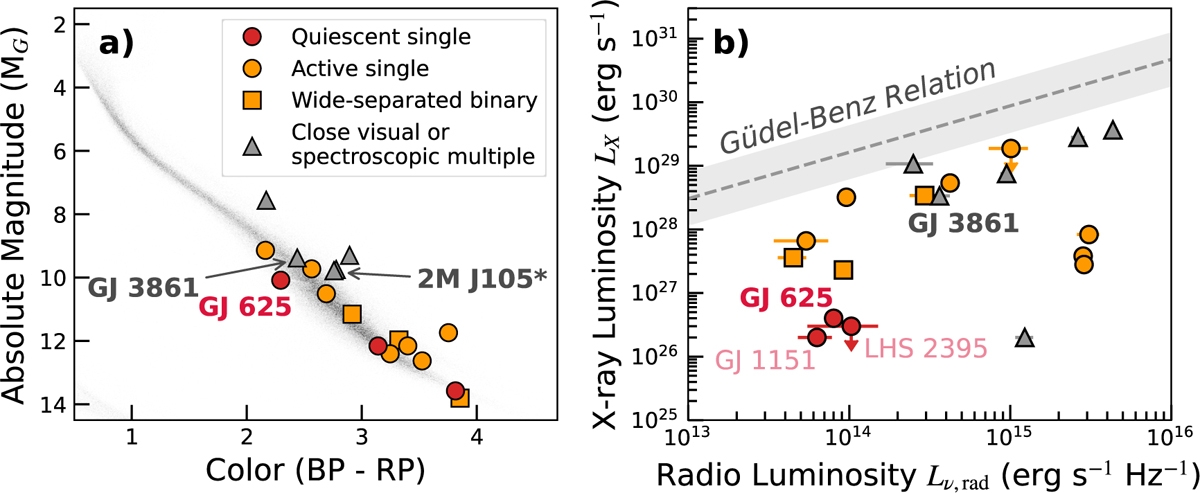
19 radio M dwarfs studied in this work, along with the designations adopted from this work (Table 2). Targets are designated according to activity and multiplicity, and overplotted on a) a color–magnitude diagram, where we use the Gaia Catalogue of Nearby Stars (Gaia Collaboration 2021) to indicate the main sequence in gray, and b) the empirical Güdel–Benz relation (as described in Williams et al. 2014) with the 1σ spread indicated in the surrounding gray shaded region. The target G 240-45 is hereby not shown on the color–magnitude diagram, as its color is not listed in Gaia. The names of the suggested best MSPI candidates are all listed, and the systems GJ 625 and GJ 3861 – which are further discussed in Sections 4 and 5 – are highlighted in bold.
Current usage metrics show cumulative count of Article Views (full-text article views including HTML views, PDF and ePub downloads, according to the available data) and Abstracts Views on Vision4Press platform.
Data correspond to usage on the plateform after 2015. The current usage metrics is available 48-96 hours after online publication and is updated daily on week days.
Initial download of the metrics may take a while.