


Fig. 5
Download original image
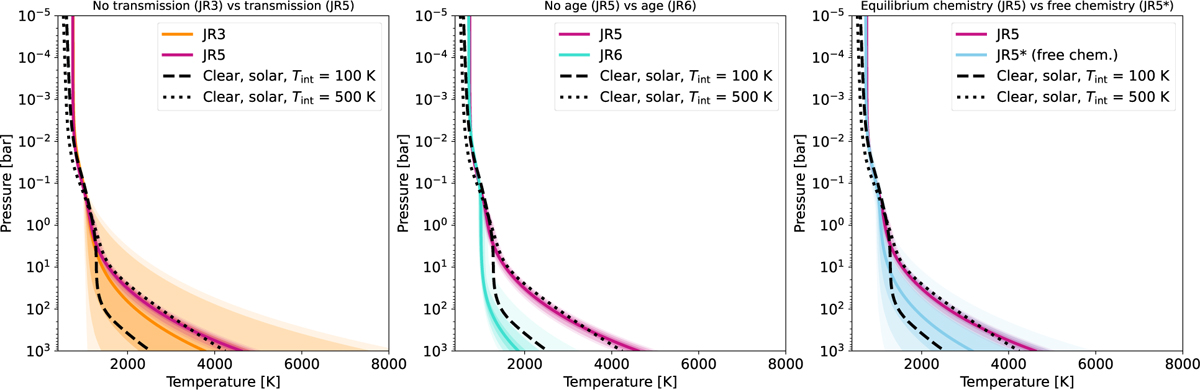
P–T proflies of WASP-80 b as constrained by four of our joint retrievals. The shaded regions indicate the 1, 2, and 3σ regions of the retrieval, while solid lines correspond to the mean. Black lines highlight self-consistent models from Mollière et al. (2017); Acuña et al. (2024) of a clear atmosphere with solar composition at Tim = 100 (dashed) and 500 K (dotted) for comparison. Left: the difference between JR3 and JR5 shows the effect of adding the transmission spectrum to JR3, which incorporates emission spectra plus the mass and radius. The transmission spectrum reduces significantly the uncertainties in thermal structure. Center, comparing JR6 and JR5 allows us to study the effect of including the age to the retrieval. JR6 is the most data-complete of the joint retrievals, since it incorporates both transmission and emission, plus the mass and age. If the age is removed (JR5), the temperature in the deep atmosphere increases. Right: comparison between JR5 and JR5*, which illustrates the effect of assuming equilibrium chemistry in the joint retrieval. If we relax the assumption of equilibrium chemistry in JR5 by changing to a free chemistry model (JR5*), the temperature decreases in the deep interior.
Current usage metrics show cumulative count of Article Views (full-text article views including HTML views, PDF and ePub downloads, according to the available data) and Abstracts Views on Vision4Press platform.
Data correspond to usage on the plateform after 2015. The current usage metrics is available 48-96 hours after online publication and is updated daily on week days.
Initial download of the metrics may take a while.