


Fig. 4.
Download original image
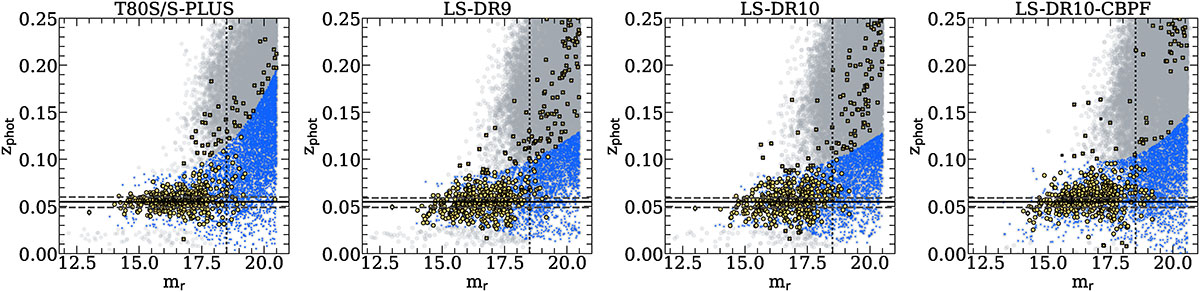
Photometric redshift as a function of r-band magnitude for each set of photometric redshifts, from left to right: T80S/S-PLUS, LS-DR9, LS-DR10, and LS-DR10-CBPF. We include the corresponding parent sample (grey circles), the A0085 galaxy cluster candidate members selected from our photometric method (blue), the spectroscopically confirmed members (yellow circles), and the confirmed spectroscopic cluster members and spectroscopic objects within the cluster redshift range (yellow crosses) that were not selected by our method. The solid black line indicates the cluster redshift obtained from the mean spectroscopic redshift distribution, while the dashed lines indicate the cluster spectroscopic redshift lower and upper limits. The bright-faint boundary at mr = 18.5 is indicated by a vertical dotted line. Adopting different zphot with their corresponding σNMAD curves lead to a different cluster galaxy candidate members selection, specially at fainter magnitudes (mr ≥ 18.5), where S-PLUS selects more candidates as compared with –zphot.
Current usage metrics show cumulative count of Article Views (full-text article views including HTML views, PDF and ePub downloads, according to the available data) and Abstracts Views on Vision4Press platform.
Data correspond to usage on the plateform after 2015. The current usage metrics is available 48-96 hours after online publication and is updated daily on week days.
Initial download of the metrics may take a while.