


Fig. 9.
Download original image
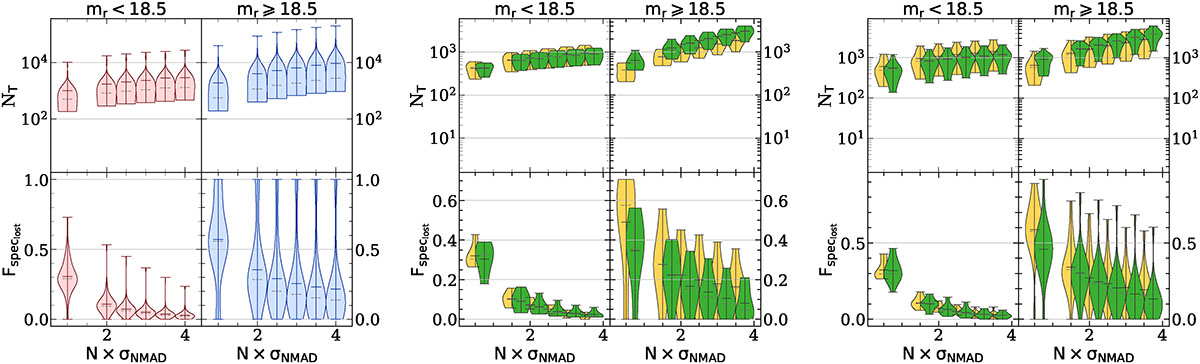
Number of galaxy cluster candidate members selected photometrically (top) and the fraction of lost spectroscopically confirmed members normalised to N × σNMAD = 1 (bottom) as a function of N × σNMAD considering the CHANCES low-redshift magnitude-limited regimes: bright end (mr < 18.5, red) and faint end (mr ≥ 18.5, blue). Assuming N × σNMAD = 4 our target selection process selects the largest number of galaxy cluster candidate members with the lowest fraction loss of spectroscopic members, while assuming N × σNMAD = 1 we select the lowest number of galaxy cluster candidate members, with the highest fraction of lost spectroscopically confirmed members. The first panel shows this by considering only our internal LS-DR10-CBPF-zphot estimations, while the middle and right panels show a direct comparison between LS-DR10-CBPF- and S-PLUS-zphot, considering 10 clusters with good T80S/S-PLUS coverage (middle panel) and an extended sample considering 16 clusters with T80S/S-PLUS coverage >80%(rightmost panel); see Section 2.3 for details. Assuming N × σNMAD = 3.5 and 3 for S-PLUS and LD-DR10-CBPF-zphot, respectively, successfully reduces the total number of the galaxy cluster candidate members selected with a spectroscopic members loss of ∼2 − 3%.
Current usage metrics show cumulative count of Article Views (full-text article views including HTML views, PDF and ePub downloads, according to the available data) and Abstracts Views on Vision4Press platform.
Data correspond to usage on the plateform after 2015. The current usage metrics is available 48-96 hours after online publication and is updated daily on week days.
Initial download of the metrics may take a while.