


Fig. A.1
Download original image
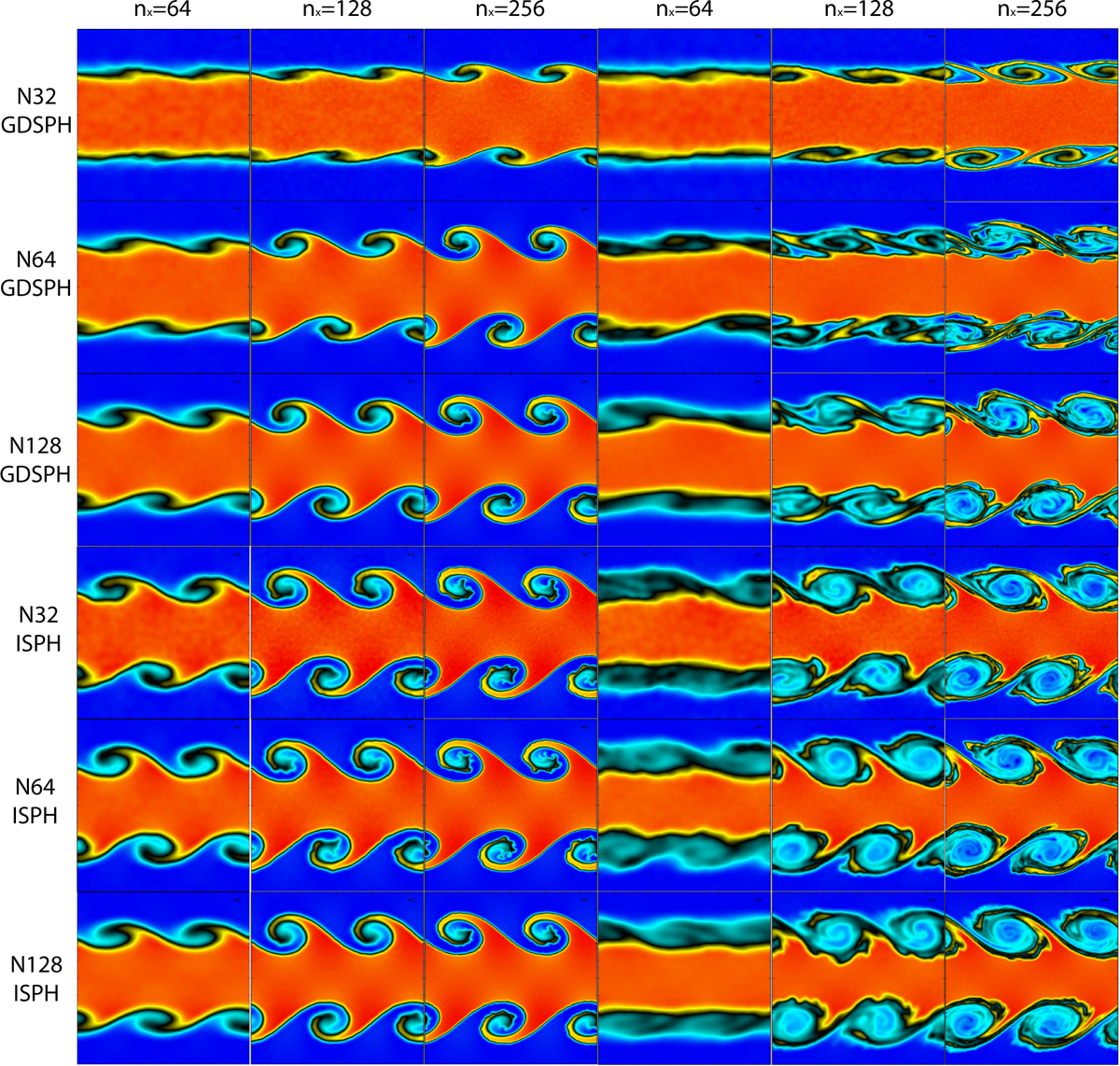
Density rendering of the Kelvin-Helmholtz instability (∆ρ = 2) at t = 2 (three left columns) and t = 4 (three right columns) for varying resolution (nx = 64,128,256), Nsmooth = 32,64,128, and method (GDSPH upper three rows and ISPH bottom three rows). The X and Y axis have a length of 1a. These simulations were all run with the optimized kernel for each ONsmooth GDSPH and OI,Nsmooth for ISPH. We can see that ISPH manages to generate the same vortex structure, regardless of the number of neighbors if the resolution is high enough, while GDSPH struggles with lower number of neighbors even at the highest resolution.
Current usage metrics show cumulative count of Article Views (full-text article views including HTML views, PDF and ePub downloads, according to the available data) and Abstracts Views on Vision4Press platform.
Data correspond to usage on the plateform after 2015. The current usage metrics is available 48-96 hours after online publication and is updated daily on week days.
Initial download of the metrics may take a while.