


Fig. A.3
Download original image
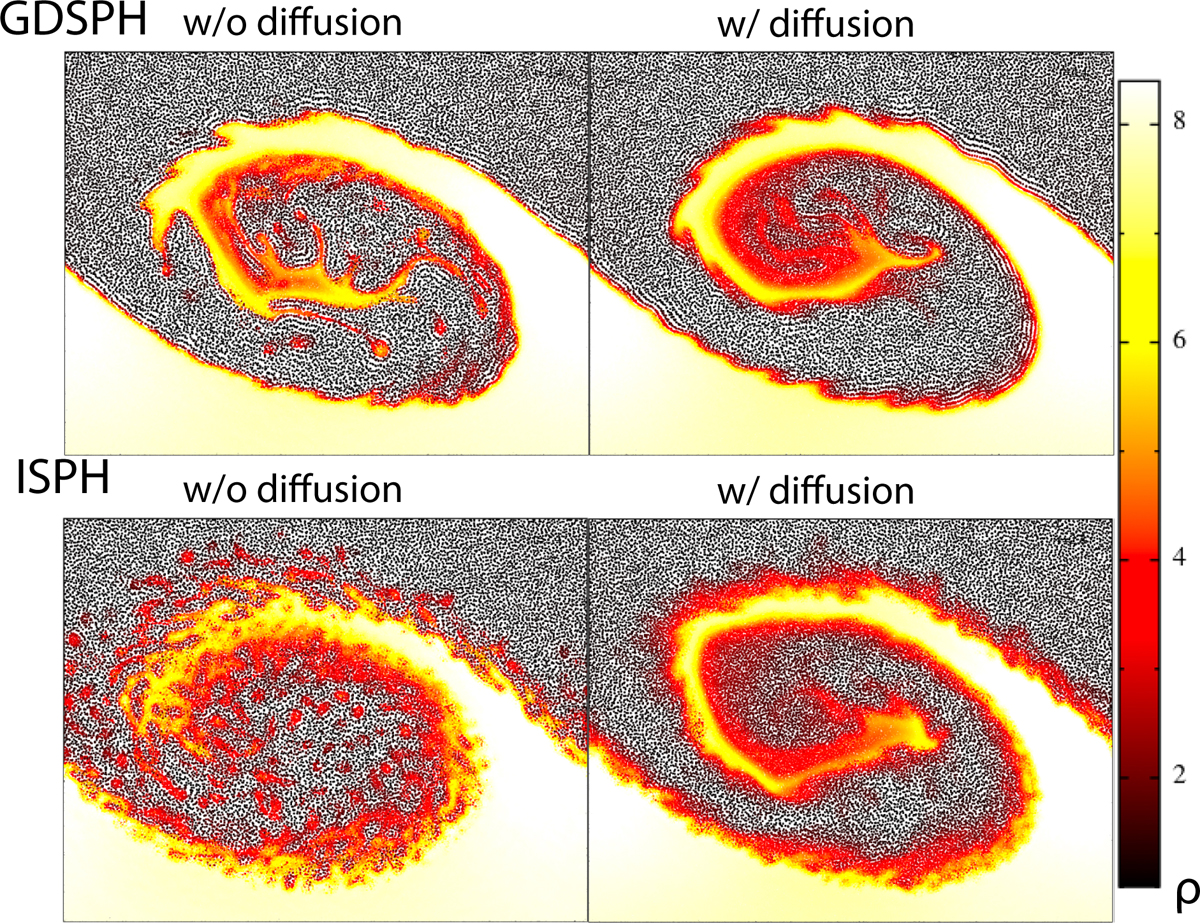
Particle density rendering of Kelvin-Helmholtz instability swirl at t = 2 for ∆ρ = 8. The figures shows the different behavior of not using diffusion versus using diffusion for the GDSPH and ISPH methods. A significant number of entropy clumps can be seen being generated in the low density medium for ISPH, as the removal of linear gradient together with sharp boundaries causes chaotic noise at the boundary. Lagrangian SPH formalisms that are derived directly from the density estimate, provide full spatial conservation of entropy. However, deviation from the Lagrangian formalism, while still using the traditional density estimate means that we will introduce entropy errors in our solution. GDSPH corrects for firstorder errors in entropy making it second-order in entropy. ISPH removes linear-gradient errors and will thus only be first-order accurate with entropy. The issue might be further aggravated by the use of average gradient kernels within ISPH. Adding thermal diffusion allows for local mixing between the cold and hot phase, and we can see that we get good behavior in both ISPH and GDSPH. Slight numerical surface tension effect can be seen for GDSPH, while none can be seen for ISPH.
Current usage metrics show cumulative count of Article Views (full-text article views including HTML views, PDF and ePub downloads, according to the available data) and Abstracts Views on Vision4Press platform.
Data correspond to usage on the plateform after 2015. The current usage metrics is available 48-96 hours after online publication and is updated daily on week days.
Initial download of the metrics may take a while.