


Fig. 5
Download original image
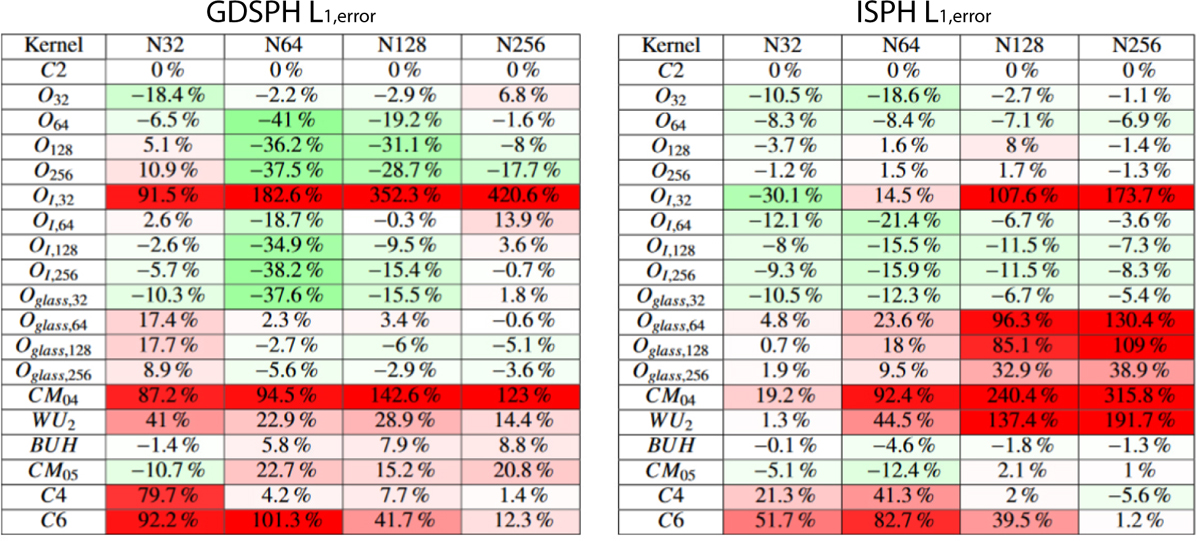
Relative increase or decrease of the L1,error of the Gresho-chan vortex at t = 1 and nx = 64 for different kernels in respect to the L1,error of the C2 kernel. The terms N32, N64, N128, and N256 refer to the number of neighbors: Nsmooth = 32,64,128,256. Left : simulations done with the GDSPH method. Right : simulations done with the ISPH method. The L1,error of the C2 kernel for each Nsmooth is L1,error = 1.49375 × 10⁻¹, 9.57342 × 10⁻², 4.70888 × 10⁻², 2.99816 × 10⁻² for GDSPH and L1,error = 9.34635 × 10⁻², 4.66192 × 10⁻², 2.64744 × 10⁻², 2.22268 × 10⁻² for ISPH. An improvement for the optimized kernel at a given Nsmooth across all Nsmooth can be seen for both methods, where the biggest improvements are for the N64 and N128 for GDSPH and N32 and N64 for ISPH. Of the non-optimized kernels, we observed that the C2 kernel performs best, except for Nsmooth = 32 (GDSPH), Nsmooth = 32,64 (ISPH), where CM05 performs better and C4 performs slightly better at Nsmooth = 256 (ISPH).
Current usage metrics show cumulative count of Article Views (full-text article views including HTML views, PDF and ePub downloads, according to the available data) and Abstracts Views on Vision4Press platform.
Data correspond to usage on the plateform after 2015. The current usage metrics is available 48-96 hours after online publication and is updated daily on week days.
Initial download of the metrics may take a while.