


Fig. 6
Download original image
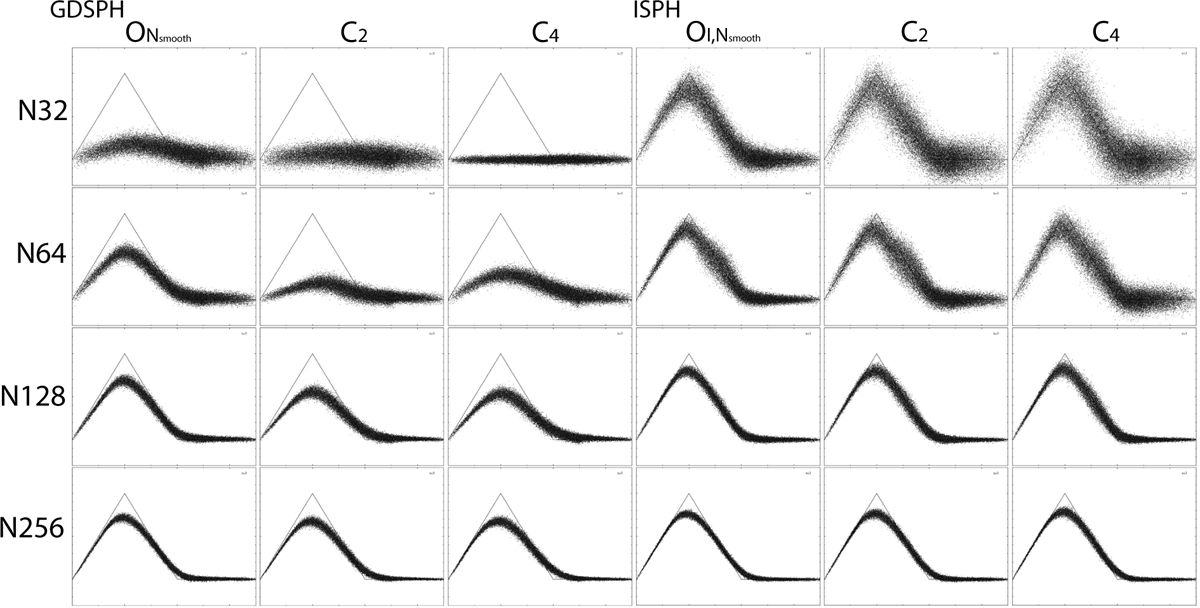
Azimuthal velocity in the radial direction of the Gresho-Chan vortex at t = 3. Here the resolution is nx = 64 and simulation was performed with GDSPH (left three columns) and ISPH (right three columns). We compare the optimized kernel at a given Nsmooth to the popular Wendland C2 and C4 kernels, and vary the number of neighbors in each row (Nsmooth = 32,64,128,256), referred here to N32, N64, N128, N256. The solid black line show the analytical solution and the black dots show the results from the simulation. The X axis (cylindrical radius) extends from 0.0 to 0.7, and the vertical extent from the top to the bottom of the analytical solution is 1. We can see a significant improvement in the optimized kernels for the GDSPH method for Nsmooth = 32,64,128, where the vortex structure becomes more pronounced. Overall less noise can be seen for all Nsmooth. The ISPH method captures the overall vortex structure well for all Nsmooth, due to exact linear gradients. But we can see significant improvement in the noise level of the optimized kernels, compared to the C2 and C4 kernels.
Current usage metrics show cumulative count of Article Views (full-text article views including HTML views, PDF and ePub downloads, according to the available data) and Abstracts Views on Vision4Press platform.
Data correspond to usage on the plateform after 2015. The current usage metrics is available 48-96 hours after online publication and is updated daily on week days.
Initial download of the metrics may take a while.