


Fig. 5
Download original image
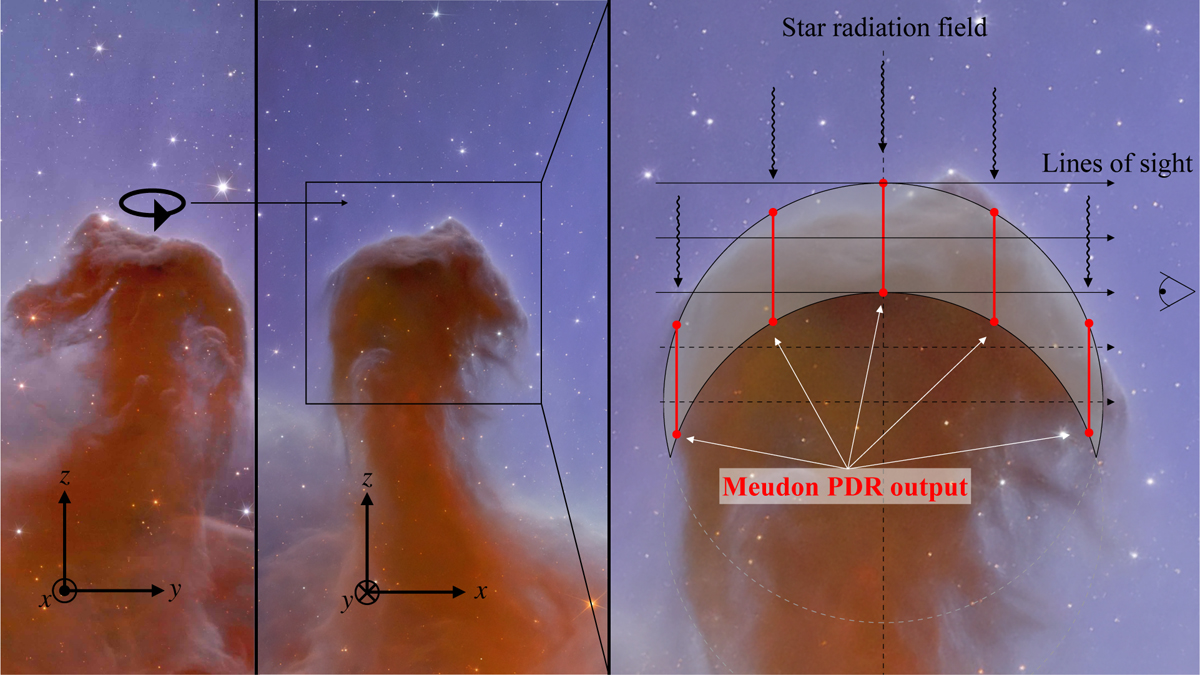
Illustration of the geometry of the PDR wrapper. (Left panel) Image of the Horsehead nebula as seen by the Euclid space telescope (Credits: ESA/Euclid/Euclid Consortium/NASA, image processing by J.-C. Cuillandre (CEA Paris-Saclay), G. Anselmi). Notice the reference frame, with the x-axis corresponding to the direction of the lines of sight. We rotate the nebula so that the x–axis points to the right. (Middle panel) Artistic interpretation of the rotation of the Horsehead nebula, generated using OpenAI’s DALL·E model based on the first panel image. (Right panel) Geometry of the wrapping 2D model, with the star radiation field coming from the top, and examples of Meudon PDR model output overplotted as vertical red lines. Each of these lines correspond to a PDR model as represented on Fig. 4. Notice that we use the same model for each position along the cut of the cloud. The multiple lines of sight correspond to different pixels along a vertical 1D cut in the Horsehead nebula. We emphasize that only the lines of sight shown as solid lines are correctly accounted for by the model, as the central section of the nebula outside of the crescent-shaped area is not included in the computations. The geometry is assumed to be circular with a radius of curvature that remains to be determined.
Current usage metrics show cumulative count of Article Views (full-text article views including HTML views, PDF and ePub downloads, according to the available data) and Abstracts Views on Vision4Press platform.
Data correspond to usage on the plateform after 2015. The current usage metrics is available 48-96 hours after online publication and is updated daily on week days.
Initial download of the metrics may take a while.