


Fig. 4.
Download original image
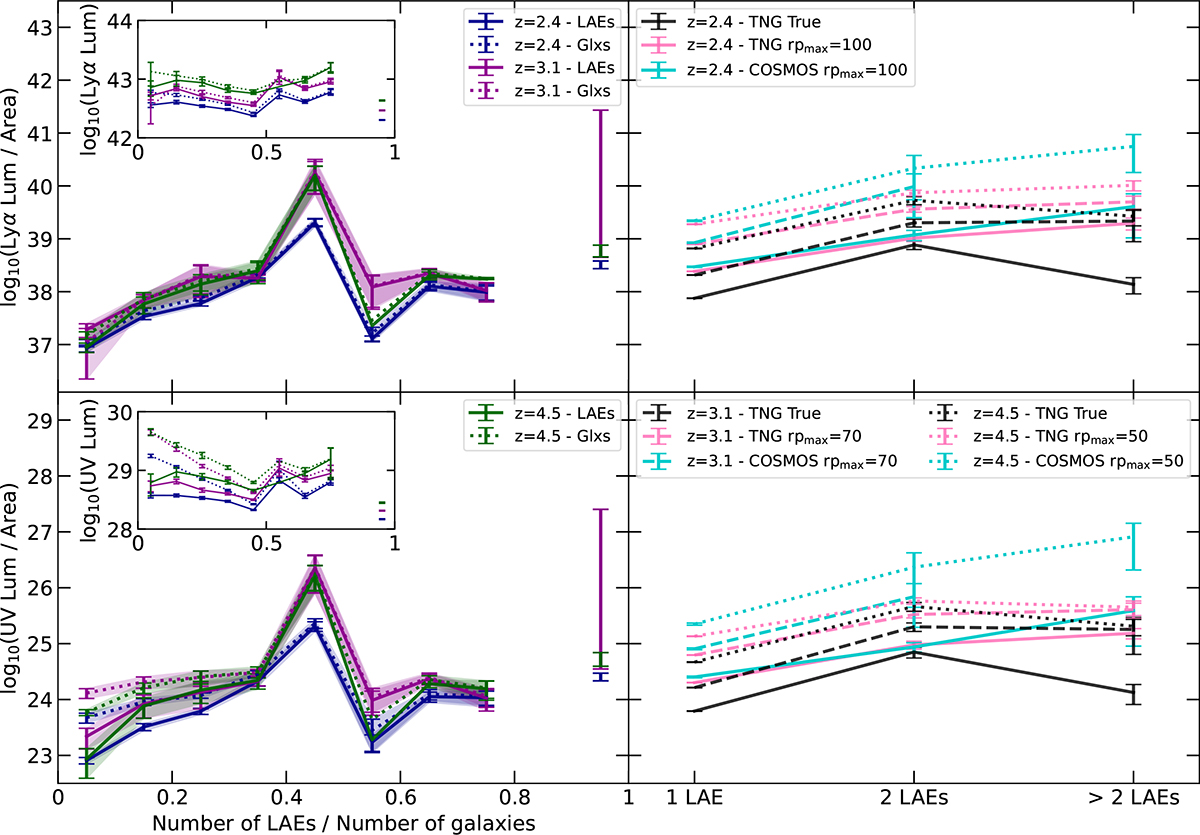
Virial surface brightness of Lyα (erg s−1 kpc−2) and UV (erg s−1 Hz−1 kpc−2) luminosities as a function of LAE multiplicity. Left panels: Mean virial surface luminosities for Lyα (top) and UV (bottom) emissions in TNG100, defined as the total luminosity per projected area, at z = 2.4 (blue), z = 3.1 (magenta), and z = 4.5 (green), plotted as a function of the fraction of LAEs relative to the total number of galaxies in the halo. Solid lines correspond to LAE-based densities, while dotted lines correspond to galaxy-based densities. Insets display the mean total luminosity before normalization. Error bars represent the standard error of the mean. Both Lyα and UV virial densities increase with the LAE fraction, reaching a peak at ∼0.5. This behavior is mainly driven by the Lyα model, which produces a more compact spatial distribution of LAE galaxies within halos. Right panels: Mean virial surface luminosities as a function of LAE multiplicity. Black lines show the TNG100-true values, pink lines show the TNG100-identified sample, and cyan lines are for the ODIN-COSMOS data. The solid, dashed, and dotted line styles denote z = 2.4, z = 3.1, and z = 4.5, respectively. Error bars represent the standard error of the mean in each bin. Higher LAE multiplicity appears to be associated with increased virial surface brightness densities.
Current usage metrics show cumulative count of Article Views (full-text article views including HTML views, PDF and ePub downloads, according to the available data) and Abstracts Views on Vision4Press platform.
Data correspond to usage on the plateform after 2015. The current usage metrics is available 48-96 hours after online publication and is updated daily on week days.
Initial download of the metrics may take a while.