


Fig. 2.
Download original image
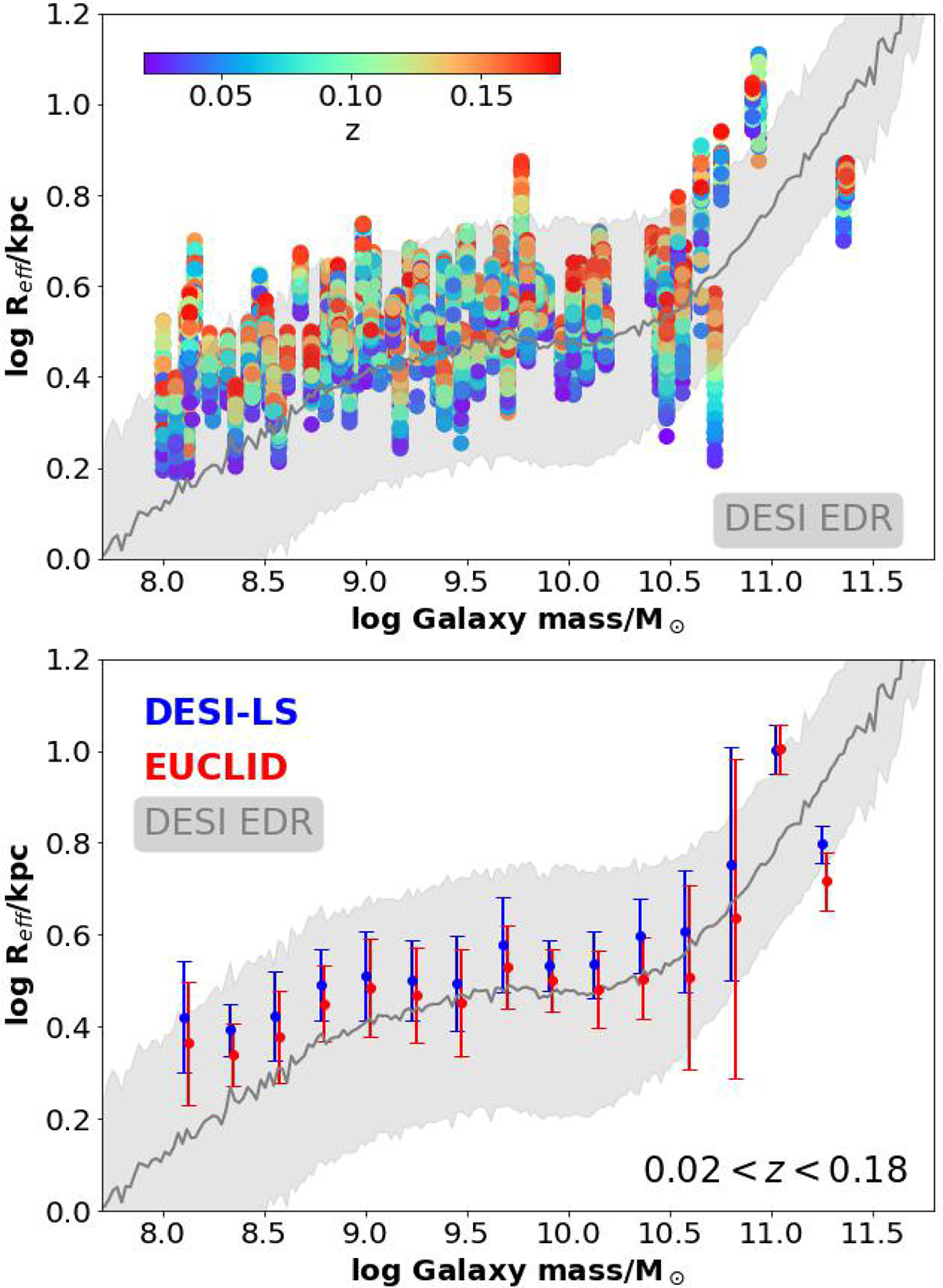
Variations in the effective radius estimated from synthetic DESI-LS r-band images with respect to the galaxy mass (upper panel). For each galaxy, we generated 50 synthetic images by assigning random spatial orientations and redshifts in the range 0.02 < z < 0.18. For qualitative comparison with observational data, the black line represents the average half-light radius measured from the DESI Early Data Release (EDR), based on a sample of 151 530 galaxies within the same redshift range. The shaded gray area denotes the dispersion around the mean value. Overall, the trend observed in our synthetic sample agrees reasonably well with observational expectations, suggesting that the theoretical estimates of Re are reliable. In the lower panel, we compare the corresponding Re values derived from the synthetic Euclid images. On average, the effective radii estimated from the DESI-LS synthetic images are slightly larger than those obtained from Euclid, primarily due to the lower angular resolution of DESI-LS.
Current usage metrics show cumulative count of Article Views (full-text article views including HTML views, PDF and ePub downloads, according to the available data) and Abstracts Views on Vision4Press platform.
Data correspond to usage on the plateform after 2015. The current usage metrics is available 48-96 hours after online publication and is updated daily on week days.
Initial download of the metrics may take a while.