


Fig. B.1.
Download original image
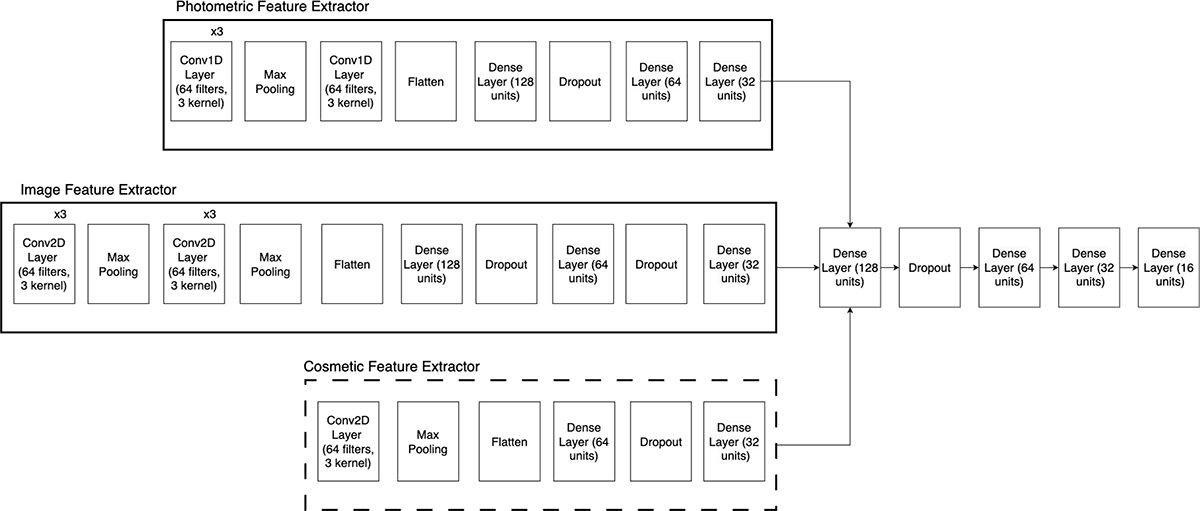
Model architecture consisting of three parallel branches designed for multi-mode data integration: (1) a spectral branch (upper), which processes the photometric flux through 1D convolutional layers; (2) an image branch (middle), which analyses the galaxy image using 2D convolutions to extract morphological features; and (3) a defect-detection branch (lower), which processes localized image regions around the emission-line position to identify cosmetic artefacts. Each branch applies a combination of convolutional, pooling, and dense layers, with dropout regularization to prevent overfitting. The outputs from the active branches are concatenated and passed through a shared set of fully connected layers, followed by a final sigmoid activation that produces the output label. For the primary EELG classifier (P0), only the spectral and image branches (upper and middle) are used. For the cosmetic-defect classifier (P1), all three branches are active, including the additional defect-detection branch. A detailed description can be found in Appendix B.
Current usage metrics show cumulative count of Article Views (full-text article views including HTML views, PDF and ePub downloads, according to the available data) and Abstracts Views on Vision4Press platform.
Data correspond to usage on the plateform after 2015. The current usage metrics is available 48-96 hours after online publication and is updated daily on week days.
Initial download of the metrics may take a while.