


Fig. 1
Download original image
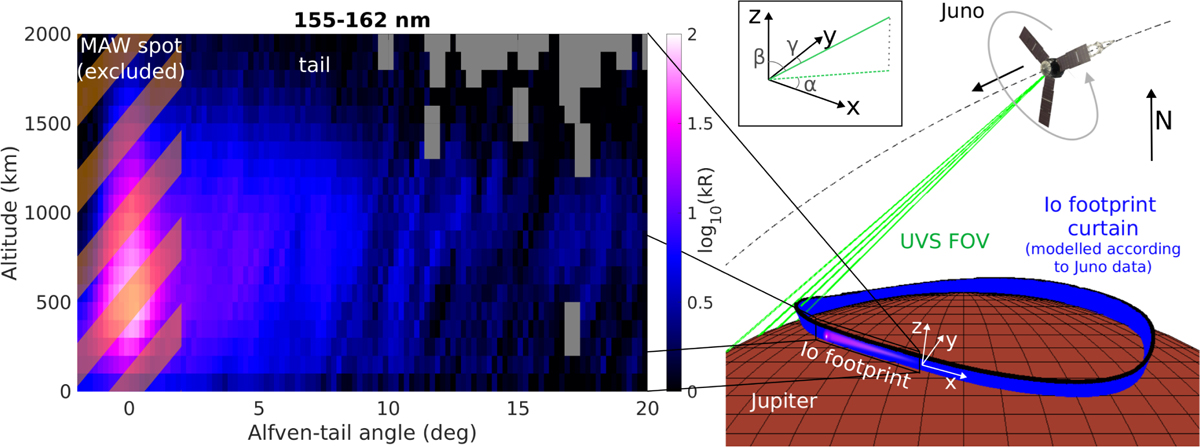
Example of the typical observation geometry used to inspect the vertical profile of the IFP using Juno-UVS on February 22, 2022, corresponding to Juno’s 40th perijove. On the right, the blue ribbon represents the Io curtain, which is a 2D approximation of the source location of the auroral emission. Details on the IFP curtain are given in Sect. 3.1. Juno flies north-to-south along the dashed line while spinning around its spin axis. The green lines show the projection of the dog-bone shaped slit at 01:28:37.200 UTC. The xyz axes show the coordinate system of the Io curtain: x is along the IFP tail, z is along the magnetic field, and y is orthogonal to x and z, pointing poleward. The inset panel at the top of the right image shows the definitions of the angles used to select the observations at limb: α is the “heading angle” with respect to the direction of the IFP in Jupiter’s frame, β is the “pitch angle” with respect to the magnetic field, and γ is the “emission angle” with respect to the normal to the Io curtain. The left panel shows the vertical emission profile of the IFP in the 155-162 nm band, acquired between 01:21:35 and 01:44:15 UTC, as a function of the Alfvén-tail angle and altitude. The orange hatched area highlights the emission we excluded for the retrieval of the energy distribution of the precipitating electrons, as the instrumental pulse height distribution suggests an unreliable UVS calibration (only when using the wide slit).
Current usage metrics show cumulative count of Article Views (full-text article views including HTML views, PDF and ePub downloads, according to the available data) and Abstracts Views on Vision4Press platform.
Data correspond to usage on the plateform after 2015. The current usage metrics is available 48-96 hours after online publication and is updated daily on week days.
Initial download of the metrics may take a while.