


Fig. 1.
Download original image
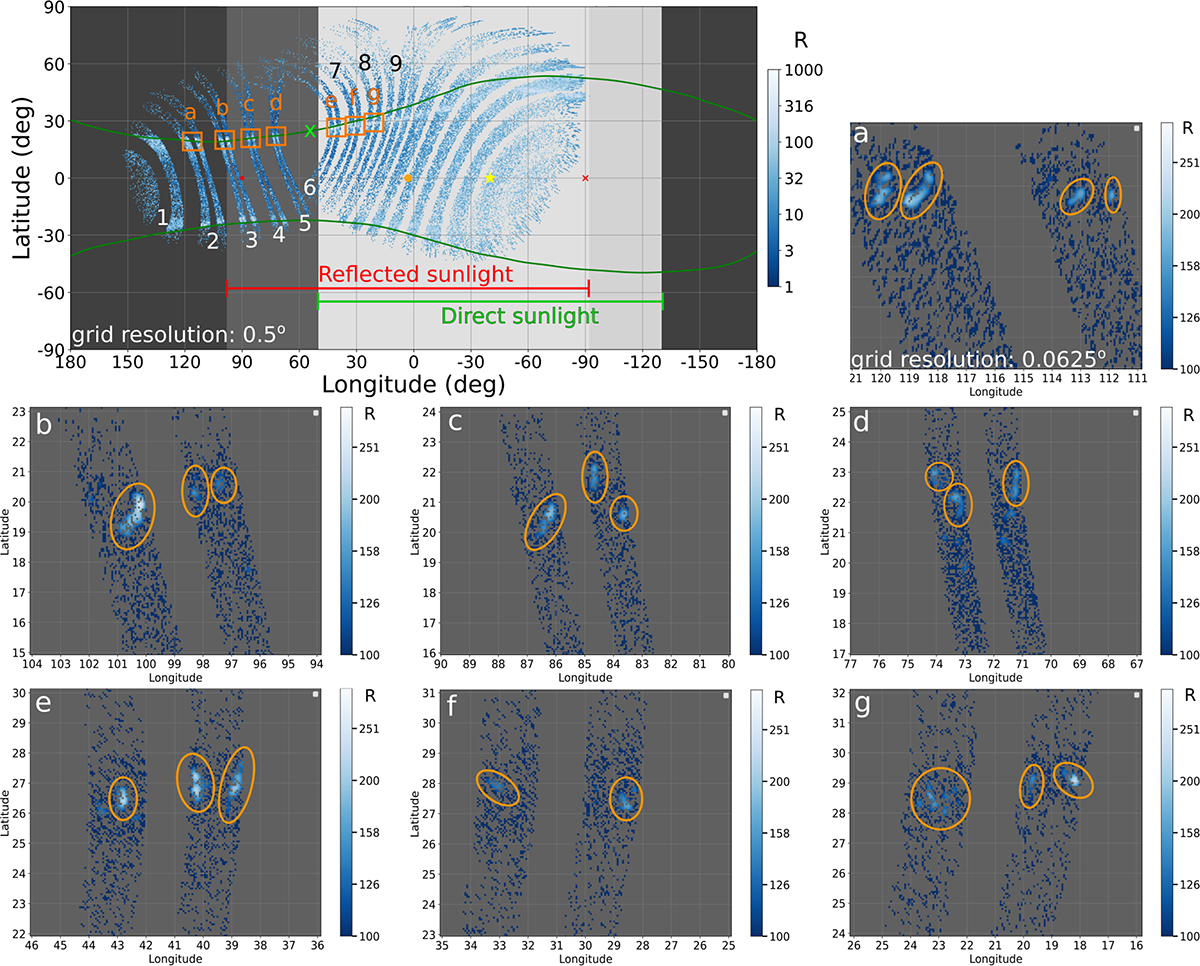
Top-left panel: Projection of Ganymede’s FUV aurora acquired by Juno-UVS on June 7th, 2021, from 16:52 to 17:04 UTC. We used the Ganymede-centered Phi-Omega (GPhiO) frame of reference, with z parallel to Jupiter’s spin axis and y toward Jupiter; x completes the right-handed system. The brightness is integrated over 130.4 ± 1.5 nm and 135.6 ± 1.5 nm. The green lines show the predicted OCFB (Duling et al. 2022). The background shades of gray (from dark to light) represent the surface illumination: surface that is not illuminated, only sunlight reflected by Jupiter, only direct sunlight, and both reflected and direct sunlight. The green and red bars mark the direct and reflected illuminations, respectively. The red dot around 90° is the downstream direction, while the red cross at −90° is the upstream direction. The orange dot at 0° and the yellow star at ∼–40° are the direction to Jupiter and to the Sun, respectively. The numbers 1–9 mark successive Juno spins. The green cross is the projection of Juno’s closest approach. The orange boxes labeled a-g are reproduced in the seven panels, which show the patches observed along Ganymede’s aurora smoothed using a 3 × 3 Gaussian kernel with 2 sigma that approximately matches the ∼0.1° point spread function of UVS. We encircled the visually identified patches. The color levels are logarithmic; for panels a-g, we visually display 100R (S/N ∼ 1) as the lower level to highlight the beads.
Current usage metrics show cumulative count of Article Views (full-text article views including HTML views, PDF and ePub downloads, according to the available data) and Abstracts Views on Vision4Press platform.
Data correspond to usage on the plateform after 2015. The current usage metrics is available 48-96 hours after online publication and is updated daily on week days.
Initial download of the metrics may take a while.