


| Issue |
A&A
Volume 706, February 2026
|
|
|---|---|---|
| Article Number | C1 | |
| Number of page(s) | 1 | |
| Section | Planets, planetary systems, and small bodies | |
| DOI | https://doi.org/10.1051/0004-6361/202658886e | |
| Published online | 12 February 2026 | |
Pebble-driven migration of low-mass planets in the 2D regime of pebble accretion (Corrigendum)
1
Charles University, Faculty of Mathematics and Physics, Astronomical Institute,
V Holešovičkách 747/2,
180 00
Prague 8,
Czech Republic
2
Instituto de Ciencias Físicas, Universidad Nacional Autonoma de México, Av. Universidad s/n,
62210
Cuernavaca, Mor.,
Mexico
3
IRAP, Université de Toulouse, CNRS, UPS,
31400
Toulouse,
France
★ Corresponding author: This email address is being protected from spambots. You need JavaScript enabled to view it.
Key words: hydrodynamics / methods: numerical / planets and satellites: formation / protoplanetary disks / planet-disk interactions / errata, addenda
We report problematic behaviour in the empirical scaling law used in Chrenko et al. (2024) to fit the dependence of the pebble torque Γp, as measured in our simulations, on the Stokes number St and the planet-to-star mass ratio q. The scaling law defined by Eqs. (14)–(18) of our original article exhibits a discontinuity in the interval 0.38 ≲ St ≲ 0.55, where the fitting function becomes constant and independent of St. We failed to notice this discrepancy in Fig. 5 because the horizontal axis was sampled too sparsely: we used discrete St values corresponding directly to the individual simulation runs, and our plotting routine automatically connected these data points with line segments. The grey curves in Fig. 1 (analogous to Fig. 5 in the original article) reveal the problematic feature when the true behaviour of the original fitting function is reconstructed.
Since the main purpose of our scaling law is to enable the implementation of the pebble torque in models with prescribed migration forces, any abrupt jump in Γp is undesired, even though the affected region of the parameter space is small. To remedy this, we propose the following improved fitting function:
![Mathematical equation: $\[\frac{\Gamma_{\mathrm{p}}}{\Gamma_0}=\frac{Z}{0.01} h^{-0.45} \mathrm{St}^{-19 h} \min \left[\Gamma_3, \max \left(\Gamma_2, \Gamma_1\right)\right],\]$](/articles/aa/full_html/2026/02/aa58886e-26/aa58886e-26-eq1.png) (1)
together with
(1)
together with
![Mathematical equation: $\[\begin{aligned}& \Gamma_1=5.909 \times 10^{-3} \mathrm{St}^{3.595} q^{(-0.479+0.2 ~\operatorname{log~St})}, \\& \Gamma_2=5.195 \times 10^{-4} \mathrm{St}^{1.05} q^{(-0.713-0.052 ~\operatorname{log~St})}, \\& \Gamma_3=1.463 \times 10^{-6} \mathrm{St}^{-5.136} q^{(-1.074-0.311 ~\operatorname{log~St})}.\end{aligned}\]$](/articles/aa/full_html/2026/02/aa58886e-26/aa58886e-26-eq2.png) (2)
(2)
Equations (1) and (2) are intended to replace Eqs. (16)–(18) of our original article. A replacement of Eqs. (14)–(16) can be readily obtained by dropping the factor h−0.45St−19h from Eq. (1) and multiplying Eq. (2) by 0.05−0.45St−0.95.
The conclusions and results of Chrenko et al. (2024) remain unchanged. The purpose of this corrigendum is solely to prevent spurious behaviour in future models that employ our scaling law.
Acknowledgements
We wish to thank Sijme-Jan Paardekooper for alerting us to the problematic behavior of the fitting function addressed in this corrigendum.
References
- Chrenko, O., Chametla, R. O., Masset, F. S., Baruteau, C., & Brož, M. 2024, A&A, 690, A41 [NASA ADS] [CrossRef] [EDP Sciences] [Google Scholar]
© The Authors 2026
 Open Access article, published by EDP Sciences, under the terms of the Creative Commons Attribution License (https://creativecommons.org/licenses/by/4.0), which permits unrestricted use, distribution, and reproduction in any medium, provided the original work is properly cited.
This article is published in open access under the Subscribe to Open model. This email address is being protected from spambots. You need JavaScript enabled to view it. to support open access publication.
All Figures
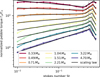 |
Fig. 1 As Fig. 5 of Chrenko et al. (2024), with the black curves corresponding to the updated fitting function (Eqs. (1) and (2)). The original fitting function, which contains an undesired jump, is shown with the grey curves. |
| In the text | |
Current usage metrics show cumulative count of Article Views (full-text article views including HTML views, PDF and ePub downloads, according to the available data) and Abstracts Views on Vision4Press platform.
Data correspond to usage on the plateform after 2015. The current usage metrics is available 48-96 hours after online publication and is updated daily on week days.
Initial download of the metrics may take a while.