


Fig. 13.
Download original image
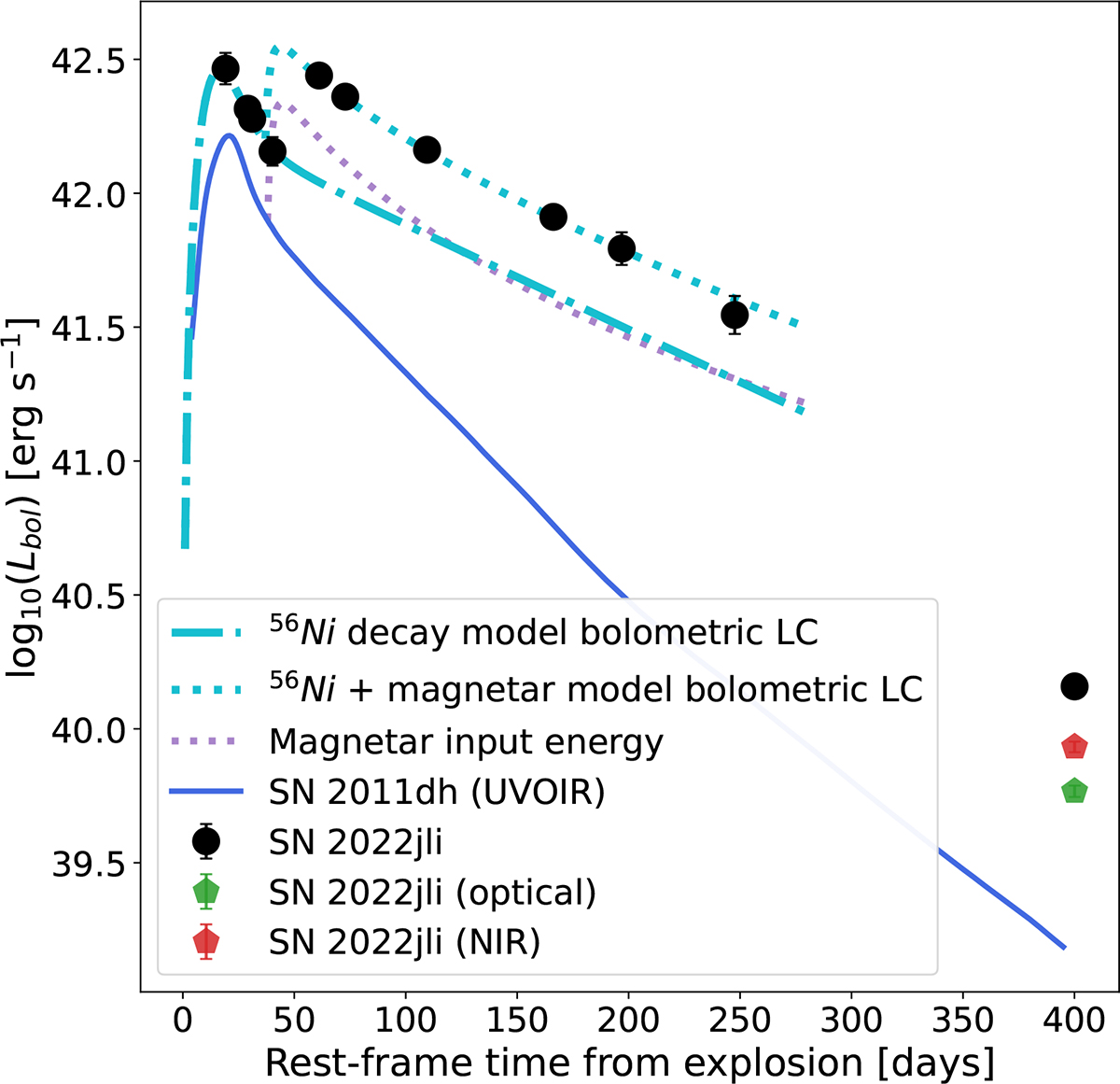
Fit of the radioactive decay of 56Ni to the first maximum of the bolometric light curve of SN 2022jli, using the Arnett (1982) analytic approximation. The parameters of the best-fit model are τrise = 14 days, Mej ∼ 1.5 M⊙, MNi ∼ 0.12 M⊙, vej = 8500 km s−1 and κ = 0.07 cm2 gr−1. This model illustrates that the first maximum of SN 2022jli is consistent with the typical rise time, 56Ni and ejecta mass of a normal SN Ic. The estimated MJD of the explosion is 59695.4 days. The secondary maximum is modelled as the sum of the radioactive decay of 56Ni and the spin-down energy from a magnetar (dotted cyan line; see Cartier et al. 2022, for details about the magnetar model). To model the secondary maximum the magnetar birth is delayed 37 days relative to the assumed time of the SN explosion and the magnetar parameters are B ∼ 8.5 × 10¹⁴ G and P ∼ 48 ms. The dotted purple line shows the magnetar contribution to the bolometric light curve. The optical and NIR luminosity at +383 days are shown using green and red pentagons, respectively. The pseudo-bolometric (UVOIR) light curve of the well-observed SE SN 2011dh (IIb) is shown for comparison (MNi = 0.075 M⊙; Ergon et al. 2015).
Current usage metrics show cumulative count of Article Views (full-text article views including HTML views, PDF and ePub downloads, according to the available data) and Abstracts Views on Vision4Press platform.
Data correspond to usage on the plateform after 2015. The current usage metrics is available 48-96 hours after online publication and is updated daily on week days.
Initial download of the metrics may take a while.