


Fig. 7
Download original image
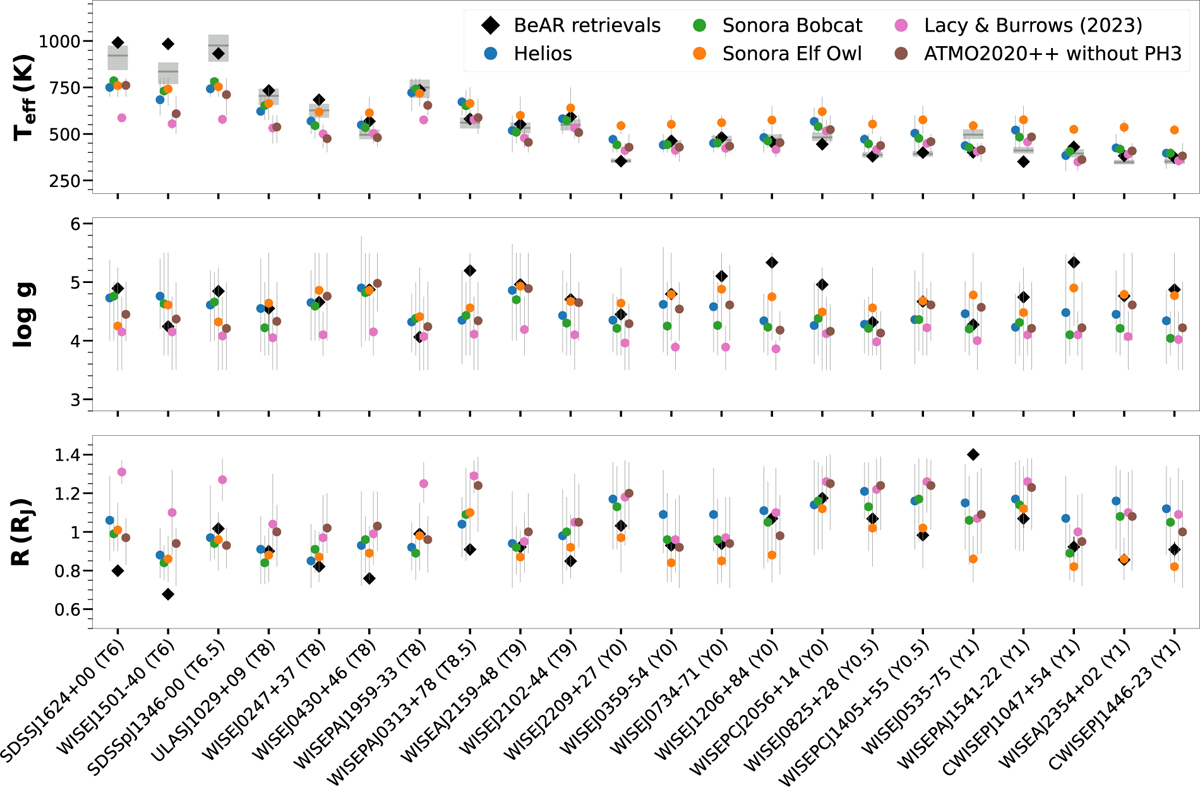
Comparison of retrieved posterior outcomes for effective temperature (top), surface gravity (middle), and radii (bottom) from our suite of brown dwarf retrievals across the T-Y sequence. The brown dwarfs are ordered with respect to their spectral class, from T6 to Y1 (see Table 1 for details). For each object within the curated sample, all permutations of the theoretical grid models, which were used for training the HELA random forest routine, are shown as well as the posterior parameters retrieved by using the nested sampling BeAR framework. For each posterior, the 1σ uncertainties are shown, but they are too small to be visible for the BeAR posteriors. Gray bars in the top panel indicate the effective temperature values determined by Beiler et al. (2024a) using integrated luminosities and radii from evolutionary models (see their Table 4).
Current usage metrics show cumulative count of Article Views (full-text article views including HTML views, PDF and ePub downloads, according to the available data) and Abstracts Views on Vision4Press platform.
Data correspond to usage on the plateform after 2015. The current usage metrics is available 48-96 hours after online publication and is updated daily on week days.
Initial download of the metrics may take a while.