


Fig. 5.
Download original image
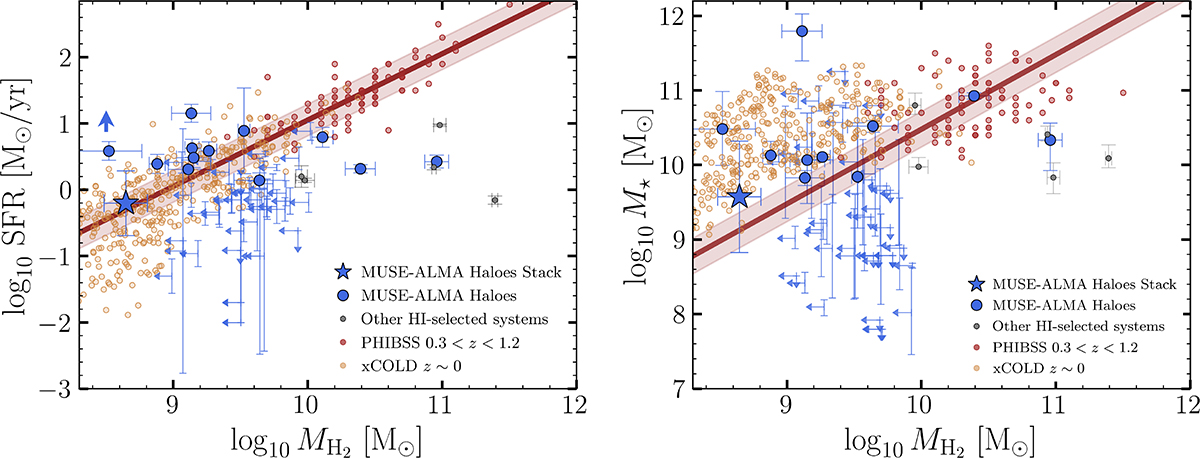
Left: Star formation rate as a function of molecular gas mass (MH2). Right: Stellar mass (M★) as a function of molecular gas mass (MH2). Our sample is shown in blue circles, and the blue arrows represent a 3σ upper limit. The result from the stacked spectrum described in Sect. 3.2 is shown by the blue star. We also include the mean dust correction for SFR depicted by a large blue arrow on the corner of the left panel. For comparison, we include data from the xCOLD GASS survey (Saintonge et al. 2017), which represents low-redshift galaxies, and the PHIBSS survey (Tacconi et al. 2018), in the redshift range z ∼ 0.3 − 1.2. The solid line represents the molecular gas main sequence scaling relation from Tacconi et al. (2018). We also included estimates from Kanekar et al. (2018) and Klitsch et al. (2021) in both panels, labelled as other H I–selected systems. Our sources with MH2/M⊙ ≲ 109.8 lie ∼0.3 dex above the expected SFR−MH2 relations for ‘normal star-forming galaxies’ at the same redshift range, while the systems with with MH2/M⊙ > 109.8 lie ∼1.5 dex below the relation. This trend suggests that H I–selected systems have a dual behaviour. Galaxies with low molecular gas masses form stars efficiently, following both the depletion timescales and the M★ − MH2 scaling relations of main-sequence galaxies. In contrast, galaxies with high molecular gas masses show inefficient star formation and fall below the expected stellar mass growth, likely because they are still actively accreting gas from the intergalactic medium or interacting within group environments. These systems appear not yet to have reached the equilibrium conditions characteristic of main-sequence galaxies.
Current usage metrics show cumulative count of Article Views (full-text article views including HTML views, PDF and ePub downloads, according to the available data) and Abstracts Views on Vision4Press platform.
Data correspond to usage on the plateform after 2015. The current usage metrics is available 48-96 hours after online publication and is updated daily on week days.
Initial download of the metrics may take a while.