


Fig. 6.
Download original image
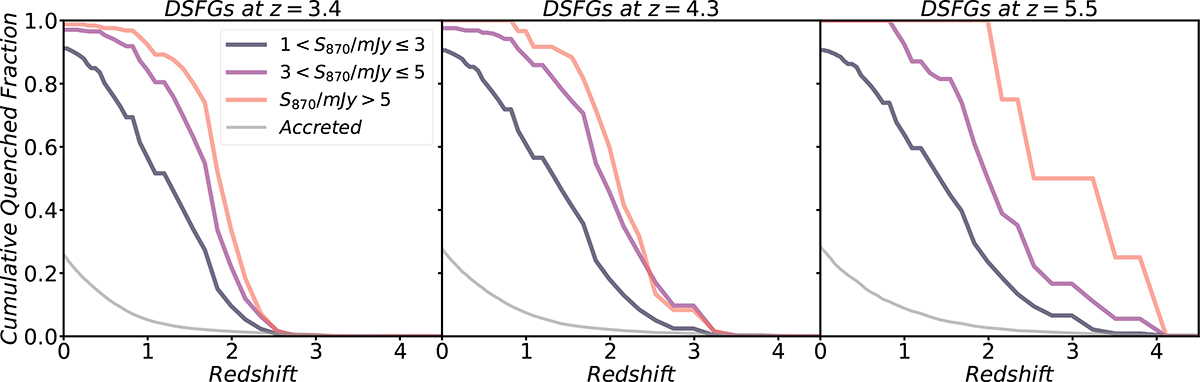
Cumulative fraction of dusty star-forming galaxies (DSFGs) selected at z = 3.4, 4.3, and 5.5 (from left to right) that become massive and quiescent as a function of redshift. The dark blue, purple, and orange lines represent DSFGs with sub-millimetre flux densities of 1 < S870/mJy ≤ 3, 3 < S870/mJy ≤ 5, and S870/mJy > 5, respectively. The grey line indicates the fraction of DSFGs that were accreted by a more massive galaxy. We note that all DSFGs with S870 ≳ 3 mJy are already massive at all selection redshifts. The most remarkable trend is that brighter DSFGs quench more rapidly than their fainter counterparts. For example, 50% of the bright DSFGs selected at z = 3.4, 4.3, and 5.5 become quenched by z ∼ 1.85, 2.08, and 2.54, respectively. In contrast, the fainter DSFGs across all selected redshifts tend to quench later, with similar quenched redshift, typically around z ∼ 1.3. This is because faint DSFGs selected at high redshift may continue to grow and potentially become brighter at later times.
Current usage metrics show cumulative count of Article Views (full-text article views including HTML views, PDF and ePub downloads, according to the available data) and Abstracts Views on Vision4Press platform.
Data correspond to usage on the plateform after 2015. The current usage metrics is available 48-96 hours after online publication and is updated daily on week days.
Initial download of the metrics may take a while.