


Fig. 7.
Download original image
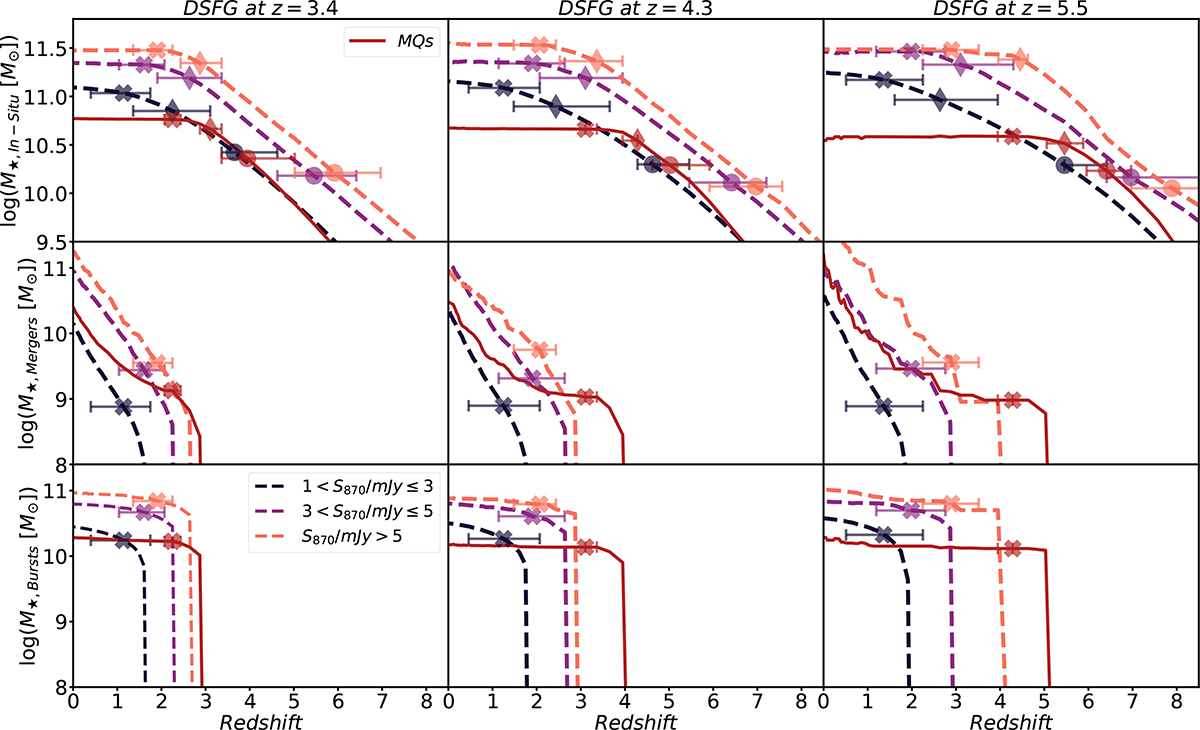
Median stellar mass evolution attributed to secular processes (in situ, top panels), accretion via mergers (mergers, middle panels), and merger-induced starbursts (burst, bottom panels) for massive quiescent progenitors (solid red line) the bright (dashed orange line), intermediate (purple dashed lines), and faint DSFGs (dark blue dashed lines). From left to right we show DSFG and MQ progenitors selected at z = 3.4, 4.3, and 5.5. The dots, diamonds, and crosses highlight the median redshifts at which the galaxy population exceeded S870 > 1 mJy for the first time, reaches the sub-millimetre peak, and quenches. The formation of all four galaxy populations is initially dominated by secular star formation, suggesting that sub-millimetre emission is not primarily triggered by mergers at early times. The main difference in stellar mass growth between typical DSFGs and MQ progenitors lies in the timing of major mergers. MQ progenitors experience a significant merger event earlier, which induces an extreme starburst and rapid SMBH-driven cold gas accretion, thereby depleting the available gas for continued secular star formation. Following this early violent merger, these galaxies grow their stellar mass primarily through dry mergers.
Current usage metrics show cumulative count of Article Views (full-text article views including HTML views, PDF and ePub downloads, according to the available data) and Abstracts Views on Vision4Press platform.
Data correspond to usage on the plateform after 2015. The current usage metrics is available 48-96 hours after online publication and is updated daily on week days.
Initial download of the metrics may take a while.