


Fig. 9.
Download original image
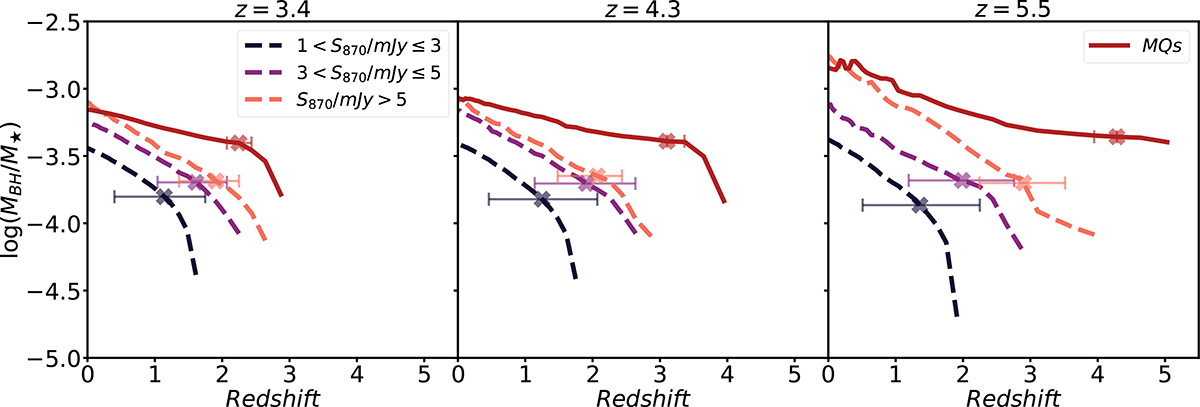
Evolution of the median supermassive black hole mass (MBH) to stellar mass (M★) ratio for MQ progenitors (red solid line), and for faint (dark blue dashed line), intermediate (purple dashed line), and bright (orange dashed line) DSFGs selected at z = 3.4 (left panel), z = 4.3 (central panel), and z = 5.5 (right panel), the typical redshifts at which MQs at z = 2, 3, and 4, respectively, exceeded at least 1 mJy. The crosses and their error bars indicate the median, along with the 16th and 84th percentiles, of the redshift at which each galaxy population quenched. DSFGs, independently of selection redshift or sub-millimetre flux density, exhibit a similar MBH/M★ ratio at the time of quenching (log(MBH/M★)∼ − 3.75). In contrast, MQs host more massive SMBHs relative to their stellar mass at the time of quenching, even though the overall energy input from AGN is typically lower (see Figure 8), and reflects the lower stellar masses of the highest-redshift MQs at the time of quenching. In summary, in our model, rapid growth of a black hole triggered by an early galaxy-galaxy merger produces a black hole that is overmassive and sufficiently energetic to maintain the quenched state of the galaxy.
Current usage metrics show cumulative count of Article Views (full-text article views including HTML views, PDF and ePub downloads, according to the available data) and Abstracts Views on Vision4Press platform.
Data correspond to usage on the plateform after 2015. The current usage metrics is available 48-96 hours after online publication and is updated daily on week days.
Initial download of the metrics may take a while.