


Fig. 2.
Download original image
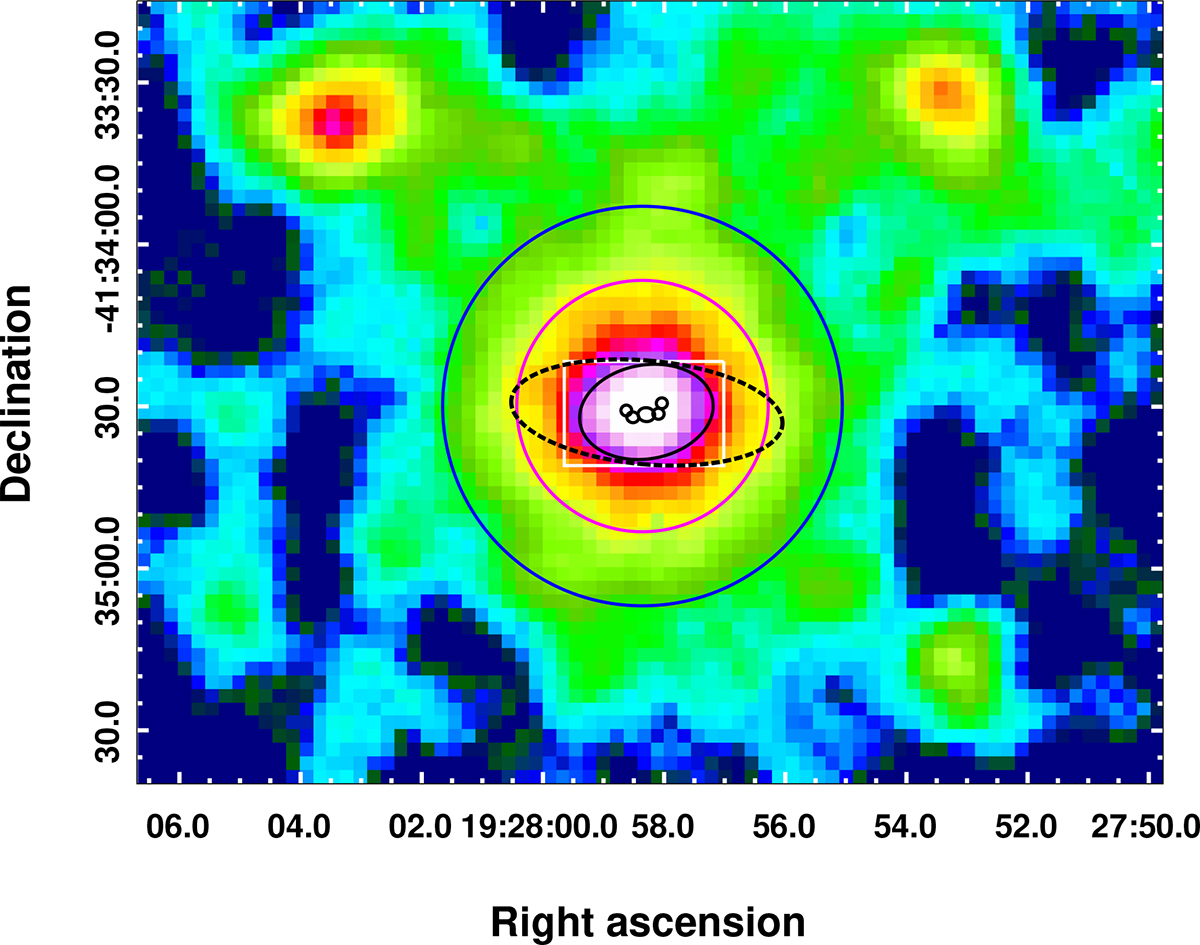
Intensity image of the combined XMM-Newton EPIC pn and MOS1/2 exposures in the 0.2–12 keV band. The image has been adaptively smoothed and background corrected following standard SAS procedures and is presented with the gist_ncar color map. We highlight the Chandra 3σ contours presented in Fig. 1 with black ellipses. Since XMM-Newton does not resolve the individual sources, we depict them through a blended central region represented by the larger black ellipse. To highlight the different scale between the Chandra and XMM-Newton images, we note the extent of Fig. 1 with a white box. For purposes of the spectral fitting in Sect. 2.4, we describe the galactic halo as the region between the black ellipse and the magenta circle. Beyond the halo, soft diffuse structures are visible, extending significantly beyond the extent of the galaxy. A second extended halo is defined by the region between the magenta and blue circles. Its properties agree with the galactic halo and are discussed in Appendix B. The D25 ellipse (HyperLEDA; Makarov et al. 2014) is noted with dashed black to facilitate comparison with the optical extent of the galaxy. The two bright loci in the NW and NE of the galaxy are background sources not associated with ESO 338-4.
Current usage metrics show cumulative count of Article Views (full-text article views including HTML views, PDF and ePub downloads, according to the available data) and Abstracts Views on Vision4Press platform.
Data correspond to usage on the plateform after 2015. The current usage metrics is available 48-96 hours after online publication and is updated daily on week days.
Initial download of the metrics may take a while.