


Fig. 8.
Download original image
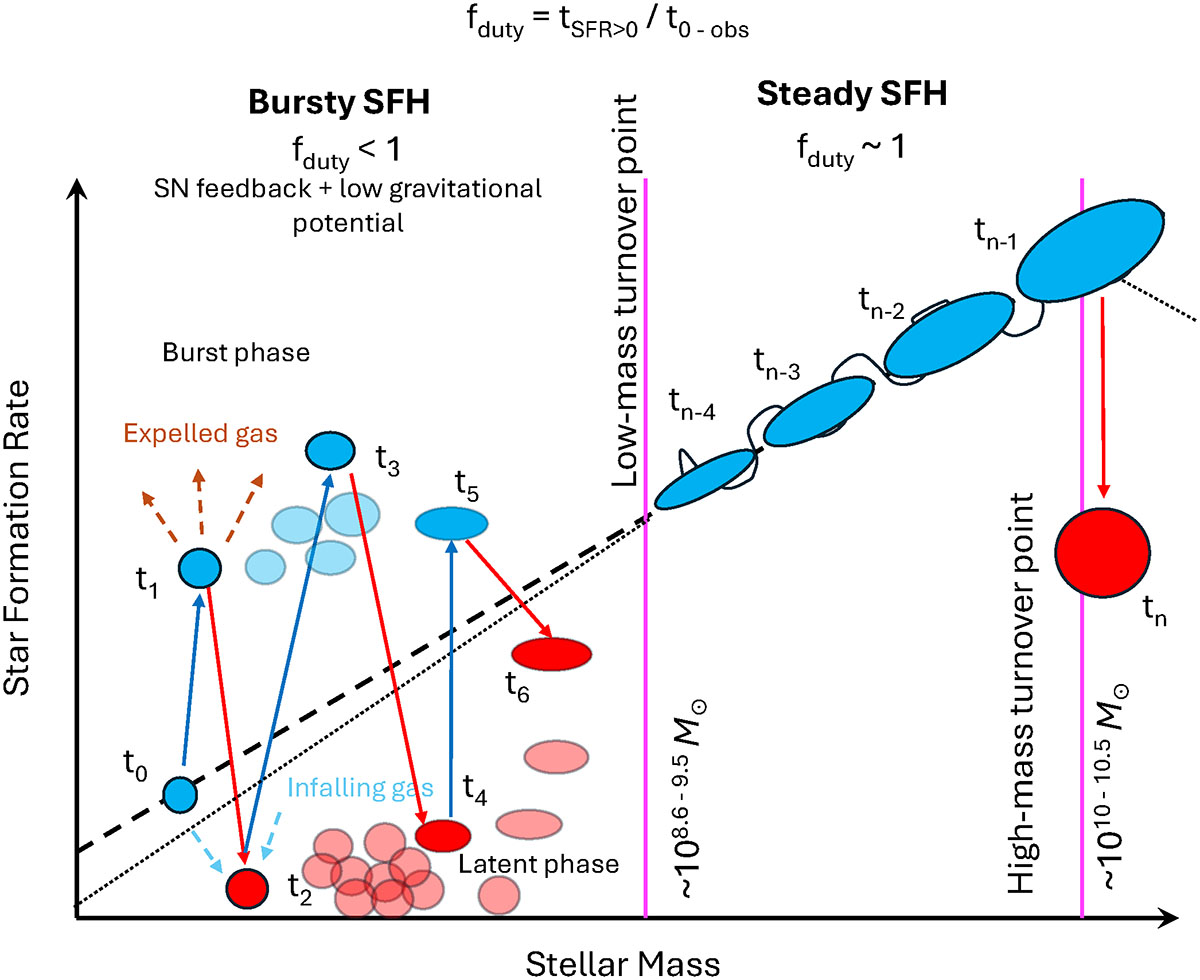
Cartoon depicting a possible evolutionary pathway of low-M★ galaxies along the main sequence. Galaxies in a burst or star-forming phase are shown with blue colors. Those in red correspond to latent or dormant phases or quiescence (the distance of these galaxies from the main sequence can be much larger). The vertical lines denote the high-M★ turnover point from the literature (see Sect. 1) and the low-M★ turnover point reported in this work, which is z-independent. We include an M★ range that covers the different values reported from the literature and our estimates. Our value should be regarded as the end of the transition from a busty stochastic SFH to the smooth accretion mode. Below the low-M★ turnover point, the star formation is mainly driven by supernova feedback that can expel the gas from the galaxy and push it to a latent phase. Infalling gas reignites star formation again in the form of a new burst. As the galaxy assembles mass, the disk starts to form, and the galaxy becomes more stable against feedback. The number of galaxies in a latent phase increases with decreasing M★, which can be reflected in a steepening of the main-sequence slope.
Current usage metrics show cumulative count of Article Views (full-text article views including HTML views, PDF and ePub downloads, according to the available data) and Abstracts Views on Vision4Press platform.
Data correspond to usage on the plateform after 2015. The current usage metrics is available 48-96 hours after online publication and is updated daily on week days.
Initial download of the metrics may take a while.