


Fig. 3
Download original image
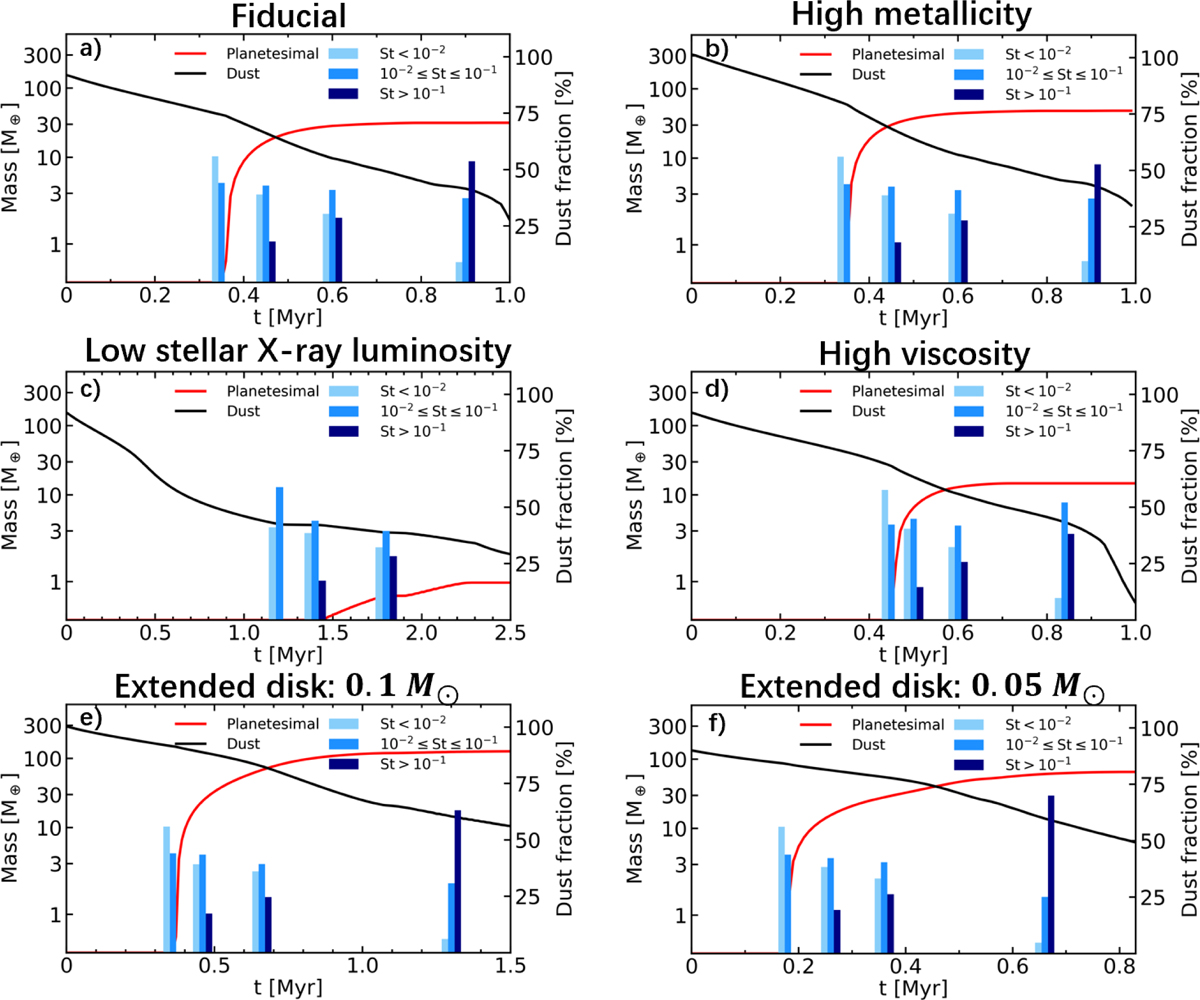
Evolution of dust mass (black lines), planetesimal mass (red lines), and dust mass fraction within the pressure bump in three Stokes number bins (light blue for St<10−2, blue for 10−2 ≤ St ≤ 10−1, and deep blue for St>10−1), across four evolutionary stages: (i) pre-cavity, (ii) cavity at 10 au, (iii) cavity at 20 au, and (iv) cavity at 100 au. These panels show how initial conditions affect dust retention and planetesimal formation: Panel a: fiducial model (Z=0.01, LX=2.6 LX, ⊙, Mdisk=0.05 M⊙, Rc=60 au, α=10−4) serves as the baseline for comparison, showing balanced dust evolution and planetesimal production across the disk. Panel b: higher metallicity (Z=0.02) facilitates the retention of dust mass, thereby promoting planetesimal formation. Panel c: decreased X-ray luminosity (from 2.6 LX, ⊙ to 1.0 LX, ⊙) diminishes dust mass and consequently impedes planetesimal formation. Panel d: higher viscosity parameters (α=10−3, δt=10−4) induce gas replenishment from the outer disk, delay cavity opening, reduce the overall dust reservoir, and thus hinder planetesimal formation. Panel e: a more massive and extended disk (Mdisk=0.1 M⊙, Rc=120 au) prolongs dust retention, thereby extending the duration of planetesimal formation. Panel f: a less massive but extended disk (Mdisk=0.05 M⊙, Rc=120 au) lowers the inner-disk dust density, causing photoevaporation to open a cavity earlier. This makes more dust retained at the onset of photoevaporative cavity, which also provides more building blocks for planetesimal formation.
Current usage metrics show cumulative count of Article Views (full-text article views including HTML views, PDF and ePub downloads, according to the available data) and Abstracts Views on Vision4Press platform.
Data correspond to usage on the plateform after 2015. The current usage metrics is available 48-96 hours after online publication and is updated daily on week days.
Initial download of the metrics may take a while.