


Fig. 7
Download original image
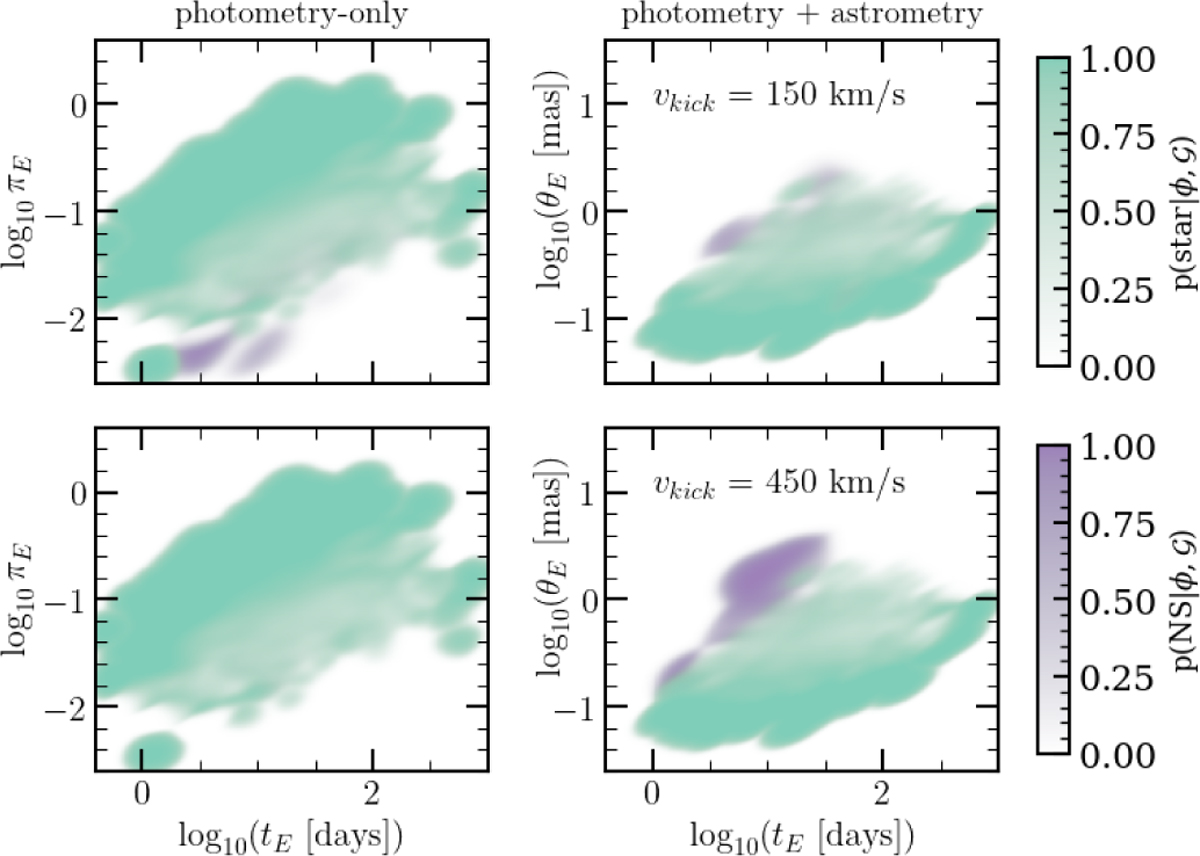
Left: relative class probabilities in log10 tE–log10 πE, i.e. the space of observables that is accessible from photometric observations alone. The probability map was constructed using all photometrically detectable events. Right: relative class probabilities in log10 tE–log10 θE, i.e. the space of observables that can be measured with high precision with the combination of photometry and astrometry. The probability map was constructed using all photometrically and astrometrically detectable events. Each relative probability map is presented for vkick = 150 km/s (top) and 450 km/s (bottom). High vkick results in a parameter distribution that is more distinguishable from other lens classes. In particular, in the log10 tE–log10 θE space, there is a region preferentially occupied by NSs, which reaches p(NS|ϕ, 𝒢) ≈ 1 and could be used for constructing optimal samples of isolated NS candidates. (For clarity, the WD and BH lens class probabilities are not plotted, as the Star class is the main source of confusion with the NS class.)
Current usage metrics show cumulative count of Article Views (full-text article views including HTML views, PDF and ePub downloads, according to the available data) and Abstracts Views on Vision4Press platform.
Data correspond to usage on the plateform after 2015. The current usage metrics is available 48-96 hours after online publication and is updated daily on week days.
Initial download of the metrics may take a while.