


| Issue |
A&A
Volume 707, March 2026
|
|
|---|---|---|
| Article Number | C2 | |
| Number of page(s) | 3 | |
| Section | Extragalactic astronomy | |
| DOI | https://doi.org/10.1051/0004-6361/202659393e | |
| Published online | 03 March 2026 | |
Multi-wavelength observations of the luminous fast blue optical transient AT 2023fhn
Up to ∼200 days post-explosion (Corrigendum)
1
European Space Agency (ESA), European Space Research and Technology Centre (ESTEC) Keplerlaan 1 2201 AZ Noordwijk, The Netherlands
2
Department of Astrophysics/IMAPP, Radboud University PO Box 9010 6500 GL Nijmegen, The Netherlands
3
Department of Physics, University of Warwick Gibbet Hill Road CV4 7AL Coventry, United Kingdom
4
Inter-University Institute for Data Intensive Astronomy, Department of Astronomy, University of Cape Town Private Bag X3 Rondebosch 7701, South Africa
5
South African Astronomical Observatory P.O. Box 9 7935 Observatory, South Africa
6
School of Natural Sciences, Institute for Advanced Study 1 Einstein Drive Princeton NJ 08540, USA
★ Corresponding author: This email address is being protected from spambots. You need JavaScript enabled to view it.
Key words: errata, addenda / stars: black holes / circumstellar matter / supernovae: general / stars: winds / outflows / supernovae: individual: AT2023fhn
ESA research fellow.
1. Revised X-ray luminosities
In the published paper, we adopted a photon index (Γ) of 2 when calculating Chandra X-ray fluxes of the luminous fast blue optical transient (LFBOT) AT2023fhn. Based on these results, we claimed that AT2023fhn was under-luminous in X-rays with respect to other LFBOTs, including the proto-typical AT2018cow (e.g. Kuin et al. 2019). When the measurements are made without fixing Γ, we obtain higher fluxes. For each epoch, we performed spectral fitting with SHERPA (Siemiginowska et al. 2024) by first modelling the background as a power law, freezing these parameters (i.e. the normalisation and photon index, Γbkg) and then modelling the spectrum at the source position as the sum of the predetermined (scaled) background and a source power law. We find that while Γ is poorly constrained (in epoch 1 we find Γbkg = 0.9 ± 0.4 and  ), this nevertheless indicates that the spectra are harder than previously assumed. The new fluxes in the 0.5–10 keV range, corrected for an X-ray absorption column density of NH = 2.6 × 1020 cm−2, are provided in Table 1. The corresponding luminosities (for a redshift z = 0.24) are shown in Fig. 1 (see also Nayana et al. 2025 and Sevilla et al. 2026, who also present new, higher fluxes), and the updated X-ray/UV ratios in Fig. 2. Given the increased luminosities, we no longer claim that AT2023fhn was sub-luminous in X-rays with respect to AT2018cow in particular. However, we note that there is still significant variation in the population (see Fig. 1).
Updated unabsorbed X-ray fluxes from the Chandra observations of AT 2023fhn (programme 24500143).
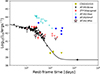 |
Fig. 1. Update to Fig. 7 of the original paper with the new X-ray measurements for AT2023fhn. |
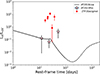 |
Fig. 2. Update to Fig. 8 of the original paper with the new X-ray measurements for AT2023fhn. |
2. DL versus Dθ in synchrotron blast-wave modelling
In the original paper we calculated the circumstellar properties of AT2023fhn based on radio observations and synchrotron blast-wave modelling following Chevalier (1998) and DeMarchi et al. (2022). These properties included the emission radius (Rp), Lorentz factor of the outflow (Γβ), wind density parameter (Ṁ/Vw), electron density (ne), internal magnetic field (B), and internal energy of the shock (U). In these calculations, we erroneously used the angular diameter distance (Dθ). It has become clear that the correct distance to use in these calculations is the luminosity distance (DL; see also Sevilla et al. 2026) because the parameter estimation ultimately depends on luminosities (i.e. no angular extent is being directly measured). In the case of AT2023fhn at z = 0.24, Dθ = 780 Mpc and DL = 1200 Mpc (for a flat Λ cold dark matter cosmology with Ωm = 0.3 and ΩΛ = 0.7). We provide updated versions of Table 7 and Figs. 10 and 11 of the original paper in Table 2 and Figs. 3 and 4, where DL has been used instead. The derived parameter values do not change so much that our conclusions are affected, but we note that making the same error at higher redshifts would be more consequential.
Update to Table 7 of the original paper using DL for the parameter calculations rather than Dθ.
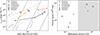 |
Fig. 3. Update to Fig. 10 of the original paper using DL rather than Dθ for the parameter estimation of AT2023fhn. |
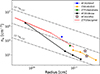 |
Fig. 4. Update to Fig. 10 of the original paper using DL rather than Dθ for the parameter estimation of AT2023fhn. |
Acknowledgments
The authors thank Raffaella Margutti and Ben Margalit for bringing these points to our attention.
References
- Chevalier, R. A. 1998, ApJ, 499, 810 [NASA ADS] [CrossRef] [Google Scholar]
- DeMarchi, L., Margutti, R., Dittman, J., et al. 2022, ApJ, 938, 84 [NASA ADS] [CrossRef] [Google Scholar]
- Kuin, N. P. M., Wu, K., Oates, S., et al. 2019, MNRAS, 487, 2505 [NASA ADS] [CrossRef] [Google Scholar]
- Nayana, A. J., Margutti, R., Wiston, E., et al. 2025, ApJ, 993, L6 [Google Scholar]
- Sevilla, C., Ho, A. Y. Q., Nayana, A. J., et al. 2026, ArXiv e-prints [arXiv:2601.18926] [Google Scholar]
- Siemiginowska, A., Burke, D., Günther, H. M., et al. 2024, ApJS, 274, 43 [Google Scholar]
© The Authors 2026
 Open Access article, published by EDP Sciences, under the terms of the Creative Commons Attribution License (http://creativecommons.org/licenses/by/4.0), which permits unrestricted use, distribution, and reproduction in any medium, provided the original work is properly cited.
All Tables
Updated unabsorbed X-ray fluxes from the Chandra observations of AT 2023fhn (programme 24500143).
Update to Table 7 of the original paper using DL for the parameter calculations rather than Dθ.
All Figures
|
Fig. 1. Update to Fig. 7 of the original paper with the new X-ray measurements for AT2023fhn. |
| In the text | |
|
Fig. 2. Update to Fig. 8 of the original paper with the new X-ray measurements for AT2023fhn. |
| In the text | |
|
Fig. 3. Update to Fig. 10 of the original paper using DL rather than Dθ for the parameter estimation of AT2023fhn. |
| In the text | |
|
Fig. 4. Update to Fig. 10 of the original paper using DL rather than Dθ for the parameter estimation of AT2023fhn. |
| In the text | |
Current usage metrics show cumulative count of Article Views (full-text article views including HTML views, PDF and ePub downloads, according to the available data) and Abstracts Views on Vision4Press platform.
Data correspond to usage on the plateform after 2015. The current usage metrics is available 48-96 hours after online publication and is updated daily on week days.
Initial download of the metrics may take a while.