


Fig. 2
Download original image
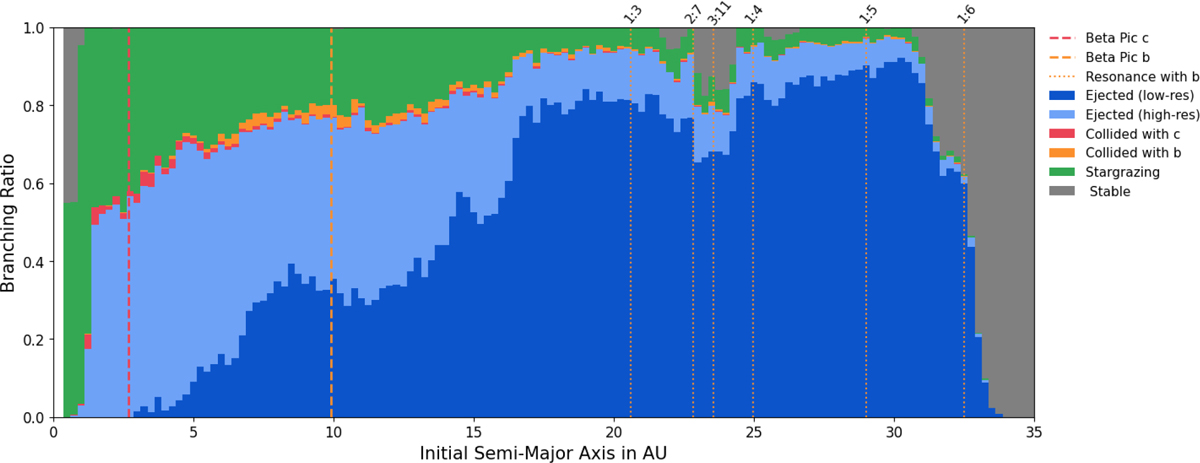
Branching ratios of the entire initial particle population, up to 35 AU after running the simulation (see our methods in Sect. 2) for 25 million years. Throughout the system, the majority of particles are ejected (blue) up to a distance of ∼35 AU, beyond which particles are stable over the system’s lifetime. Particles that are ejected without attaining an orbit that passes within the 3 AU limit (i.e. they are only ever simulated using the lower resolution time step before being ejected) are shown in dark blue. However, many particles from the outer system pass within the 3 AU boundary and are also simulated using the high-resolution time step before being ejected (light blue). All particles initiated on orbital distance smaller than 3 AU are always simulated in high-resolution and, thus, also shown in light blue if ejected. A significant number of particles approach the star to within 0.4 AU, which we classify as star-grazers (green). A small number of particles collides with either of the planets. This figure is comparable with the simulation output of Rodet & Lai (2024, their Fig. 19).
Current usage metrics show cumulative count of Article Views (full-text article views including HTML views, PDF and ePub downloads, according to the available data) and Abstracts Views on Vision4Press platform.
Data correspond to usage on the plateform after 2015. The current usage metrics is available 48-96 hours after online publication and is updated daily on week days.
Initial download of the metrics may take a while.