


Fig. 4.
Download original image
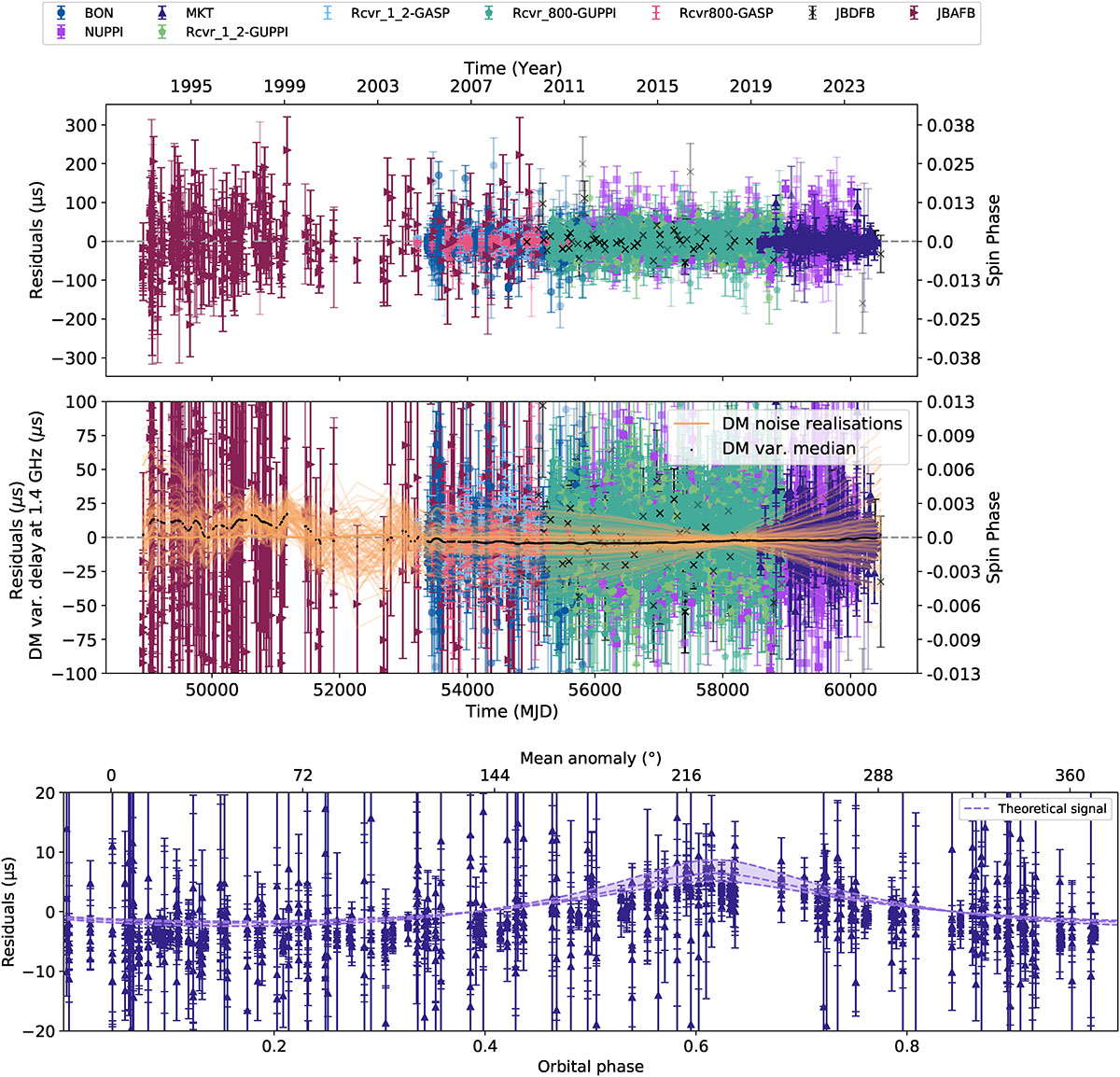
Timing residuals across epochs (top, middle) and orbital phase (bottom). Top: We obtain a weighted rms of 3.201 μs after applying the best-fit values using the T2 timing and noise model described in Sect. 4. Middle: Post-fit timing residuals without subtracting the DM noise model. The time domain realisations of the 100 parameter DM noise model are overlaid as orange lines and the black dots show the median across all the DM model realisations at each ToA. Bottom: MeerKAT residuals as a function of orbital phase, where the orbital phase is measured from the longitude of periastron (ω = 223.47°). Superior conjunction = Tasc + 90°, occurs at orbital phase = 0.63. A Shapiro delay signal is discernible at orbital phase 0.63 when setting Mc = 0 while keeping all other parameters fixed. We overplot the expected theoretical signal based on the best-fit inclination and companion mass values of the full dataset in purple. The line width indicates the 1σ deviations in companion mass and inclination angle.
Current usage metrics show cumulative count of Article Views (full-text article views including HTML views, PDF and ePub downloads, according to the available data) and Abstracts Views on Vision4Press platform.
Data correspond to usage on the plateform after 2015. The current usage metrics is available 48-96 hours after online publication and is updated daily on week days.
Initial download of the metrics may take a while.