


Fig. 2
Download original image
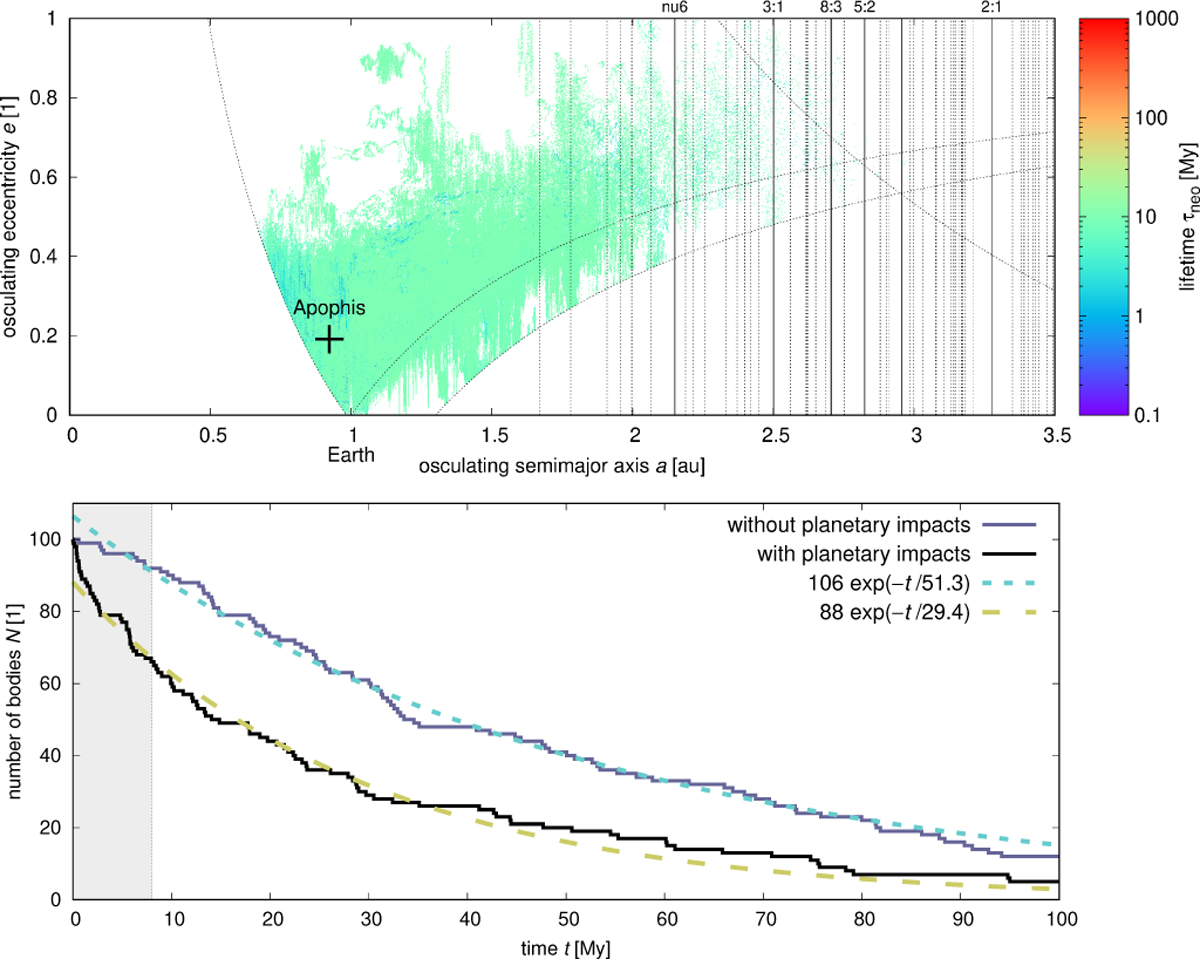
Top: osculating semimajor axis a vs. eccentricity e showing long-term evolution of Apophis-like orbits, after 10Myr. The curves correspond to the boundaries of the NEO space (q < 1.3 au, Q > 0.983 au) and of the adjacent Mars-crossing population. The dotted vertical lines correspond to locations of various mean-motion resonances, including the ν6 secular resonance. The majority of the 100 clones of Apophis remain in the NEO (or Mars-crossing) space; the respective orbit is relatively long-lived. Bottom: number of Apophis clones N vs. time t. The corresponding e-folding timescale is -30 Myr or 50 Myr, respectively, depending on whether or not planetary impacts were used as a criterion for the removal of bodies.
Current usage metrics show cumulative count of Article Views (full-text article views including HTML views, PDF and ePub downloads, according to the available data) and Abstracts Views on Vision4Press platform.
Data correspond to usage on the plateform after 2015. The current usage metrics is available 48-96 hours after online publication and is updated daily on week days.
Initial download of the metrics may take a while.