


Fig. 2.
Download original image
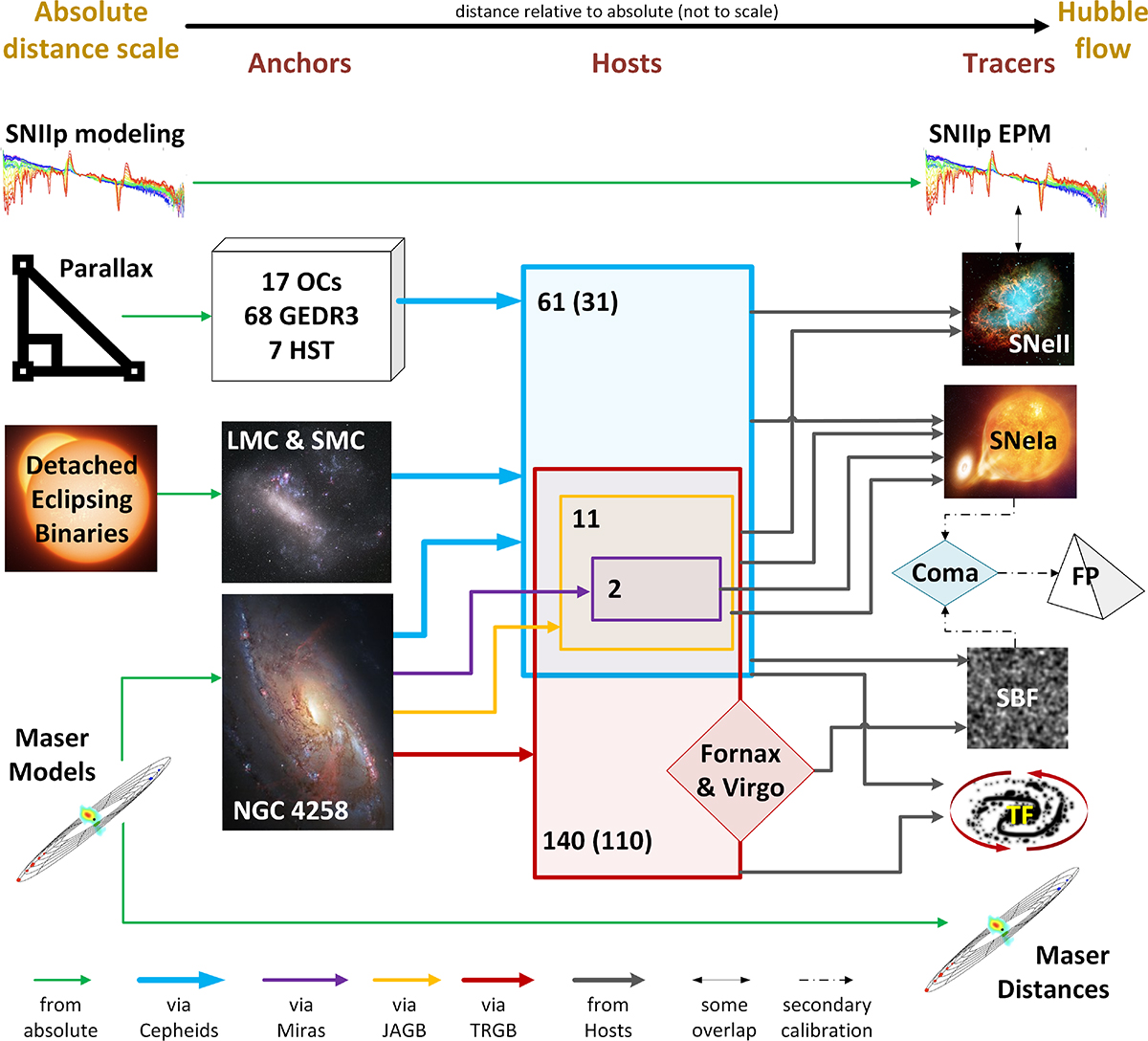
Complete Distance Network, with all possible pathways illustrated. Anchors are objects that establish an absolute scale based on the methods shown to their left. The primary distance indicators (Cepheids, TRGB, Miras, and JAGB) transfer the absolute scale to hosts (i.e., galaxies), the ensemble of which calibrates secondary distance indicators in the Hubble flow (tracers). Exceptions are Megamasers and astrophysically modeled SNe II, both of which serve as primary distance indicators and are capable of reaching the Hubble flow without intermediate steps. Green arrows illustrate direct connections between anchors or tracers and the method used to determine the absolute scale. Blue, violet, yellow, and red arrows show which calibrators constrain host distances; line width qualitatively distinguishes the attainable precision. Among hosts, rectangles qualitatively indicate overlap among objects measured via multiple methods. Diamond shapes represent groups. Dark gray arrows tie subsets of hosts whose distance is constrained by different calibrators to tracers. Any given arrow may represent multiple datasets, for example, HST or JWST photometry of Cepheids or optical versus infrared photometry of SNe Ia. The number of hosts is labeled for Cepheids, TRGB, JAGB, and Miras, with the number of hosts exclusively available to each method shown in parentheses.
Current usage metrics show cumulative count of Article Views (full-text article views including HTML views, PDF and ePub downloads, according to the available data) and Abstracts Views on Vision4Press platform.
Data correspond to usage on the plateform after 2015. The current usage metrics is available 48-96 hours after online publication and is updated daily on week days.
Initial download of the metrics may take a while.