


Fig. 1
Download original image
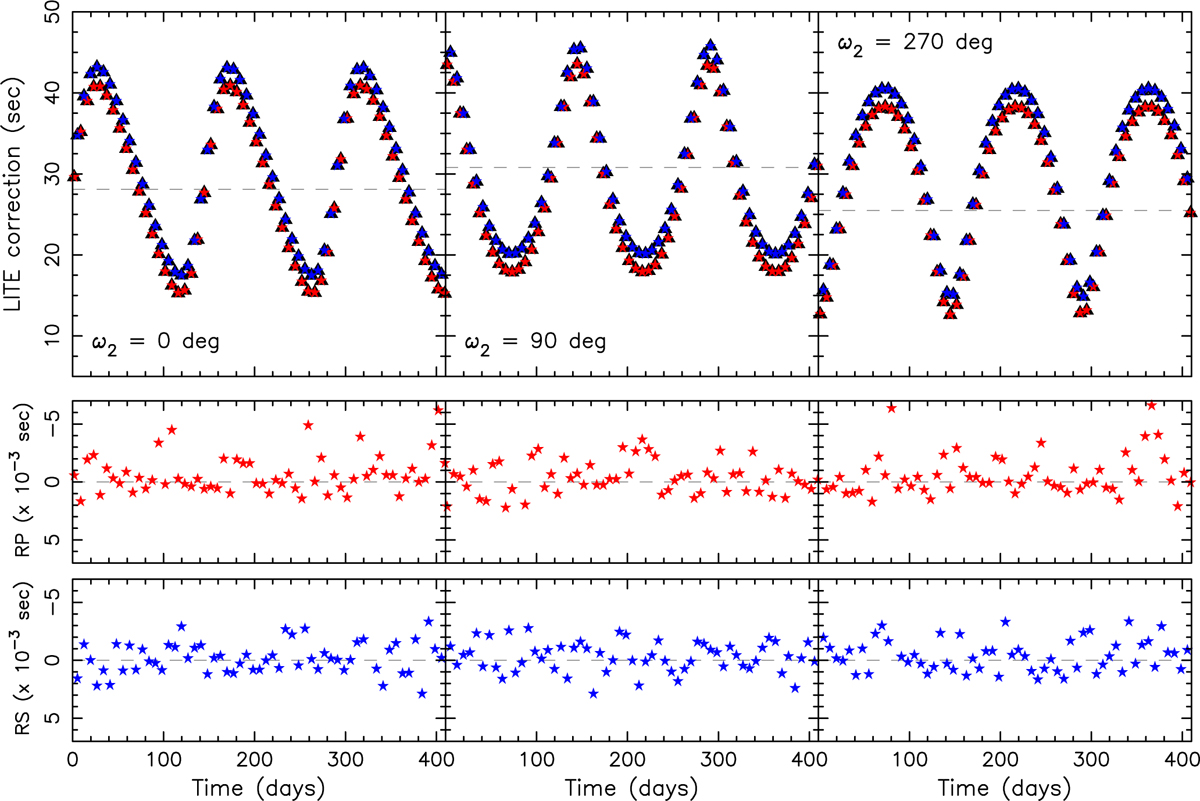
Upper panels: LITE correction due to finite light travel time in the binary system: black triangles are from our analytical model (e.g.,  and
and  from Eqs. (11) and (13) for primary eclipses), red and blue stars from direct numerical integration of light travel through the system (primary and secondary eclipses). We used parameters of a well constrained multiple system ξ Tauri (e.g., Nemravová et al. 2016) that harbors inner triple system with a distant fourth component (for sake of simplicity the effect of the fourth star was neglected in this example). The triple system is near coplanar with inclination i ≃ 87◦, inner and outer periods P1 = 7.146 d and P2 = 146 d, eccentricities e1 = 0 and e2 = 0.2. The results are shown for three different values of the argument of pericenter of the outer orbit, ω2 = 0 (left panel), ω2 = π/2 (middle panel), and ω2 = 3π/2 (right panel; the present value is ≃10◦ and precesses with a rate ˙ω2 ≃ 2◦ yr−1 due to interaction with the eclipsing binary). The masses are m0 = 2.23 M⊙, m1 = 2 M⊙ and m2 = 3.74 M⊙. Time at abscissa in days covers three revolutions of the outer orbit, LITE on the ordinate in seconds. The mean value of the correction ≃a1/(2c) would combine with the second term on the right hand side of Eq. (9) to be near zero. The P2-periodic variation with an amplitude of ≃15 s is significant and exceeds uncertainty of the TESS photometry. Middle and lower panels: the residuals between the exact numerical simulation and our analytic formulation are shown for primary eclipses by red stars in the middle panel and secondary eclipses by blue stars in the lower panel. Their average value is zero and no signal above ≃0.005 seconds (namely 0.03% of the LITE correction) is observed.
Current usage metrics show cumulative count of Article Views (full-text article views including HTML views, PDF and ePub downloads, according to the available data) and Abstracts Views on Vision4Press platform.
Data correspond to usage on the plateform after 2015. The current usage metrics is available 48-96 hours after online publication and is updated daily on week days.
Initial download of the metrics may take a while.