


Fig. 9
Download original image
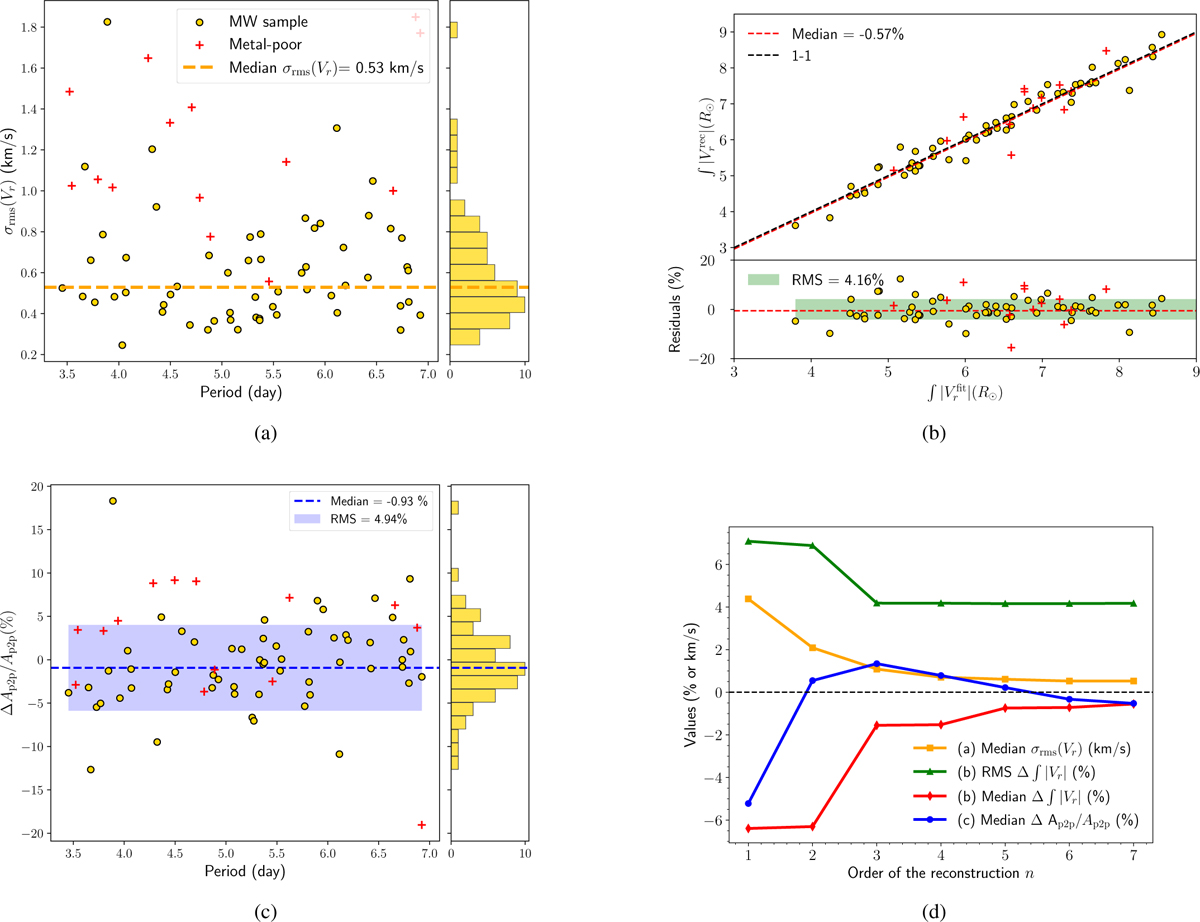
Internal accuracy of reconstructed RV curves for calibrating Cepheids and for metal-poor Cepheids (yellow circles and red crosses, respectively). (a) Reconstruction residuals, σrms(Vr), for individual stars, as defined by Eq. (8). The dashed orange line indicates the median of the residuals for the calibrating sample. (b) Comparison of absolute integrated RV curves, as defined in Eq. (9). In the lower panel, we plot the differences between the two values. The dashed red line indicates the median of the differences, with the shaded green area marking their RMS. (c) Relative peak-to-peak amplitude difference between the reconstructed RV curves and true RV curves (Fourier fits), as defined in Eq. (10). The dashed blue line indicates the median value for the calibrating sample. (d) Accuracy of the RV curve reconstruction for Cepheids of the calibrating sample, versus the Fourier order (see also Table 2). The different lines represent the four previously discussed measures of accuracy, plotted with the same colours as in Figs. 9a–c (see Sect. 5.3).
Current usage metrics show cumulative count of Article Views (full-text article views including HTML views, PDF and ePub downloads, according to the available data) and Abstracts Views on Vision4Press platform.
Data correspond to usage on the plateform after 2015. The current usage metrics is available 48-96 hours after online publication and is updated daily on week days.
Initial download of the metrics may take a while.