


| Issue |
A&A
Volume 709, May 2026
|
|
|---|---|---|
| Article Number | A167 | |
| Number of page(s) | 5 | |
| Section | Stellar structure and evolution | |
| DOI | https://doi.org/10.1051/0004-6361/202659678 | |
| Published online | 13 May 2026 | |
The Be star o Cas is indeed the primary of a triple system
1
Astronomical Institute of Charles University, Faculty of Mathematics and Physics, V Holešovičkách 2, CZ-180 00 Praha 8, Troja, Czech Republic
2
Department of Physics and Astronomy, University of Victoria, P.O. Box 1700, STN CSC, Victoria, BC V8W 2Y2, Canada
3
Astronomical Institute, Czech Academy of Sciences, CZ-251 65 Ondřejov, Czech Republic
4
Vanderbilt University, Nashville, Tennessee, USA
5
Observatório Astronómico do Centro de Informação Geoespacial do Exército, Lisboa, Portugal
6
Faculty of Mathematics and Physics, Charles University, Prague, Czech Republic
★ Corresponding author: This email address is being protected from spambots. You need JavaScript enabled to view it.
Received:
3
March
2026
Accepted:
15
April
2026
Abstract
Analysis of radial velocities of two narrow absorption components in the Mg II 4481 Å line demonstrated that the secondary of the Be star o Cas is indeed a close binary system composed of two B7 stars orbiting each other with a period of 11.″6604. Orbital solutions and spectral disentangling lead to consistent system properties. The system is extremely important for the research of Be stars since its future interferometric observations with a high spatial resolution could allow the mass and perhaps even the radius of a Be star to be derived without too many model assumptions, mainly on the dynamical grounds.
Key words: binaries: spectroscopic / stars: emission-line / Be / stars: fundamental parameters / stars: individual: o Cas
© The Authors 2026
 Open Access article, published by EDP Sciences, under the terms of the Creative Commons Attribution License (https://creativecommons.org/licenses/by/4.0), which permits unrestricted use, distribution, and reproduction in any medium, provided the original work is properly cited.
This article is published in open access under the Subscribe to Open model. This email address is being protected from spambots. You need JavaScript enabled to view it. to support open access publication.
1. Introduction
The B2V – B5III-IVe star o Cas (22 Cas, HD 4180, BD+47°183, MWC 8, HIP 3504) is the brighter component of a wide visual system WDS J00447+4817, which exhibits few or no signs of orbital motion. Component B is an  F8 star BD+47°183B at recorded separations ranging from
  to
to  . Abt & Levy (1978) concluded that o Cas is a single-line spectroscopic binary with a period of 1033 days and a nearly circular orbit. Although this conclusion was questioned in some studies, the existence of such a pair was ultimately confirmed; see Koubský et al. (2010) and references therein. The orbit is circular with a period of
  and a remarkably large semi-amplitude of more than 20 km s−1. This represents a problem, since for the inclination of the orbit derived from interferometry, the companion to the Be primary should be the more massive of the two. However, there is no trace of it in the optical spectra. To explain this puzzle, Koubský et al. (2010) tentatively suggested that the companion could actually be a close binary composed of two A stars. Inspired by this suggestion, Grundstrom (2007) carefully inspected the Kitt Peak National Observatory (KPNO) blue spectra at her disposal and discovered two weak and narrow absorption lines in the core of the broad Mg II 4481 Å line, which had been changing their positions on a timescale of days, perhaps with about a four-day period.
Since no further studies of this possible binary appeared, this prompted us to combine our efforts, obtain new spectra, and analyse them in an effort to prove the existence of such a close binary and to derive its orbital elements.
2. Spectroscopic data and their reductions
Throughout this paper, we shall use the dates of observations expressed in the ‘reduced heliocentric Julian date’ (RJD) defined as

Inspecting the Ondřejov (OND) and the Dominion Astrophysical Observatory (DAO) data archive, we actually found several pre-discovery blue spectra of o Cas. New electronic spectra were obtained at KPNO, DAO, OND, and Lisbon. We also used 22 amateur spectra from the BeSS database (Neiner et al. 2011) having a spectral resolution of 10000 or better. The journal of all spectroscopic observations used here is in Table 1.
Journal of blue electronic spectra of o Cas.
The initial reduction of all spectra (bias subtraction, flatfielding, and creation of 1D frames) was carried out with the pipelines used in individual observatories. Further reduction (spectra normalisation, cleaning from cosmics and flaws, and radial-velocity (RV) measurements) were carried out in the programme reSPEFO 2. This programme is written in JAVA and can run on different platforms (Linux, Windows, MacOS). It is being developed by Adam Harmanec. It can, among other things, import spectra that were originally reduced in SPEFO (Horn et al. 1996; Krpata 2008) and treat spectra stored as FITS files. For the DAO spectra, it also provides wavelength calibration. The programme is described in more detail in Appendix A.
A prediscovery series of Mg II line profiles is shown in Fig. 1 and two examples of the blue spectra that we have are in Fig. 2.
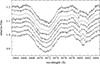 |
Fig. 1. A pre-discovery series of one OND and seven DAO spectra in the neighbourhood of the He I 4471.508 and Mg II 4481.228 Å from September 2003. From top to bottom the RJDs of the spectra are 52909.9993, 52910.0102, ...10.4959 (OND), ...10.6240, ...10.9934, 52911.6137, ...11.7928, and ...11.9786. A smooth change in the position of the two narrow Mg II lines in time is clearly seen. |
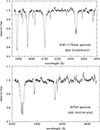 |
Fig. 2. Examples of some blue spectra at our disposal. |
3. The inner orbit
In spite of the fact that we managed to accumulate 85 higher-resolution spectra with the Mg II 4481.228 Å sharp lines well visible (out of the total number of 137 spectra listed in Table 1), finding the true orbital period of the inner orbit was all but easy. The two weak and narrow lines are rather similar to each other and it is easy to misinterpret one for another. Another complication arises from the fact that the whole binary moves with the Be tertiary in the 1032 d orbit with a non-negligible semi-amplitude of about 20 km s−1. It was necessary to obtain spectral series covering several consecutive days to see the relative motion of the two components in continuous time sequences. Three limited series of spectra obtained within about a week of consecutive observations were obtained. Their RVs for (seemingly) stronger and weaker components of narrow Mg II lines were plotted versus time in the three panels of Fig. 3. After a number of trials for period searches, separately for the RVs of the stronger and fainter components, using a programme based on the Deeming (1975) period search technique, we concluded that the most probable orbital period of the inner system is close to  . Then we used the programme FOTEL (Hadrava 1990, 2004a), which is able to derive orbital solutions for triple systems. In our case, we kept the orbital elements of the outer
  orbit fixed at values obtained by Koubský et al. (2010) from a very long series of observations. After properly identifying the primary and secondary components, we finally arrived at a very satisfactory solution presented in Table 2. The phase plots of all well-resolved RVs measured in reSPEFO through a comparison of direct and flipped line-profile images are in Fig. 4.
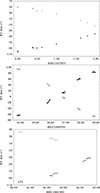 |
Fig. 3. Comparison of the RVs of the two narrow components of the Mg II 4481.228 Å line for three available time segments. The RVs of the primary and secondary are shown by black dots and open circles, respectively. |
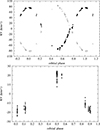 |
Fig. 4. Top: RV curves of the narrow Mg II lines for the period of |


Orbital elements based on reSPEFO RVs of the two narrow Mg II 4481 Å lines and a FOTEL triple-star solution.
To confirm the result, we then used all 137 available spectra to disentangle them with the programme KOREL (Hadrava 1995, 1997, 2004b). The resulting orbital elements are also listed in Table 2 and the disentangled line profiles of all three stars are shown in Fig. 5. The referee called our attention to the fact that the disentangled Mg II line profile of the Be primary seems to have a small central peak, reminiscent of central quasi-emission peaks found for several Be stars seen roughly equator-on (see Rivinius et al. 1999, and references therein). Although we agree that this possibility deserves further investigation with high-quality spectra, for the moment we conclude that the effect is only an artefact of the disentangling process. The same feature is not seen in the neighbouring stronger He I line, and we have verified that it is absent if we disentangle only the high-resolution spectra.
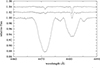 |
Fig. 5. The disentangled line profiles of the He I 4471 Å, and Mg II 4481 Å line for the three components of the triple system. All profiles are normalised to the joint continuum of the whole system and the profiles of the primary and secondary of the |

4. Probable properties of the triple system
Obviously unaware of the Koubský et al. (2010) study, Videla et al. (2022) and Anguita-Aguero et al. (2023) attempted to estimate the masses of the wide  binary system o Cas using Bayesian inference. Videla et al. (2022) estimated the mass of the Be primary as (5.62 ± 1.19) M⊙ while Anguita-Aguero et al. (2023) derived masses as 5.77 and 4.66 M⊙, however with huge errors.
Our study allows us to provide more realistic estimates of the basic physical properties of the system and its components. Based on the KOREL solution of Table 2 and assuming that the inner system is observed under the same orbital inclination of 65° as that estimated from interferometry for the outer system, we obtain the masses of the components of the inner binary, 3.37 M⊙ and 3.26 M⊙, therefore the total mass of the inner binary is 6.63 M⊙. From the solution for the outer system, we obtain the total mass of the inner binary as 6.73 M⊙, the mass of the distant Be component being 6.07 M⊙. These two results are in very good agreement. We note that according to the tabulation of normal masses by Harmanec (1988) the two components of the inner binary are probably B7 stars, while the Be component would correspond to a normal star of spectral type B3, in accordance with available spectral classifications. We wish to point out that o Cas is an astrophysically unique and very important system. Its future interferometric observations with a high spatial resolution should permit the first determination of the precise mass of a Be star based solely on the dynamical considerations, without the use of any statistical relations between the spectral type and stellar properties. A very favourable circumstance is also the relatively short outer orbit, with semi-amplitudes of the orbital motion of about 20 km s−1, which guarantee good accuracy of mass determination.
It is true that dynamically determined masses of several Be stars in binaries and/or multiple systems have already been published; see, for example Klement et al. (2022) and references therein. However, some of these estimates depend either on distance estimates or on less certain RV curves of compact companions detected in the far-UV spectra.
We are aware of only the following few triple systems containing a Be star; all are much less favourable for accurate mass determination than o Cas. For V2048 Oph = 66 Oph, an inner binary rather similar to o Cas, composed of two late B or early A stars orbiting each other with a period of  , was found by Štefl et al. (2004). However, the outer orbit of this binary with the Be primary is very long,
  according to Hutter et al. (2021), and not very favourable for mass determination. Another triple system, ν Gem = HD 45542 (Klement et al. 2021) consists of two stars orbiting with a period of
  and a distant Be star with a long outer orbit of about 7000 d. The Hα emission of the Be star is rather weak, and the RV curve of the Be star was thus derived from the RV of the Hα shell absorption line, which does not need to return the true RV amplitude. V1371 Tau = HD 36665 (Rocha et al. 2026) consists of three early B stars. Two of them form a peculiar eccentric-orbit eclipsing binary with a period of
  and the third body is a Be star in uncertain ∼11 yr period. There is a suspicion of secular change of the orbital inclination of the inner eclipsing binary, and there are also rapid light changes present in the system. A well-known B6e star o And = HD 217675 is in a wide orbit of a still uncertain period of several years with two sharp-lined stars, which revolve around each other with a
  period (Hill et al. 1988; Zhuchkov et al. 2010).
In passing, we note that similar triple or even multiple systems represent an interesting challenge to the theory of their evolutionary history. In addition to o Cas and the systems discussed above, one can also mention the compact triple system ξ Tau (Nemravová et al. 2016), with a rapidly rotating B star, not known to have Balmer emission.
Acknowledgments
We gratefully acknowledge the use of the latest publicly available versions of the programmes FOTEL and KOREL written by P. Hadrava. We thank Marek Skarka who obtained two of the OND OES spectra in service mode for us. Several constructive suggestions by an anonymous referee helped to improve the paper and are gratefully acknowledged. Based on spectroscopic CCD observations obtained at the Dominion Astrophysical Observatory, Herzberg Astronomy and Astrophysics Research Centre, National Research Council of Canada, on new and archival spectroscopic observations obtained with the Heros echelle spectrograph, linear CCD coudé-focus spectrograph, and Ondřejov echelle spectrograph, all three attached to the 2.0 m reflector of the Astronomical Institute of Czech Academy of Sciences, on CCD spectra from the coudé feed spectrograph attached to the Kitt Peak 0.9 m reflector, on CCD spectra from Lisbon 0.356 m reflector, and on amateur echelle spectra from the BeSS database, operated at LESIA, Observatoire de Meudon, France: http://basebe.obspm.fr. The collection of spectra was supported by the grants 205/06/0304, 205/08/H005, P209/10/0715, and GA15-02112S of the Czech Science Foundation. Finally, we acknowledge the use of the electronic database from the CDS, Strasbourg, and the electronic bibliography maintained by the NASA/ADS system.
References
- Abt, H. A., & Levy, S. G. 1978, ApJS, 36, 241 [Google Scholar]
- Anguita-Aguero, J., Mendez, R. A., Videla, M., et al. 2023, AJ, 166, 172 [Google Scholar]
- Deeming, T. J. 1975, Ap&SS, 36, 137 [Google Scholar]
- Grundstrom, E. D. 2007, Ph.D. Thesis, Georgia State University [Google Scholar]
- Hadrava, P. 1990, Contrib. Astron. Obs. Skaln. Pleso, 20, 23 [Google Scholar]
- Hadrava, P. 1995, A&AS, 114, 393 [NASA ADS] [Google Scholar]
- Hadrava, P. 1997, A&AS, 122, 581 [NASA ADS] [CrossRef] [EDP Sciences] [Google Scholar]
- Hadrava, P. 2004a, Publ. Astron. Inst. Acad. Sci. Czech Rep., 92, 1 [Google Scholar]
- Hadrava, P. 2004b, Publ. Astron. Inst. Acad. Sci. Czech Rep., 92, 15 [Google Scholar]
- Harmanec, P. 1988, Bull. Astron. Inst. Czech., 39, 329 [NASA ADS] [Google Scholar]
- Harmanec, P., Lipták, J., Koubský, P., et al. 2020, A&A, 639, A32 [EDP Sciences] [Google Scholar]
- Hill, G. M., Walker, G. A. H., Dinshaw, N., Yang, S., & Harmanec, P. 1988, PASP, 100, 243 [Google Scholar]
- Horn, J., Kubát, J., Harmanec, P., et al. 1996, A&A, 309, 521 [NASA ADS] [Google Scholar]
- Hutter, D. J., Tycner, C., Zavala, R. T., et al. 2021, ApJS, 257, 69 [NASA ADS] [CrossRef] [Google Scholar]
- Kaufer, A. 1988, Rev. Mod. Astrophys., 11, 177 [Google Scholar]
- Klement, R., Hadrava, P., Rivinius, T., et al. 2021, ApJ, 916, 24 [NASA ADS] [CrossRef] [Google Scholar]
- Klement, R., Baade, D., Rivinius, T., et al. 2022, ApJ, 940, 86 [NASA ADS] [CrossRef] [Google Scholar]
- Koubský, P., Hummel, C. A., Harmanec, P., et al. 2010, A&A, 517, A24 [NASA ADS] [CrossRef] [EDP Sciences] [Google Scholar]
- Krpata, J. 2008, http://astro.troja.mff.cuni.cz/ftp/hec/SPEFO [Google Scholar]
- Neiner, C., de Batz, B., Cochard, F., et al. 2011, AJ, 142, 149 [Google Scholar]
- Nemravová, J. A., Harmanec, P., Brož, M., et al. 2016, A&A, 594, A55 [Google Scholar]
- Rivinius, T., Štefl, S., & Baade, D. 1999, A&A, 348, 831 [NASA ADS] [Google Scholar]
- Rocha, D. F., Emilio, M., Labadie-Bartz, J., et al. 2026, ApJ, 996, 61 [Google Scholar]
- Štefl, S., Hadrava, P., Baade, D., et al. 2004, IAU Symp., 215, 166 [Google Scholar]
- Videla, M., Mendez, R. A., Clavería, R. M., Silva, J. F., & Orchard, M. E. 2022, AJ, 163, 220 [NASA ADS] [CrossRef] [Google Scholar]
- Wolf, M., Harmanec, P., Božić, H., et al. 2021, A&A, 647, A97 [NASA ADS] [CrossRef] [EDP Sciences] [Google Scholar]
- Zhuchkov, R. Y., Malogolovets, E. V., Kiyaeva, O. V., et al. 2010, Astron. Rep., 54, 1134 [Google Scholar]
Appendix A: Program reSPEFO for the reductions and measurements of 1D electronic spectra
Program reSPEFO, written in Java by Adam Harmanec, is a modern replacement for the original SPEFO program developed in Pascal by the late Jiří Horn (Horn et al. 1996). It runs on different platforms (Unix, Windows, macOS) and provides a comprehensive environment for one-dimensional spectral analysis. reSPEFO operates primarily on 1D spectra produced by standard observatory pipelines. For the majority of observatories, the spectra in 1D frames are already stored as pairs of wavelength and relative flux, typically in FITS format. The program converts imported data into an internal .spf format, which preserves raw data, metadata, preprocessing steps, and measurement results, allowing workflows to be revisited without repeating earlier steps. Besides spectra recorded in the standard FITS format, the current version 2 of reSPEFO can process spectra from the CHIRON echelle spectrograph from CTIO, spectra from the BeSS database, FEROS echelle spectra, spectra from the Hercules echelle spectrograph, and also spectra from the DAO, for which it can also derive the wavelength scale from measurements of comparison ThAr or FeAr spectra. It is also able to import spectra reduced earlier with the original SPEFO as well as plain ASCII files recorded as wavelength - relative flux pairs.
The usual sequence of reduction steps is to define the project, import the spectra, rectify them, clean them of cosmics and residual flaws not removed by standard observatory pipelines, and measure RVs and spectrophotometric quantities of selected spectral lines. The tracing paper method of RV measurement allows flexible settings on different parts of more complicated line profiles in spectra from several components of a multiple stellar system. For red and infrared spectra, it is also possible to measure a selection of telluric lines to apply small additional corrections to the zero point to bring spectra from different instruments onto a common wavelength scale. The tracing paper method is illustrated in Appendix C of the paper by Harmanec et al. (2020) and its practical realisation in the program reSPEFO is described in detail in Sect. 3.1 of the paper by Wolf et al. (2021).
Version 2 of the program, together with a detailed documentation and user manual can be downloaded at https://astro.troja.mff.cuni.cz/projects/respefo, separately for Unix, Windows, and macOS operating systems.
The software is distributed under the EPL 2.0 license and remains under active development.
All Tables
Orbital elements based on reSPEFO RVs of the two narrow Mg II 4481 Å lines and a FOTEL triple-star solution.
All Figures
|
Fig. 1. A pre-discovery series of one OND and seven DAO spectra in the neighbourhood of the He I 4471.508 and Mg II 4481.228 Å from September 2003. From top to bottom the RJDs of the spectra are 52909.9993, 52910.0102, ...10.4959 (OND), ...10.6240, ...10.9934, 52911.6137, ...11.7928, and ...11.9786. A smooth change in the position of the two narrow Mg II lines in time is clearly seen. |
| In the text | |
|
Fig. 2. Examples of some blue spectra at our disposal. |
| In the text | |
|
Fig. 3. Comparison of the RVs of the two narrow components of the Mg II 4481.228 Å line for three available time segments. The RVs of the primary and secondary are shown by black dots and open circles, respectively. |
| In the text | |
|
Fig. 4. Top: RV curves of the narrow Mg II lines for the period of |
| In the text | |
|
Fig. 5. The disentangled line profiles of the He I 4471 Å, and Mg II 4481 Å line for the three components of the triple system. All profiles are normalised to the joint continuum of the whole system and the profiles of the primary and secondary of the |
| In the text | |
Current usage metrics show cumulative count of Article Views (full-text article views including HTML views, PDF and ePub downloads, according to the available data) and Abstracts Views on Vision4Press platform.
Data correspond to usage on the plateform after 2015. The current usage metrics is available 48-96 hours after online publication and is updated daily on week days.
Initial download of the metrics may take a while.