


Fig. 6.
Download original image
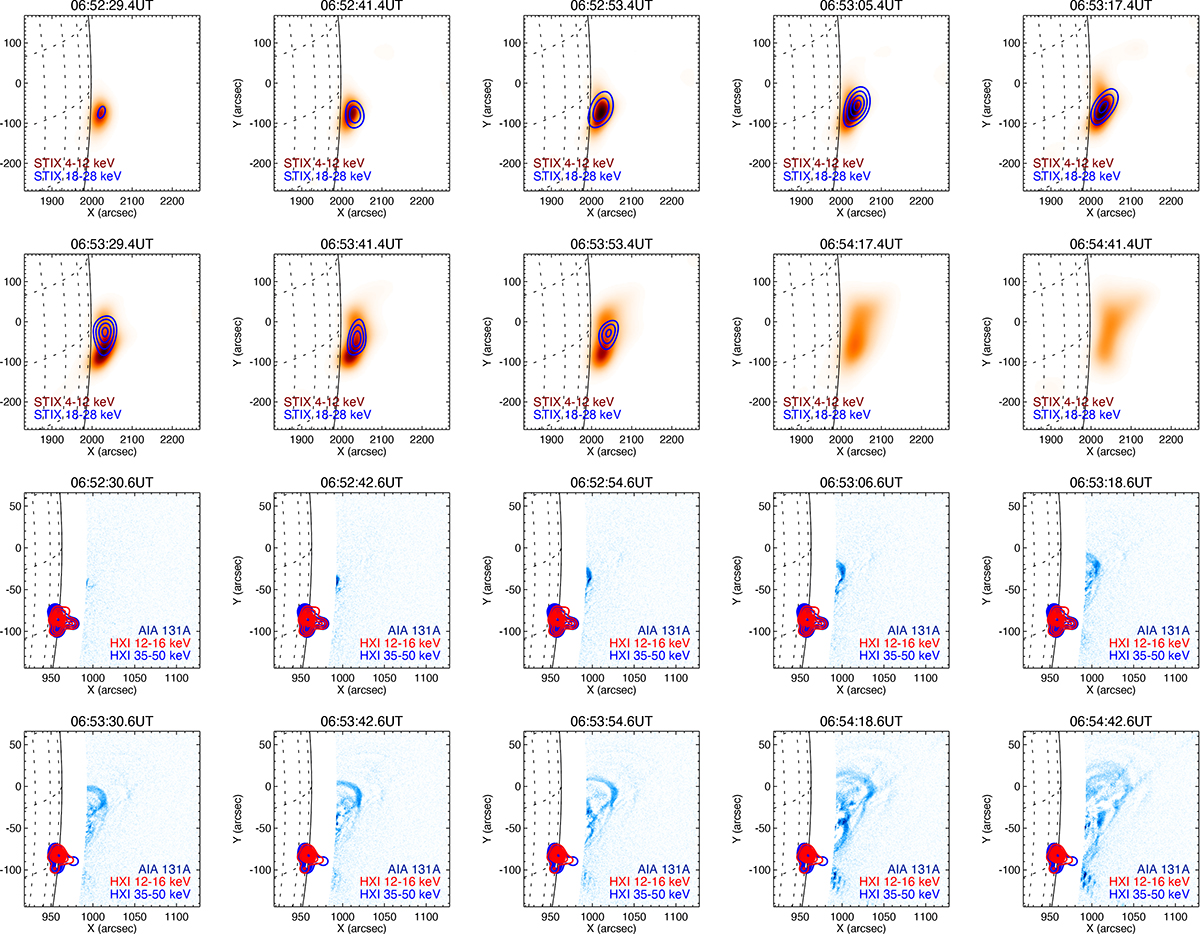
Time evolution during the impulsive phase in ten time steps (STIX times are adjusted to Earth; for a reference of the duration, see the green bar in Fig. 5, top). The cadence was taken from the AIA 131A frames (12 s cadence with a 2.9 second integration time). STIX images were reconstructed around the same time steps as the AIA images with a 12 second integration time to enhance counting statistics. The top ten panels show the STIX observations with thermal images (4–12 keV) shown in a red-colored table and nonthermal images (18–28 keV) are given with blue contours. The contour levels are scaled to the 20, 40, 60, 80% of the maximum emission in the time series. For the last two frames, the nonthermal emission drops below 20% of the maxmimum and therefore no blue contours are seen. The bottom panels show running difference images (AIA 131A) in a blue-colored table, with the dark representing enhanced intensity. To highlight the visibility of the faint EUV emission from the high corona, the low corona has been flagged and set to zero. For reference, the location of the main X-ray flare is shown by the contours; see Fig. 1.
Current usage metrics show cumulative count of Article Views (full-text article views including HTML views, PDF and ePub downloads, according to the available data) and Abstracts Views on Vision4Press platform.
Data correspond to usage on the plateform after 2015. The current usage metrics is available 48-96 hours after online publication and is updated daily on week days.
Initial download of the metrics may take a while.