


Fig. 4
Download original image
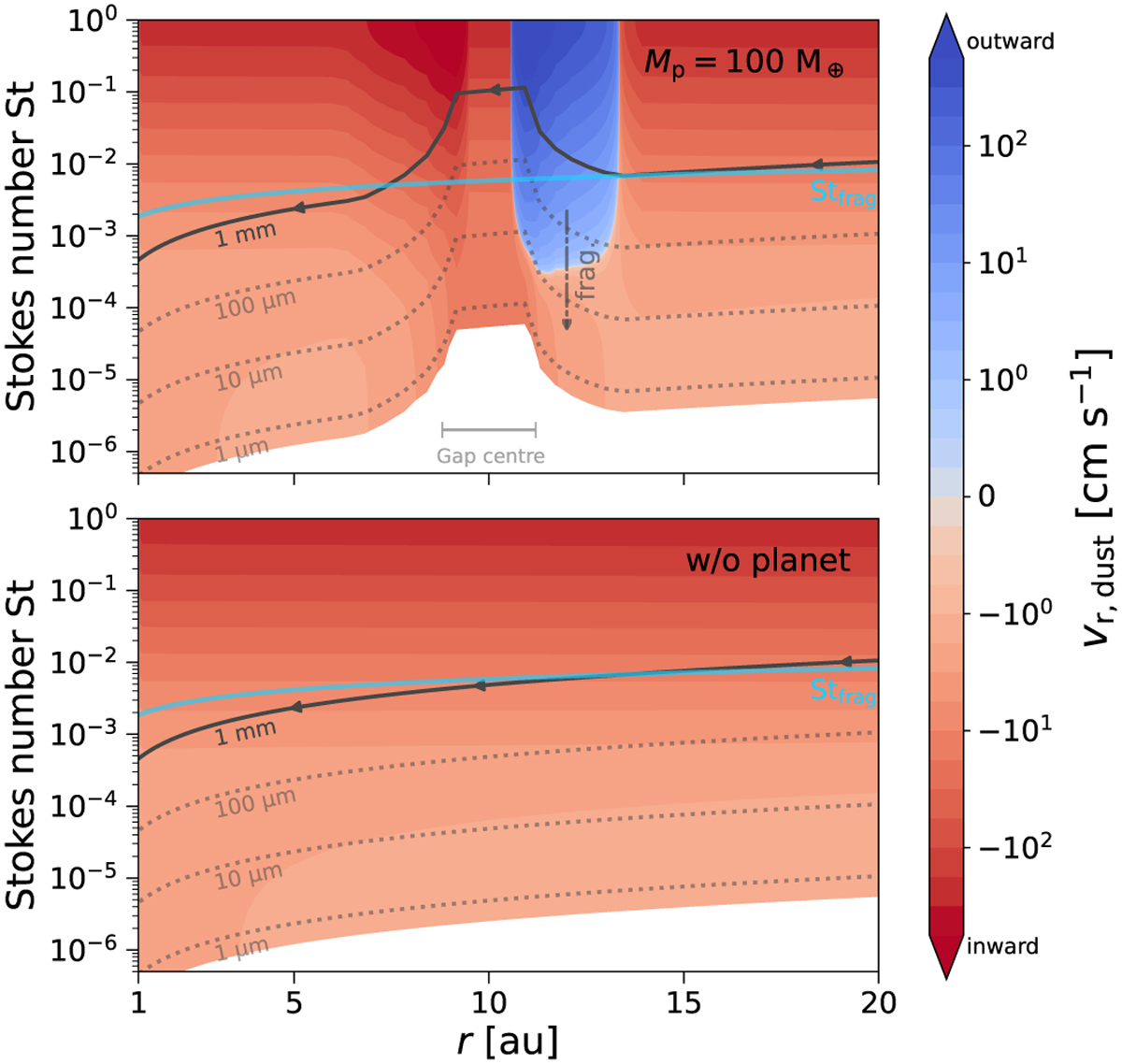
Dust velocity as a function of distance from the star and dust Stokes number in a disc hosting a 100 M⊕ planet that has carved a gap at 10 au (upper panel) compared to a smooth disc (lower panel) for a global viscosity αvisc = 10−3 and local turbulence δturb = 3.2 × 10⁻⁴. Negative velocity represents the inwards motion of dust grains (red) while a positive velocity shows the outwards motion (blue). The dark contours represent the variations in Stokes number for fixed particle size (from 1 μm to 1 mm). The Stokes number decreases monotonously in the smooth disc when approaching the star. In planet-hosting discs, low gas density in the planetary gap increases the Stokes number locally.
Current usage metrics show cumulative count of Article Views (full-text article views including HTML views, PDF and ePub downloads, according to the available data) and Abstracts Views on Vision4Press platform.
Data correspond to usage on the plateform after 2015. The current usage metrics is available 48-96 hours after online publication and is updated daily on week days.
Initial download of the metrics may take a while.