

In this section we compare the observed parameters of the wave-like variation - its amplitude and profile - to those given by the reflection effect.
The largest amplitude, between  0.5 and 2.5mag, is observed
in the U band (Fig. 1, Table 1). In the model of the reflection effect,
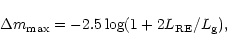
it is given by the luminosity ratio of the illuminated to the
non-illuminated giant's hemisphere. The upper limit (
0.5 and 2.5mag, is observed
in the U band (Fig. 1, Table 1). In the model of the reflection effect,
it is given by the luminosity ratio of the illuminated to the
non-illuminated giant's hemisphere. The upper limit (
 )
of
the magnitude difference between the two hemispheres,
)
of
the magnitude difference between the two hemispheres,
 ,
can be expressed as
,
can be expressed as
 |
(1) |
 is the luminosity of the giant and
 represents the portion of the hot component luminosity,
 ,
impacting the giant. If the separation between
the stars, A, is significantly larger than the giant's radius,
,
impacting the giant. If the separation between
the stars, A, is significantly larger than the giant's radius,
 ,
then
,
then
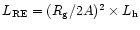 ,
and Eq. (1)
reads as
,
and Eq. (1)
reads as
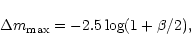 |
(2) |
 |
(3) |
 .
Because of its
importance in defining the investigated amplitude we also determined
its uncertainties in the cases under discussion (Appendix A). Results
are summarized in Table 1. We can see that the parameter
determined from observations can produce a maximum magnitude difference
.
Because of its
importance in defining the investigated amplitude we also determined
its uncertainties in the cases under discussion (Appendix A). Results
are summarized in Table 1. We can see that the parameter
determined from observations can produce a maximum magnitude difference
 mag, which is far below the observed
quantities. On the other hand, the reflection effect (Eq. 2) requires
mag, which is far below the observed
quantities. On the other hand, the reflection effect (Eq. 2) requires
 to match the observed amplitudes.
![\begin{figure}
\par\includegraphics[width=8cm]{ms9660f2r.eps} \end{figure}](/articles/aa/full/2001/04/aa9660/img39.gif) |
Figure 2:
Profiles of LCs given by the reflection function
for inclination of the orbit
and
 and limb darkening coefficient u=0.6. They are characterized by
the parameter
and limb darkening coefficient u=0.6. They are characterized by
the parameter  (Sect. 3.2) (Sect. 3.2) |
However, this problem should be treated by solving the radiation
transfer of a very hot light (
 )
throughout a very cool atmosphere
(
)
throughout a very cool atmosphere
(
 )
to learn how the reprocessed UV/EUV radiation contributes into
the Balmer and Paschen continua. An exact approach to the reflection
effect was outlined by
Vaz & Nordlund (1985) and Nordlund & Vaz (1990)
for similar effective temperatures of the component stars, but not for
very cool stars, where the TiO absorption bands are important.
Recently, Proga et al. (1996) treated this problem for symbiotic
binary stars using a non-LTE photoionization model, but also without
including molecules. According to their model, significant changes
in the structure of the red giant atmosphere are expected for
)
to learn how the reprocessed UV/EUV radiation contributes into
the Balmer and Paschen continua. An exact approach to the reflection
effect was outlined by
Vaz & Nordlund (1985) and Nordlund & Vaz (1990)
for similar effective temperatures of the component stars, but not for
very cool stars, where the TiO absorption bands are important.
Recently, Proga et al. (1996) treated this problem for symbiotic
binary stars using a non-LTE photoionization model, but also without
including molecules. According to their model, significant changes
in the structure of the red giant atmosphere are expected for
 1 and negligible when
  1.
Their calculations showed that the magnitude difference between
the illuminated and non-illuminated hemisphere
1.
Their calculations showed that the magnitude difference between
the illuminated and non-illuminated hemisphere
 mag
in the range of considered temperatures between 20000 and 200000K
for
= 10, 1, 0.1 and 0.01 (cf. their Fig. 6).
Also according to this study, the theoretical differences
in broadband magnitudes between the opposite hemispheres of an
illuminated red giant are also very small,
mag
in the range of considered temperatures between 20000 and 200000K
for
= 10, 1, 0.1 and 0.01 (cf. their Fig. 6).
Also according to this study, the theoretical differences
in broadband magnitudes between the opposite hemispheres of an
illuminated red giant are also very small,
 mag,
far from those observed.
mag,
far from those observed.
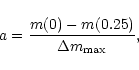
To characterize the shape of the observed LC we introduce
a parameter a as
 |
(4) |
is the amplitude of
the LC. The shape of the LC resembles a sinusoidal curve for a = 0.5,
but a > 0.5 implies a broader maximum than minimum. We can recognize
3 types of LCs, characterized by
(i)
 (e.g. V1329Cyg, AGPeg, left panels of Fig. 1),
(ii)
0.5 < a < 1 (e.g. CICyg, AXPer, mid panels of Fig. 1) and
(iii)
(e.g. V1329Cyg, AGPeg, left panels of Fig. 1),
(ii)
0.5 < a < 1 (e.g. CICyg, AXPer, mid panels of Fig. 1) and
(iii)
 (e.g. He2-467, EGAnd, right panels of
Fig. 1).
In some cases the parameter a depends on wavelength:
(e.g. He2-467, EGAnd, right panels of
Fig. 1).
In some cases the parameter a depends on wavelength:
 (Table 1). Note that extreme
values of
(Table 1). Note that extreme
values of  1 indicate the possible presence of a secondary
minimum in the LC.
1 indicate the possible presence of a secondary
minimum in the LC.
Shaping of LCs caused by the reflection effect is determined
by a reflection function. To construct such a LC we assume that
the observed luminosity of the binary,
 ,
is given by
the sum of a constant part of the system luminosity,
,
is given by
the sum of a constant part of the system luminosity,
 ,
given mainly by stellar components, and a phase dependent variable
light,
,
given mainly by stellar components, and a phase dependent variable
light,
 ,
given by the reflection function.
Then we can write
,
given by the reflection function.
Then we can write
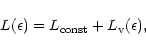 |
(5) |
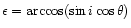 is the angle between
the line of sight and the direction to the hot component, the phase
angle
is the angle between
the line of sight and the direction to the hot component, the phase
angle  is determined by the position of the hot star
on its relative orbit around the cool giant and i is the orbital
inclination. The observed magnitude of the system then can be
expressed as
is determined by the position of the hot star
on its relative orbit around the cool giant and i is the orbital
inclination. The observed magnitude of the system then can be
expressed as
![\begin{displaymath}m(\epsilon) = - 2.5\log\left[1+\frac{L_{\rm v}(\epsilon)}{L_{\rm const}}
\right]+m_{\rm const}.
\end{displaymath}](/articles/aa/full/2001/04/aa9660/img56.gif) |
(6) |
.
Therefore the observed profiles characterized with
 cannot be reproduced by the reflection effect. In addition, recently
revealed systematic variation in the minima positions in the LCs of
symbiotic binaries (Skopal 1998a) also argues against
the location of the main source of the optical continuum on
the giant's hemisphere.
cannot be reproduced by the reflection effect. In addition, recently
revealed systematic variation in the minima positions in the LCs of
symbiotic binaries (Skopal 1998a) also argues against
the location of the main source of the optical continuum on
the giant's hemisphere.
We conclude that the observational characteristics of the LCs of symbiotic binaries - the large amplitude, the profile of minima and variation in their positions - cannot be reproduced by the reflection effect.
Copyright ESO 2001