

To get a better idea of the origin of the orbitally related wave-like variation we discuss it within the basic model of symbiotic binaries - the cool giant losing material via the stellar wind and the hot luminous compact object ionizing a portion of the neutral wind. Such composition creates a strong source of nebular emission in the binary, which often dominates the optical region (e.g. BFCyg, AG Dra, He2-467, AS338). Therefore we discuss the apparent variation in the optical continuum within an ionization model.
First, we introduce the simplest model of the ionization structure in symbiotic binaries.
| Object |
 |
Ref. |
 (Eq. 9)
 |
 (Eq. 10)
 |
(Eq. 13) |
 |
| [ergcm-2s-1Å-1] | [cm-3] | [cm-3] | [cm-3] | [cm-3] | ||
| ZAnd | 7.5a | 1 | 3.4
 |
2.9
|
1.7
|
|
| ZAnd | 2.4 - 9.6b | Fig. 1 |
 |
 |
||
| BFCyg | 5.0a | 2 | 3.8
 |
2.9
|
d | |
| BFCyg | 2.7 - 7.9b | Fig. 1 |
 |
 |
||
| AGDra | 2.4 a | 3 | 1.5
|
1.5
|
1.1
|
|
| AGDra | 0.9 - 2.2b | Fig. 1 |
 |
 |
||
| AXPer | 2.0a | 4 | 2.1
|
1.2
|
d | |
| AXPer | 1.0 - 2.5b | Fig. 1 |
 |
 |
||
| V443Her | 2.1a | 5 | 3.0
|
4.2
|
1.9
|
|
| V443Her | 1.1 - 2.1b | Fig. 1 |
 |
 |
a - from the energy distribution in the spectrum at
 3646-Å. 3646-Å. b - from the dereddened U-magnitude at minimum and maximum, respectively: ZAnd: U = 12.3 - 10.8, EB-V = 0.35, d = 1.12kpc, BFCyg: U = 12.4 - 11.3, EB-V = 0.4, d = 4.6kpc, AGDra: U = 12.0 - 11.0, EB-V = 0.05, d = 1.0kpc (Appendix A), AXPer: U = 12.9 - 11.9, EB-V = 0.27, d = 1.73kpc, V443Her: U = 12.2 - 11.5, EB-V = 0.15, d = 2.0kpc. |
c - the range of the observed EM referred in the literature.
d - not applicable. Ref.: 1 - Fig. 1 of Fernández-Castro et al. (1988), 2 - Fig. 3b of Fernández-Castro et al. (1990), Skopal et al. (1997), 3 - Fig. 3 of Mikolajewska et al. (1995), Appendix A, 4 - Fig. 2 of Mikolajewska & Kenyon (1992), Skopal (2000), 5 - Fig. 1 of Dobrzycka et al. (1993). |
![\begin{figure}
\par\includegraphics[width=8cm]{ms9660f3r.eps} \end{figure}](/articles/aa/full/2001/04/aa9660/img75.gif) |
Figure 3:
The Hi/Hii boundary calculated for
X = 0.3, 1, 10, the stellar wind model characterized by the parameters
 = 2.5 and
 = 0.28
 |
 |
(7) |
 ,
with the origin at the hot star. The function
,
with the origin at the hot star. The function
 was treated for the first time by Seaquist et al. (1984),
hereafter STB, for a steady state situation
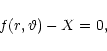
and pure hydrogen gas. The parameter X is given mainly by the binary
properties - separation of the components, number of hydrogen
ionizing photons, terminal velocity of the wind,
was treated for the first time by Seaquist et al. (1984),
hereafter STB, for a steady state situation
and pure hydrogen gas. The parameter X is given mainly by the binary
properties - separation of the components, number of hydrogen
ionizing photons, terminal velocity of the wind,
 ,
and
the mass-loss rate (for details see STB, Nussbaumer & Vogel 1987).
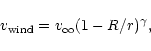
The particle density of the ionized material is given by the velocity
distribution of the giant's wind, which is assumed to be of the form
,
and
the mass-loss rate (for details see STB, Nussbaumer & Vogel 1987).
The particle density of the ionized material is given by the velocity
distribution of the giant's wind, which is assumed to be of the form
 |
(8) |
 the
radius of the giant).
Figure 3 shows examples of the Hi/Hii boundary for
X = 0.3, 1, 10 and the parameter
= 2.5 in the wind model (8).
STB used
= 0, which represents a constant velocity of
the wind (=
); no acceleration zone above the giant's
photosphere exists. However, stellar wind characterized by
the parameter
the
radius of the giant).
Figure 3 shows examples of the Hi/Hii boundary for
X = 0.3, 1, 10 and the parameter
= 2.5 in the wind model (8).
STB used
= 0, which represents a constant velocity of
the wind (=
); no acceleration zone above the giant's
photosphere exists. However, stellar wind characterized by
the parameter
 will accelerate gradually above
the photosphere to its terminal velocity; it is a more realistic model.
Therefore, according to Schröder (1985), we adopted
= 2.5 in our calculations. In this model, the source of
the nebular radiation is physically displaced from the cool giant
photosphere.
will accelerate gradually above
the photosphere to its terminal velocity; it is a more realistic model.
Therefore, according to Schröder (1985), we adopted
= 2.5 in our calculations. In this model, the source of
the nebular radiation is physically displaced from the cool giant
photosphere.
We now test if the amount of emission produced by this model is consistent with observations.
We investigate the balance between the observed nebular
emission in the continuum and that produced by the ionization model.
The nebular flux largely depends on the number of hydrogen
recombinations, and is proportional to
 ,
(the so called emission measure - EM); n+ and
,
(the so called emission measure - EM); n+ and  is
the concentration of ions (protons) and electrons, respectively.
is
the concentration of ions (protons) and electrons, respectively.
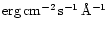
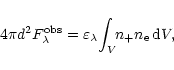
(i) Observations: The quantity of the EM can be estimated,
for example, from the measured flux,
 (
(
 ), of the nebular continuum
at the wavelength ,
according to the equation
), of the nebular continuum
at the wavelength ,
according to the equation
 |
(9) |
 is
the volume emission coefficient per electron and per ion
(
is
the volume emission coefficient per electron and per ion
(
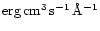 )
and V is the volume of
the ionized zone. The nebular flux can be obtained from the energy
distribution in the spectrum. Its upper limit can also be estimated
from the dereddened U-magnitude of systems, in which the nebular
continuum dominates the optical.
)
and V is the volume of
the ionized zone. The nebular flux can be obtained from the energy
distribution in the spectrum. Its upper limit can also be estimated
from the dereddened U-magnitude of systems, in which the nebular
continuum dominates the optical.
(ii) Model: The source of the nebular radiation in the model
is the ionized region, in which the rate of ionization/recombination
processes is balanced by the rate of photons,
 (photonss-1), capable of ionizing the element under
consideration. In the case of pure hydrogen we can write
the equilibrium condition as
(photonss-1), capable of ionizing the element under
consideration. In the case of pure hydrogen we can write
the equilibrium condition as
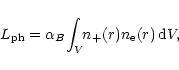 |
(10) |
 (
(
 )
is the total hydrogenic
recombination coefficient. The number of hydrogen ionizing
photons,
is
)
is the total hydrogenic
recombination coefficient. The number of hydrogen ionizing
photons,
is
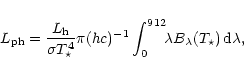 |
(11) |
 [ergs-1] and
  is the total
luminosity and the temperature of the hot star, respectively.
Having independently determined
we
compare the EM given by observations (Eq. 9) and that required by
the ionization model (Eq. 10). In Table 2 we give results for the
objects with available parameters. We obtained the observed
fluxes from the energy distribution in the spectrum at
is the total
luminosity and the temperature of the hot star, respectively.
Having independently determined
we
compare the EM given by observations (Eq. 9) and that required by
the ionization model (Eq. 10). In Table 2 we give results for the
objects with available parameters. We obtained the observed
fluxes from the energy distribution in the spectrum at
 Å and used the hydrogen emission coefficient
 (Gurzadyan 1997).
For a comparison, we also estimated the nebular flux from
the U-magnitude according to the calibration of
Henden & Kaitchuck (1982). In this case we adopted
(Gurzadyan 1997).
For a comparison, we also estimated the nebular flux from
the U-magnitude according to the calibration of
Henden & Kaitchuck (1982). In this case we adopted
 as the average of
 and
and
 .
.
We can calculate the EM directly by integrating emission
contributions throughout the volume of the ionized zone defined by
the model (Eq. 7). The calculation of the Hi/Hii and
Hei/Heii boundary in 2-D representation can be found
in STB and Nussbaumer & Vogel (1987), respectively. Using
Nussbaumer & Vogel (1989), we derive an upper limit to the modeled
EM assuming the sphere around the cool star to be fully ionized from
r = Q to
 .
The parameter Q is the location of
the Hi/Hii boundary on the line joining the cool and the hot
star (
.
The parameter Q is the location of
the Hi/Hii boundary on the line joining the cool and the hot
star (
 ). The particle density n(r) is given
by the mass-loss rate of the wind
). The particle density n(r) is given
by the mass-loss rate of the wind
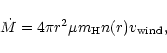 |
(12) |
 is the mean molecular weight,
  is the mass
of the hydrogen atom and the velocity of the wind is given
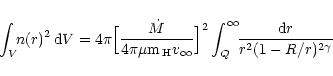
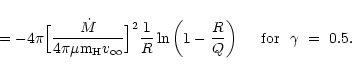
by Eq. (8). Then the EM for a completely ionized medium
(
= n+) can be calculated from the following analytical
expression
is the mass
of the hydrogen atom and the velocity of the wind is given
by Eq. (8). Then the EM for a completely ionized medium
(
= n+) can be calculated from the following analytical
expression
![\begin{displaymath}=4\pi\Big[\frac{\dot M}{4\pi\mu {\rm m}_{\,\rm H}
v_{\infty...
...ma)}
\Big[1-\Big(1-\frac{R}{Q}\Big)^{1-2\gamma}\Big]\nonumber
\end{displaymath}](/articles/aa/full/2001/04/aa9660/img107.gif)

 |
(13) |
= 2.5. This approximation can be used for cases
when the major part of the circumbinary environment is ionized,
i.e. the parameter X > 10 (Fig. 3). We applied the formula (13) to
ZAnd, AGDra and V443Her (Col. 6 in Table 2). The calculated EM
is somewhat lower than that indicated by observations. However,
given the large uncertainties in fundamental parameters (mainly
in d,  and ,
see Appendix A) we still consider
the calculated values to be consistent with observations.
However, if the calculated EM according to Eq. (13) is really lower
than that measured, this could imply the presence
of an additional source of particles in the system - for example,
the hot star wind. Note that in the case of an open ionized zone
a portion of the
photons escapes the system, and thus
an injection of new particles (emitters) into such a zone will produce
an extra flux.
and ,
see Appendix A) we still consider
the calculated values to be consistent with observations.
However, if the calculated EM according to Eq. (13) is really lower
than that measured, this could imply the presence
of an additional source of particles in the system - for example,
the hot star wind. Note that in the case of an open ionized zone
a portion of the
photons escapes the system, and thus
an injection of new particles (emitters) into such a zone will produce
an extra flux.
We find that the observed EM is consistent with that
produced by the ionization model. This implies that all
the
photons consumed by the particles of the giant wind
are needed to produce the observed nebular flux. However, in the model
of the reflection effect only a small part of ionizing photons,
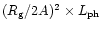 (Sect. 3), can be used to
produce the nebular radiation. This causes the discrepancy
between the
(Sect. 3), can be used to
produce the nebular radiation. This causes the discrepancy
between the  parameter given by observations and much
larger value, required by models of reflection effect to explain
the amplitude of the LCs.
parameter given by observations and much
larger value, required by models of reflection effect to explain
the amplitude of the LCs.
We now will demonstrate that the variation in the EM is responsible for the investigated wave-like variation in the LCs.
The quantity of the EM in the continuum also varies as a function of
the orbital phase (e.g. Fernandez-Castro et al. 1988;
Mikolajewska et al. 1989; Mikolajewska & Kenyon 1992;
Dobrzycka et al. 1993). To investigate this variability
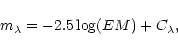
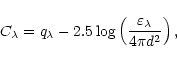
we express Eq. (9) in the scale of magnitudes
(
 )
as
)
as
 |
(14) |
 |
(15) |
 defines magnitude zero. For
the standard photometry and fluxes in units of
defines magnitude zero. For
the standard photometry and fluxes in units of
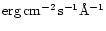 ,
qU = -20.9,
qB = -20.36 and
qV = -21.02
(Henden & Kaitchuck 1982). Using Eq. (14) we constructed
the LCs from the measured values of the EM in BFCyg and ZAnd and
compared them to those obtained photometrically. We calculated
the B-magnitudes, because in these objects the nebular contribution
still dominates the continuum and the emission coefficient
is nearly constant in this region. We used
,
qU = -20.9,
qB = -20.36 and
qV = -21.02
(Henden & Kaitchuck 1982). Using Eq. (14) we constructed
the LCs from the measured values of the EM in BFCyg and ZAnd and
compared them to those obtained photometrically. We calculated
the B-magnitudes, because in these objects the nebular contribution
still dominates the continuum and the emission coefficient
is nearly constant in this region. We used
 (Gurzadyan 1997) and d = 4.6 and 1.12kpc for BFCyg
and ZAnd, respectively. Figure 4 shows that the variation in
the EM follows well that observed in the LCs.
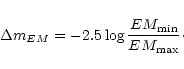
In other systems, where only a few measurements of the EM at different
orbital phases are available (AXPer, AGDra, V443Her), we estimated
the amplitude as
(Gurzadyan 1997) and d = 4.6 and 1.12kpc for BFCyg
and ZAnd, respectively. Figure 4 shows that the variation in
the EM follows well that observed in the LCs.
In other systems, where only a few measurements of the EM at different
orbital phases are available (AXPer, AGDra, V443Her), we estimated
the amplitude as
 |
(16) |
Note that the decrease of the LC amplitude with wavelength is caused
by an increase of the cool giant contribution, which does not
vary with the orbital phase. The same effect takes place towards
the short wavelengths due to an increase in the stellar contribution
from the hot star (see Fig. 4 of Kenyon et al. 1993).
![\begin{figure}
\par\includegraphics[width=7.3cm]{ms9660f4ar.eps} \includegraphics[width=7.3cm]{ms9660f4br.eps} \end{figure}](/articles/aa/full/2001/04/aa9660/img119.gif) |
Figure 4: Top: variation in the EM of BFCyg as a function of the orbital phase. The data (Mikolajewska et al. 1989) were converted into the B-magnitudes according to Eq. (14). Compared is the LC in the B band obtained photometrically during the same period, between JD 2445700 and 2446718 (Hric et al. 1993). Bottom: the same as the top, but for ZAnd. Measurements of the EM were taken from Fernandez-Castro et al. (1988), and photometric B-magnitudes from Fig. 1, but omitting the active phase. These results show that the variation in the EM is fully responsible for the variation in the LCs |
Together with the periodic variation in the nebular continuum,
the same type of variability is observed in fluxes of Balmer lines.
The source of hydrogen emission in lines is also the Hii region.
Therefore the variation in both the hydrogen continuum and the lines
should be of the same nature.
So the EM derived from the hydrogen continuum should be consistent
with that given by the Balmer lines, assuming an optically
thin regime and the case B of recombination. In Table 3
we summarize results for the line H.
| Object |
 a a |
Ref. |
 |
| [ergcm-2s-1] | [cm-3] | ||
| ZAnd | 37.3 | 1 | 4.5
 |
| BFCyg | 18 - 65 | 2 | 0.4
 |
| AGDra | 6.4 - 9.4 | 3 | 6.2
 |
| AXPer | 7.2 - 22 | 4 | 2.1
 |
| V443Her | 6.5 - 15 | 5 | 2.5
 |
| a - dereddened fluxes with EB-V referred in Table 2. Ref.: 1 - Mikolajewska & Kenyon (1996), 2 - Mikolajewska et al. (1989), 3 - Mikolajewska et al. (1995), 4 - Mikolajewska & Kenyon (1992), 5 - Dobrzycka et al. (1993). |
according to Eq. (9) using the volume
emission coefficient in the H
line,
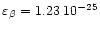 ergcm3s-1.
We can see that the
is by a factor of
ergcm3s-1.
We can see that the
is by a factor of  5,
on average, lower than that derived from the Balmer continum.
This discrepancy can be caused by atenuation of the Hi emission
due to (i) an absorption originating from the cool component wind
and (ii) the self-absorption effect, when the nebula is partially opaque
in the line H
and H,
in addition to the case B.
The first case is demonstrated well by sets of observations along
the orbital cycle (e.g. Oliversen et al. 1985). The wind
absorption component is more pronounced around the inferior conjunction
of the giant (see Fig. 3), which makes the amplitude of the variation
in line fluxes even larger.
The second case is indicated by the observed very steep
Balmer decrement (H
5,
on average, lower than that derived from the Balmer continum.
This discrepancy can be caused by atenuation of the Hi emission
due to (i) an absorption originating from the cool component wind
and (ii) the self-absorption effect, when the nebula is partially opaque
in the line H
and H,
in addition to the case B.
The first case is demonstrated well by sets of observations along
the orbital cycle (e.g. Oliversen et al. 1985). The wind
absorption component is more pronounced around the inferior conjunction
of the giant (see Fig. 3), which makes the amplitude of the variation
in line fluxes even larger.
The second case is indicated by the observed very steep
Balmer decrement (H /H/H
7/1/0.4, for objects in Table 3), which is not consistent with
the theoretical prediction (2.85/1/0.47) that the excitation is
due to photoionization. Moreover, attenuation of hydrogen fluxes
could also be in part due to electron collisions in a dense Hii
region, and/or partly caused by selective interstellar absorption.
Therefore the
represents only the lower limit of
the EM derived from the Balmer continuum.
/H/H
7/1/0.4, for objects in Table 3), which is not consistent with
the theoretical prediction (2.85/1/0.47) that the excitation is
due to photoionization. Moreover, attenuation of hydrogen fluxes
could also be in part due to electron collisions in a dense Hii
region, and/or partly caused by selective interstellar absorption.
Therefore the
represents only the lower limit of
the EM derived from the Balmer continuum.
As the variation in the emission of the Balmer lines is connected with the Hii region - the dominant source of the optical/near-UV continuum - the observed periodic wave-like variation in the continuum should always be followed by a similar variation in Balmer lines.
To produce the wave-like variation in the LCs along the orbital cycle,
the nebula - the main source of the optical continuum in symbiotic
binaries - has to be partially optically thick and of a non-spherical
shape. In our simple ionization model the opacity,  ,
of
the ionized emission medium decreases with the distance from the cool
star, since
,
of
the ionized emission medium decreases with the distance from the cool
star, since
 (i.e. its parts nearest to the giant's surface will be most opaque).
It is probable that the observed emission will also depend
on the extension of the ionized region. Below we give a qualitative
description on how, or whether, it is possible to produce the observed
profile of LCs within the ionization model mentioned above.
(i.e. its parts nearest to the giant's surface will be most opaque).
It is probable that the observed emission will also depend
on the extension of the ionized region. Below we give a qualitative
description on how, or whether, it is possible to produce the observed
profile of LCs within the ionization model mentioned above.
(i) In the case of an oval shape of the Hii zone (Fig. 3;
a small parameter X), its total emission will be atenuated more
at positions of the inferior and superior conjunction of the cool
star (the orbital phase  = 0 and 0.5, respectively) than
at positions of
= 0.25 and 0.75, respectively. Such
apparent variation in the EM will produce both the primary and
the secondary minimum in the LC and will thus mimic the ellipsoidal
effect in binaries containing a giant star. This type of LC profile
corresponds to the parameter
= 0 and 0.5, respectively) than
at positions of
= 0.25 and 0.75, respectively. Such
apparent variation in the EM will produce both the primary and
the secondary minimum in the LC and will thus mimic the ellipsoidal
effect in binaries containing a giant star. This type of LC profile
corresponds to the parameter  (right panels of Fig. 1).
(ii) A gradual opening of the Hii zone (approximately
 )
will make it optically thinner behind the hot
star (outside the binary around
= 0.5). Thus, more of
the nebular radiation, relative to the case (i), will be observed
at the position of
)
will make it optically thinner behind the hot
star (outside the binary around
= 0.5). Thus, more of
the nebular radiation, relative to the case (i), will be observed
at the position of
 .
The secondary minimum in LCs
will therefore become less pronounced or flat, and/or a maximum at
can arise. The LC profile here should be
characterized by the parameter a > 0.5 (mid panels of Fig. 1).
.
The secondary minimum in LCs
will therefore become less pronounced or flat, and/or a maximum at
can arise. The LC profile here should be
characterized by the parameter a > 0.5 (mid panels of Fig. 1).
(iii) Given an extensive emission zone (X > 10) one can imagine
the partially optically thick portion of the Hii region as
a cap on the Hi/Hii boundary around the binary axis.
This resembles the geometry of the reflection effect, but
the emission region causing the light variation is physically
displaced from the giant's surface (see also a sketch in
Baratta & Viotti (1990), who drawn such regions for
Feii and Ciii lines). In these cases the LC profile
is similar to that of the reflection effect, i.e. the parameter
 (left panels of Fig. 1).
A relationship between the parameters a and X supports the connection between the shape of the LC and the extent of the symbiotic nebula mentioned above (Fig. 5, Appendix B).
However, the real structure of the ionized region in symbiotic binaries is probably much more complex. Currently it is being intensively investigated (e.g. Schmid 1998). For example, the observed systematic variation in the minima position (i.e. an apparent change of the orbital period) requires an asymmetrical shape of the Hii zone with respect to the binary axis (see Sect. 4.1 of Skopal 1998a in more detail). A modification of the STB model, which includes effects of the orbital motion, is outlined in Appendix C.
Copyright ESO 2001