ajewska1 - M. Friedjung2 - C. Quiroga3,4
A&A 460, 191-197 (2006)
DOI: 10.1051/0004-6361:20052655
J. Mikoajewska1 - M. Friedjung2 - C. Quiroga3,4
1 -
Nicolaus Copernicus Astronomical Center,
Bartycka 18, 00-716 Warsaw, Poland
2 -
Institut d'Astrophysique de Paris - UMR 7095, CNRS/Université Pierre et Marie
Curie,
98 bis Boulevard Arago, 75014 Paris, France
3 -
Consejo Nacional de Investigaciones Científicas y Técnicas de la
República Argentina (CONICET)
4 -
Facultad de Ciencias Astronómicas y Geofísicas, Universidad Nacional de La Plata,
La Plata, Argentina
Received 7 January 2006 / Accepted 22 August 2006
Abstract
Aims. They are the interpretation of the emission line formation regions in CI Cygni
Methods. They involve the examination of radial velocities and fluxes of ultraviolet emission lines at different epochs, deduced from archival IUE and GRHS/HST spectra.
Results. The line fluxes give electron densities and were in addition used to calculate emission measures, suggesting line formation in regions rather smaller than the binary separation. Examination of the radial velocities led to us to find a systematic redshift of the high ionization resonance lines with respect to the intercombination, and He II lines. Possible explanations of the redshift and the high resolution GHRS C IV profile are discussed. We favour that involving resonance line absorption by a circum-binary region most probably in an asymmetric wind interaction shell or in a wind from the accretion disk.
Key words: stars: binaries: symbiotic - stars: fundamental parameters - stars: mass-loss - stars: individual: CI Cyg - line: profiles
CI Cyg is a symbiotic binary, containing a cool giant, of type M5.5 (Mürset &
Schmid 1999), and a much more compact companion. The infrared spectrum shows
no sign of circumstellar dust. It is moreover particularly fruitful to study
CI Cyg, because it undergoes eclipses. A detailed investigation of this object
was performed by Kenyon et al. (1991). They concluded that the compact object
was a main sequence star of
 ,
surrounded by a large accretion
disk. Recent work shows however that the compact component of this binary may
not be a main sequence star (e.g. Mikoajewska 2003).
,
surrounded by a large accretion
disk. Recent work shows however that the compact component of this binary may
not be a main sequence star (e.g. Mikoajewska 2003).
CI Cyg is one of the very few symbiotic binaries in which the cool giant fills
or nearly fills its Roche lobe (e.g. Mikoajewska 2001, and references therein).
CI Cyg is also one of the very few symbiotic systems for which a
high quality radio spectrum, covering the range between 6 cm and 850  m,
has been obtained (Mikoajewska & Ivison 2001).
These radio data enabled them to determine the free-free turnover
frequency of the ionized component, and to critically test the known
models for radio emission from symbiotic stars.
Unfortunately, they ruled out the two most popular models:
ionization of the red giant wind by Lyman continuum photons from
its hot companion, and emission resulting from
the interaction of winds from the two binary components.
m,
has been obtained (Mikoajewska & Ivison 2001).
These radio data enabled them to determine the free-free turnover
frequency of the ionized component, and to critically test the known
models for radio emission from symbiotic stars.
Unfortunately, they ruled out the two most popular models:
ionization of the red giant wind by Lyman continuum photons from
its hot companion, and emission resulting from
the interaction of winds from the two binary components.
A systematic shift in radial velocity between ultraviolet intercombination
lines and ultraviolet high ionization permitted resonance emission lines in
symbiotic binary spectra, was found by Friedjung et al. (1983).
The latter are generally redshifted with respect to the former, and
Mikoajewska & Friedjung (2005) have recently reported
an orbital variation of this redshift in CI Cyg.
Unlike the intercombination
lines, the resonance lines are expected to be optically very thick. Their
redshift might be due to the absorption of both the continuum and part of the
emission line by P Cygni profile absorpion components, or only to a radiative
transfer effect produced by photon scattering in an expanding medium.
In the present work, we have examined in detail the effect for the symbiotic binary, CI Cyg, and we find some support for the P Cygni profile interpretation. Our data base is presented in Sect. 2, analyzed in Sect. 3, and the results discussed in Sect. 4. We conclude with a brief summary of these results in Sect. 5.
The log of observations used is shown in Table 1. They include high spectral resolution observations made with the IUE satellite, archived in the INES data base and higher resolution GHRS/HST observations made on 1993 October, 11 in the regions of different lines. Though the latter were made before the COSTAR correction for the spherical aberration of the mirror, the effect should not be large, as the Small Science Aperture was used (0.25''). Profiles are shown in Fig. 1. Radial velocities and fluxes of different lines were obtained by a Gaussian fit of the line profile (Tables 2, 3, and 4). Radial velocity curves are shown in Fig. 2.
Table 1: Log of the UV observations of CI Cyg.
![\begin{figure}
\par\includegraphics[width=8.5cm]{2655fig1.eps} \end{figure}](/articles/aa/full/2006/46/aa2655-05/img9.gif) |
Figure 1: Examples of emission line profiles of He II 1640 Å C IV 1548 Å and O III] 1666 Å in CI Cyg. The numbers on the right side refer to the number of the spectrum and orbital phase, respectively. |
| Open with DEXTER | |
He II traces the motion of the hot component but the systemic
velocity,
 km s-1,
seems to be blueshifted by about 18 km s-1 with respect
to the M giant orbital solution of Kenyon et al. (1991). A similar
blueshift in the
systemic velocity was found for the radial velocity curve for the
optical He II 4686 Å line (Kenyon et al. 1991).
The amplitude of the circular orbit,
km s-1,
seems to be blueshifted by about 18 km s-1 with respect
to the M giant orbital solution of Kenyon et al. (1991). A similar
blueshift in the
systemic velocity was found for the radial velocity curve for the
optical He II 4686 Å line (Kenyon et al. 1991).
The amplitude of the circular orbit,
 km s-1, combined
with that of the M giant,
km s-1, combined
with that of the M giant,
 km s-1implies that
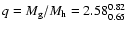 ,
and is consistent with other estimates (see Kenyon et al. 1991
for details). We should note in addition that He II shows no
systematic shift in radial velocity between decline and quiescence.
,
and is consistent with other estimates (see Kenyon et al. 1991
for details). We should note in addition that He II shows no
systematic shift in radial velocity between decline and quiescence.
Table 2:
Emission line fluxes and radial velocities from GHRS spectra
(MJD = 49271/
 ).
).
Table 3:
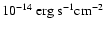
Emission line fluxes from IUE high resolution spectra
(in units of
 ).
).
Table 4: Radial velocities of the IUE emission lines (in units of km s-1).
![\begin{figure}
\par\includegraphics[width=8.5cm]{2655fig2.eps} \end{figure}](/articles/aa/full/2006/46/aa2655-05/img17.gif) |
Figure 2: Radial velocity curves for CI Cyg. The dashed line repeats the orbit of the M giant and the dotted line - the circular orbit solution for the He II 1640 Å emission line, respectively. The solid line corresponds to the elliptical orbit solution for the intercombination line (see text for details). Open and closed symbols correspond to the late decline (1979-82) and quiescent data (after 1983), respectively. |
| Open with DEXTER | |
The intercombination lines are roughly in phase with the hot component.
However the amplitude,  km s-1 is much lower,
the systemic velocity,
km s-1 is much lower,
the systemic velocity,  10 km s-1, is blueshifted with respect
to the systemic velocity of the red giant,
10 km s-1, is blueshifted with respect
to the systemic velocity of the red giant,
 km s-1 (Kenyon et al. 1991), and
the orbit seems to be eccentric with
km s-1 (Kenyon et al. 1991), and
the orbit seems to be eccentric with
 ,
the longitude of periastron,
,
the longitude of periastron,
 ,
and the
spectroscopic conjunction occurs at
,
and the
spectroscopic conjunction occurs at
 .
In fact, they follow with very good precision the orbit found
for the optical Fe II emission lines by Kenyon et al. (1991).
The solid line in the middle panel of Fig. 2 corresponds to an
orbital solution with the same parameters as those for Fe II in Table 8
of Kenyon et al. (1991) except for the amplitude and the systemic
velocity which
were fitted with our quiescent data. There is also an
interesting systematic difference between the radial
velocity curve formed by the quiescent (after 1983), and late decline
(1979-82) data, respectively (Fig. 2): although both data sets seem
to follow the same orbit the data from the decline
are slightly blueshifted (by
.
In fact, they follow with very good precision the orbit found
for the optical Fe II emission lines by Kenyon et al. (1991).
The solid line in the middle panel of Fig. 2 corresponds to an
orbital solution with the same parameters as those for Fe II in Table 8
of Kenyon et al. (1991) except for the amplitude and the systemic
velocity which
were fitted with our quiescent data. There is also an
interesting systematic difference between the radial
velocity curve formed by the quiescent (after 1983), and late decline
(1979-82) data, respectively (Fig. 2): although both data sets seem
to follow the same orbit the data from the decline
are slightly blueshifted (by  km s-1) with respect to the quiescent data. The only point above the solid curve in Fig. 2 is
the measurement from the spectrum obtained in the midle of the 1980
eclipse. We note that the radial velocities for the other emission lines
derived from this spectrum are redshifted by 20 km s-1 with respect to
the data obtained near the other eclipses, and it may be due to uncertainty in
the wavelength calibration.
km s-1) with respect to the quiescent data. The only point above the solid curve in Fig. 2 is
the measurement from the spectrum obtained in the midle of the 1980
eclipse. We note that the radial velocities for the other emission lines
derived from this spectrum are redshifted by 20 km s-1 with respect to
the data obtained near the other eclipses, and it may be due to uncertainty in
the wavelength calibration.
The blueshift of the systemic velocity of both the optically thin intercombination lines and the usually not optically very thick He II 1640 Å line suggests line formation regions approaching the observer whereas the systemic velocity difference between the intercombination lines and He II 1640 Å, appears to indicate a velocity stratification and/or acceleration effects in the ionized nebula, with electron temperature variations perhaps affecting collisionally excited lines. Probably for the same reason, the He II line shows a systematically broader profile than the intercombination O III line (Fig. 1).
The radial velocities of the optically thick resonance lines are almost stationary, and redshifted by 10-20 km s-1 with respect to the systemic velocity of the red giant.
Mikoajewska & Friedjung (2005) showed that
the velocity difference between the resonance and intercombination
emission lines seems to follow the radial velocity of the cool
giant, with a comparable amplitude, 6 km s-1, and average
velocity,
21 km s-1, almost the same as the systemic velocity.
We note however that this effect may not be physical because of
the apparent constancy of the resonance line radial velocity; which means
that the radial velocity difference curve is a mirror image of the radial
velocity curve for the intercombination lines.
A comparison of the C IV emission line profiles with those of He II
(Fig. 1), and particularly the best resolution profiles taken with the HST (Fig. 3) shows that the red wings of both lines overlap whereas the blue wing of the C IV line seems to be missing, possibly due to the presence of a blue shifted absorption
component in a P Cygni profile. The corrected emission component might in
that case trace the motion of the hot component. A P Cygni profile of
this sort seems to be mostly related to the
hot component's activity: it was certainly more pronounced
in the early 1980's (decline from the 1975 outburst) than in the
1990's when the system had reached the quiescent state.
A weak absorption component seems to be also present in the blue wing of
the He II profile taken in 1979 (
 )
whereas it may be
marginally visible in the HST/GHRS profile taken in 1993.
)
whereas it may be
marginally visible in the HST/GHRS profile taken in 1993.
It seems that some radial velocities are related to the level of ionization: the HST data give radial velocities of 29 km s-1 for the intercombination O IV], 13 km s-1 for the intercombination O III] and 11 km s-1 for the O I] lines. However, there is no systematic difference in the velocities of C IV and Si IV.
![\begin{figure}
\par\includegraphics[width=8.5cm]{2655fig3.eps} \end{figure}](/articles/aa/full/2006/46/aa2655-05/img26.gif) |
Figure 3: The smoothened and normalized He II 1640 (solid line), average C IV profiles (dotted line) and Mg II (dashed line) profiles, observed with the HST/GHRS. The He II profile was increased by a factor of about 2, in order to fit the red wing to the C IV and Mg II profiles. |
| Open with DEXTER | |
The resonance line ratios indicate moderate optical depth effects.
In particular, the average ratios are:
 ,
,
 (1.5 for HST spectra), and
 (1.5 for HST spectra),
respectively. These ratios do not seem to vary with the orbital
phase nor the activity, although the line fluxes show both orbitally
related and secular changes (Fig. 4).
In particular, the permitted resonance and He II 1640 line fluxes were increasing as the system declined from
the last outburst, and then stabilized at some high level whereas the
intercombination line fluxes tended to decrease.
Both the permitted and intercombination line fluxes change with the orbital phase,
and the minima in all lines but He II are much deeper and broader in quiescence than
during the decline in activity.
The same effect is present for the optical Balmer
lines.
(1.5 for HST spectra),
respectively. These ratios do not seem to vary with the orbital
phase nor the activity, although the line fluxes show both orbitally
related and secular changes (Fig. 4).
In particular, the permitted resonance and He II 1640 line fluxes were increasing as the system declined from
the last outburst, and then stabilized at some high level whereas the
intercombination line fluxes tended to decrease.
Both the permitted and intercombination line fluxes change with the orbital phase,
and the minima in all lines but He II are much deeper and broader in quiescence than
during the decline in activity.
The same effect is present for the optical Balmer
lines.
![\begin{figure}
\par\includegraphics[width=8.5cm]{2655fig4.eps} \end{figure}](/articles/aa/full/2006/46/aa2655-05/img30.gif) |
Figure 4: Variation of line fluxes for N V 1240, He II 1640 and O III] 1664 emission lines. The open and filled circles correspond to the data from the high and low resolution IUE spectra, respectively. |
| Open with DEXTER | |
The observed orbitally related changes of the emission line fluxes require the main line formation regions to be located inside the binary system, with possible stratification. The fact that the resonance lines show practically the same secular trend and eclipse behaviour as the He II line suggests that they are formed in the same region, and that their profiles should be intrinsically the same. Thus the lack of orbitally related radial velocity changes together with their redshift with respect to the He II and intercombination lines indicates that the resonance line profile must be seriously affected by an absorption component. Moreover, the emission must be absorbed outside the binary system in very extended region. The He II 1640 Å line would be not affected by this circumstellar absorption because it is the recombination line from a high excitation level (41 eV).
The O III] line ratio, the average
 ,
is always bigger than the optically
thin value, and the effect is much stronger during the eclipse
of the hot component. The effect was also stronger before 1983
when CI Cyg was still declining from the large 1975 outburst.
If this anomalous line ratio is due to
Bowen pumping of optically thick lines
as proposed by Kastner et al. (1989), the pumping must
be more effective during the decline as well as in the region(s)
visible during the eclipse.
The fact that the out-of-the-eclipse intensity
of the Bowen lines 3133 Å and 2837 Å decreased after
1983 whereas the intercombination doublet itself remained practically
constant, suggests that the Bowen excitation rate was indeed higher before
1983 (Kenyon et al. 1991) than in the 1990's.
On the other hand, both the Bowen lines and the intercombination doublet
show an eclipse effect, although the effect is less pronounced for
the Bowen lines.
,
is always bigger than the optically
thin value, and the effect is much stronger during the eclipse
of the hot component. The effect was also stronger before 1983
when CI Cyg was still declining from the large 1975 outburst.
If this anomalous line ratio is due to
Bowen pumping of optically thick lines
as proposed by Kastner et al. (1989), the pumping must
be more effective during the decline as well as in the region(s)
visible during the eclipse.
The fact that the out-of-the-eclipse intensity
of the Bowen lines 3133 Å and 2837 Å decreased after
1983 whereas the intercombination doublet itself remained practically
constant, suggests that the Bowen excitation rate was indeed higher before
1983 (Kenyon et al. 1991) than in the 1990's.
On the other hand, both the Bowen lines and the intercombination doublet
show an eclipse effect, although the effect is less pronounced for
the Bowen lines.
The density sensitive intercombination line ratios measured on IUE spectra
indicate
 and
and
 for N III] and O IV] (1404.8:1401.2),
respectively (Nussbaumer & Storey 1979; Nussbaumer & Storey 1982).
We note, however, that the O IV] 1404.8 line
is blended with S IV] line, which contributes 10%
of the total line flux.
The O IV] line ratios measured on the HST spectrum indicate
for N III] and O IV] (1404.8:1401.2),
respectively (Nussbaumer & Storey 1979; Nussbaumer & Storey 1982).
We note, however, that the O IV] 1404.8 line
is blended with S IV] line, which contributes 10%
of the total line flux.
The O IV] line ratios measured on the HST spectrum indicate
 (1399.8:1401.2:1404.8)
and
(1399.8:1401.2:1404.8)
and 
 (1401.2:1407.4), respectively
(Harper et al. 1999; Keenan et al. 2002).
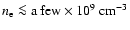
Similarly, the S IV] 1416.9/1406.0 ratio indicates
(1401.2:1407.4), respectively
(Harper et al. 1999; Keenan et al. 2002).
Similarly, the S IV] 1416.9/1406.0 ratio indicates
 (Harper et al. 1999; Keenan et al. 2002).
These electron densities are comparable to those derived for the He I,
Balmer H I, and O III] emission region(s) by Kenyon et al. (1991).
They may, however, not be representative of the resonance
line emission region.
(Harper et al. 1999; Keenan et al. 2002).
These electron densities are comparable to those derived for the He I,
Balmer H I, and O III] emission region(s) by Kenyon et al. (1991).
They may, however, not be representative of the resonance
line emission region.
Let us examine the sizes of the regions of emission of the ultraviolet high
ionization permitted zero volt lines of C IV, N V and Si IV. These lines are
expected to be excited by electron collisions.
Assuming that the line emission is effectively optically thin,
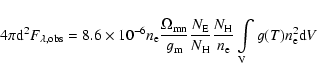
we can express the line luminosity as (e.g. Brown & Jordan 1981; Mikoajewska et al. 1988):
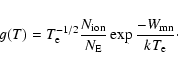
 - the reddening-corrected observed line flux,
 - the electron temperature,
 ,
,
 ,
,
 and
and  are the number densities of the ion in question, of an element E, of hydrogen, and electrons, respectively,
 is the collision strength of the transition from level m to
level n,
is the collision strength of the transition from level m to
level n,  is the statistical weight of the lower level,
and
is the statistical weight of the lower level,
and
 - the excitation energy.
Table 5:
Emission measures, EM, in units of
 .
.
The function g(T) peaks strongly at a certain temperature, and it is often assumed
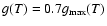 (Pottasch 1964).
Such an assumption is valid for the line formation in a hot region, like the solar transition region, e.g. an accretion disk corona.
Table 5 gives emission measures,
(Pottasch 1964).
Such an assumption is valid for the line formation in a hot region, like the solar transition region, e.g. an accretion disk corona.
Table 5 gives emission measures,
 calculated from the observed emission line fluxes, corrected for
EB-V=0.4 with the reddening curve of Seaton (1979), and
adopting d=2 kpc (Mikoajewska & Ivision 2001; Kenyon et al. 1991), for two values of g(T):
and
calculated from the observed emission line fluxes, corrected for
EB-V=0.4 with the reddening curve of Seaton (1979), and
adopting d=2 kpc (Mikoajewska & Ivision 2001; Kenyon et al. 1991), for two values of g(T):
and
 K, representative of line formation in a hot shocked region and a photoionized region, respectively. We also
assumed solar abundances (cf. Proga et al. 1996), and supposed that
most of the atoms of the
element in each line emission region were in the same state of ionization.
K, representative of line formation in a hot shocked region and a photoionized region, respectively. We also
assumed solar abundances (cf. Proga et al. 1996), and supposed that
most of the atoms of the
element in each line emission region were in the same state of ionization.
The present estimates take account of the fairly small contribution of the
electrons due to ionization of helium, supposing it singly ionized in the
Si+3 region and doubly ionized in the regions of C+3 and of
N+4. The collision strengths used are those tabulated by Brown &
Jordan (1981), and Mikoajewska et al. (1988).
In view of the presence of optical depth effects, we calculated
the total rate of collisional excitation for each multiplet considered,
assuming that photons were not lost by other sources of absorption.
It is noteworthy that if
 the emission
measure is
the emission
measure is
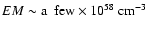 for both the resonance lines and He II 1640 Å.
For a density
for both the resonance lines and He II 1640 Å.
For a density
 ,
typical for
the central, eclipsed nebular region(s) in CI Cyg (e.g. Kenyon et al. 1991),
emission measures of this order imply spherical radii lower than
the binary separation, in agreement with some obscuration effects
clearly visible in N V lines.
,
typical for
the central, eclipsed nebular region(s) in CI Cyg (e.g. Kenyon et al. 1991),
emission measures of this order imply spherical radii lower than
the binary separation, in agreement with some obscuration effects
clearly visible in N V lines.
We may note that such values of the emission measure are similar to the
radio volume
emission measure estimate of Mikoajewska & Ivison (2001), but in
view of the large length scale of the radio emission, of the order of 1015 cm (larger than
the binary separation), this is presumably a
coincidence.
The radio emission region, however, can be the same as
the resonance line absorbing region, if the optical thickness of the C IV lines is large.
The fact the giant component of CI Cyg fills or nearly fills its tidal lobe implies that the usually adopted models for the symbiotic nebulae (with the main emission region in the spherically symmetric red giant wind ionised by the hot companion) cannot be a good match to the true conditions in the emission line region(s). The observed orbitally related changes of radial velocities and fluxes of most UV emission lines require the main formation region to be located inside the binary system. It is, however, in the partially ionised mass-loss stream and the environment of the accretion disk and the hot component rather than in a hemispherical shell just outside the red giant wind photosphere.
At the present stage, we cannot rule out completely radiative transfer as being responsible for the redshift of resonance lines with respect to the intercombination and He II lines. However a P Cygni profile explanation appears more likely, because of the lack of radial velocity changes of the resonance lines, suggesting that the lines are seriously affected by circumstellar absorption. He II 1640 Å line is optically much thinner, as its lower level is at 41 eV and is not affected. As far as the resonance line emission is concerned, our emission measures suggest line formation in regions smaller than the binary separation. The origin of the absorption component is however not obvious.
It cannot, in general, be
due to interstellar line absorption (see discussion
in Friedjung et al. 1983).
However in the case of CI Cyg, two other objects in the same direction of
the sky, show similar C IV (as well as Mg II) absorption to that
suggested by the spectrum of CI Cyg. We see the absorption in high
resolution IUE spectra of the X-ray binary Cygnus X-1 and the Wolf-Rayet star
HD 190918, which are within 4 from CI Cyg. This means that we cannot be
certain to what extent the suggested CI Cyg absorption is really circumstellar.
The absorption of HD 190918, spread out between very small negative radial
velocities and about -80 km s-1, has apparently no connection with the
much more blueshifted absorption components, due to the wind of that star.
However the spectra of the two other objects do not have N V
absorption. In fact the CI Cyg N V shift is at most only slightly less
than the mean for the 6 high ionization lines (2-7 km s-1 on spectra where
all 6 lines could be measured). This means that the redshift cannot be due to
interstellar line absorption in the blue wings of the C IV doublet.
from CI Cyg. This means that we cannot be
certain to what extent the suggested CI Cyg absorption is really circumstellar.
The absorption of HD 190918, spread out between very small negative radial
velocities and about -80 km s-1, has apparently no connection with the
much more blueshifted absorption components, due to the wind of that star.
However the spectra of the two other objects do not have N V
absorption. In fact the CI Cyg N V shift is at most only slightly less
than the mean for the 6 high ionization lines (2-7 km s-1 on spectra where
all 6 lines could be measured). This means that the redshift cannot be due to
interstellar line absorption in the blue wings of the C IV doublet.
The redshift cannot either be accounted by absorption by an iron curtain because the effect is present in all lines, including N V which should not be affected, whereas it is missing in the He II 1640 Å line which should be affected by the Fe+-curtain (e.g. Shore & Aufdenberg 1993).
Another possible effect is absorption of resonance line emission from excited Fe II levels, which results in pumping of highly excited levels of that ion and strong emission produced by cascades from these pumped levels. The emission of the C IV 1550 Å and N V 1242 Å lines is absorbed; if this absorption is optically thick, the profiles and relative fluxes of the lines in the same multiplet will be affected (Eriksson et al. 2003). However, according to Eriksson et al. (2006), no such pumping occurs for CI Cyg. The deviation of the C IV multiplet flux ratio from the optically thin value rather suggests self absorption. In any case the normalized profiles the C IV resonance multiplet lines are virtually identical, except for small noise.
The apparent absorption component should not occur in the same region as the emission. The absorbing region would need to be larger with a lower source function and would be presumably circumbinary.
Such a region would need to be mainly in expansion, but some of the apparent
absorption is to the red of the cool giant systemic velocity, as given by Kenyon et al. (1991). This means that parts
of the region (inner parts) would need to be contracting towards the central
binary. This might be just the gas pressure expansion velocity of a dense
medium into a much lower density medium.
Such a region might be due to the interaction between winds from the two binary components.
Although Mikoajewska & Ivison (2001) ruled out the interacting wind model (assuming spherically symmetric winds from both components) of Kenny (1995; see also Kenny & Taylor 2005) as a possible mechanism for the extended radio emission from CI Cyg, we note that non spherically symmetric interacting winds are still possible. In particular, the mass loss from the giant is strongly concentrated in a stream which should result in the formation of a disk of material orbiting the companion. So, any wind from the companion should be bipolar rather than spherically symmetric. Moreover the disk itself can be also a source of a wind. The geometry of the mass flow(s) in CI Cyg thus differs significantly from the simple geometries assumed for the existing models.
The resonance line absorption can be then located in the same region as the radio emission, for example, in a swept-up shell where a low-velocity material lost from the giant is overtaken by a higher velocity wind from the hot companion and/or accretion disk.
Let us note that short wavelength absorption is more clearly visible in ultraviolet spectra of other symbiotic binaries during outburst. A 1984 outburst spectrun of Z And shows two blueshifted components, one with a velocity of around 75-100 km s-1 and the other with an edge velocity of 230 km s-1 in C IV, while the lower velocity component is at least visible in N V. In particular, blueshifted absorption at 120 km s-1 in N V and C IV was reported by Fernandez-Castro et al. (1995) for Z And at maximum. In addition blue shifted absorption has also been seen for N V when AG Dra was in outburst, the velocity being larger when the star was brighter (see Viotti et al. 1984).
The suggested ultraviolet P Cygni absorption is however not blueshifted enough to be produced by the wind of a compact object (lower main sequence star or more compact). Another possibility is that it is produced by the wind of an accretion disk around the compact component, which is slowly accelerated. Such a wind could have a much higher velocity than the observed radial velocity, because the disk would have a large inclination to the line of sight in this eclipsing system. Note that the blue shifted absorption components are probably not produced by a jet perpendicular to the orbital plane; any jet perpendicular to the orbital plane would be almost perpendicular to the line of sight and not absorbing.
The He II line blueshift is explainable if the emission is formed in an expanding medium above the central regions of an optically thick accretion disk The similarity of the intercombination line orbit to that of the optical Fe II orbit might be understandable if the Fe II lines were optically thin and formed near the intercombination line region. Kenyon et al (1991) explained both the apparent eccentricity of the orbit and the phase displacement of the spectroscopic conjunction by the formation of Fe II near the inner Lagrangian point in the gas stream and/or bright spot where the matter stream impacts the outer accretion disk. The small difference in radial velocity amplitudes and phase shifts between the intercombination and Fe II lines can in principle be explained by some stratification effects in the stream. The change between decline and quiescence might be related to a change in the properties of the disk.
Archival ultraviolet spectra taken by IUE and at higher resolution at one epoch by the GHRS/HST are studied by us. We examined radial velocities and line fluxes as well as higher resolution HST line profiles, taken at one epoch. The line fluxes were used to determine electron densities and emission measures; line formation in regions rather smaller than the binary separation being indicated.
The relative systemic velocity shifts of the He II and intercombination lines may be explicable by expansion, possibly in a medium above an optically thick accretion disk, with stratification. In this framework changes in disk properties might be responsible for changes in the intercombination line radial velocity between decline and quiescence.
A systematic redshift between the optically thick resonance lines on the one hand and the optically thin intercombination lines and the usually not optically very thick He II 1640 Å line on the other hand, like that of Friedjung et al. (1983), was confirmed by us. Two possible explanations still exist. We favour that involving a non-classical P Cygni profile due to large circum-binary absorbing region, which is mainly expanding, but of which parts (perhaps inner parts) are contracting towards the binary. This region is most probably an asymmetric wind interaction shell or a wind from the accretion disk. Such a region could also produce the observed radio emission. The other explanation of the redshift, as due to radiative transfer effects, cannot yet however be completely eliminated. More theoretical work on the production of such a line shift is still required.
Acknowledgements
This research has been partly supported by KBN grants 5P03D 019 20, and 1P03D 017 27, and by the European Associated Laboratory "Astrophysics Poland-France''. It also made use of the NASA Astrophysics Data System and SIMBAD database.