


| Issue |
A&A
Volume 700, August 2025
|
|
|---|---|---|
| Article Number | L12 | |
| Number of page(s) | 5 | |
| Section | Letters to the Editor | |
| DOI | https://doi.org/10.1051/0004-6361/202555400 | |
| Published online | 12 August 2025 | |
Letter to the Editor
Looking into the jet cone of the neutrino-associated very high-energy blazar PKS 1424+240
1
Max Planck Institute for Radio Astronomy, Auf dem Hügel 69, D–53121 Bonn, Germany
2
Crimean Astrophysical Observatory, 298409 Nauchny, Crimea
3
Lebedev Physical Institute of the Russian Academy of Sciences, Leninsky Prospekt 53, 119991 Moscow, Russia
4
Instituto de Astrofísica de Andalucía-CSIC, Glorieta de la Astronomía s/n, 18008 Granada, Spain
5
Department of Physics and Astronomy, Denison University, Granville, OH 43023, USA
6
Department of Physics and Astronomy, Purdue University, 525 Northwestern Avenue, West Lafayette IN 47907, USA
7
Black Hole Initiative, Harvard University, 20 Garden St, Cambridge, MA 02138, USA
8
Aalto University Metsähovi Radio Observatory, Metsähovintie 114, FI-02540 Kylmälä, Finland
9
Aalto University Department of Electronics and Nanoengineering, PL 15500, FI-00076 Aalto, Finland
10
Institute for Nuclear Research, 60th October Anniversary Prospect 7a, Moscow 117312, Russia
11
Physics Department, Lomonosov Moscow State University, 1-2 Leninskie Gory, Moscow 119991, Russia
⋆ Corresponding author: This email address is being protected from spambots. You need JavaScript enabled to view it.
Received:
6
May
2025
Accepted:
7
July
2025
Abstract
Context. The acceleration process of massive particles as well as the production of very high-energy (VHE) photons and neutrinos remains a fundamental challenge in astrophysics.
Aims. We investigate the parsec-scale jet structure and magnetic field of the blazar PKS 1424+240, which was selected on the basis of strong VHE gamma-ray emission and is identified with one of the highest peaks in the IceCube 9-year neutrino sky.
Methods. We analyzed 15 GHz VLBA observations of this BL Lac object by stacking 42 polarization-sensitive images collected in 2009–2025 to enhance the signal and reveal the persistent parsec-scale structure.
Results. Our observations uncover a rare scenario. The object is viewed inside the jet cone, very close to the axis of its relativistic jet, with a viewing angle of < 0.6°. This effectively maximizes Doppler boosting to values ∼30 and enhances the electromagnetic and neutrino emission in the direction of the observer. Based on polarimetric observations, we unambiguously detect a net toroidal component in the magnetic field of the jet. This indicates a current-carrying jet that flows almost directly toward our line of sight.
Conclusions. Blazars with very small jet viewing angles offer a solution to the Doppler factor crisis, i.e., to the longstanding mismatch between Doppler factors inferred from the low apparent jet speed in very long-baseline interferometry and those derived from VHE observations. We show that relativistic beaming plays the critical role in the gamma-ray and neutrino emission of blazars. This has direct implications for models of their multimessenger emission.
Key words: neutrinos / galaxies: active / BL Lacertae objects: individual: PKS 1424+240 / galaxies: jets / radio continuum: galaxies
© The Authors 2025
 Open Access article, published by EDP Sciences, under the terms of the Creative Commons Attribution License (https://creativecommons.org/licenses/by/4.0), which permits unrestricted use, distribution, and reproduction in any medium, provided the original work is properly cited.
This article is published in open access under the Subscribe to Open model.
Open Access funding provided by Max Planck Society.
1. Introduction
It is of broad interest to understand how the Universe produces photons and neutrinos at the highest observable energies because it directly relates to fundamental physics that can only be explored through astronomy. Active galactic nuclei (AGN) are strong emitters of very high-energy (VHE) photons (e.g., Albert et al. 2007; Aharonian et al. 2007) and have been proposed as efficient proton accelerators (starting with Berezinsky 1977) that can produce neutrinos at TeV–PeV and beyond. Their observed properties are strongly influenced by relativistic beaming effects that also introduce significant observational biases. For example, AGN samples selected based on flux density measured by Very Long Baseline Interferometry (VLBI) are dominated by distant beamed blazars with a median redshift of z ∼ 1 (Petrov & Kovalev 2025); however, the role of beaming at very high energies (≳100 GeV) is not firmly established. While the fast variability of VHE gamma-rays implies high values of the Doppler factor δ, the lack of strong apparent superluminal motions in VLBI-observed jets suggests the opposite. This is known as the Doppler factor crisis (see, e.g., Albert et al. 2007; Aharonian et al. 2007; Piner & Edwards 2018). Breakthroughs in this area have been rare over the past 35 years, and the Doppler factor crisis still poses a significant barrier to progress. The neutrino emission from distant blazars is expected to be beamed, and the proton acceleration probably occurs preferentially along the jet direction (e.g., IceCube Collaboration 2018; Plavin et al. 2025). In contrast, weaker AGN may emit neutrinos (Abbasi et al. 2022) without any preferred direction.
With a redshift z = 0.605 (Paiano et al. 2017), the BL Lac object PKS 1424+240 (common name OQ 240) is the most distant blazar detected in quiescent VHE (e.g., Aleksić et al. 2014; Padovani et al. 2022). The all-sky analysis performed by Abbasi et al. (2022) has identified it as the possible source of the second-highest neutrino excess in the predefined source list in the northern sky (see Figure 1). The best-fit neutrino spectrum for PKS 1424+240 is soft, with a spectral index of γ = 3.5 (Abbasi et al. 2022). The IceCube signal is dominated by neutrinos with relatively low energies (≲10 TeV). The time-integrated IceCube analysis is predominantly sensitive to persistent emission. Together with off-flare VHE detections in gamma-rays, this motivates the study of time-independent properties of PKS 1424+240. We address the question of which general property of PKS 1424+240 might cause its exceptional VHE photon and neutrino fluxes.
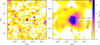 |
Fig. 1. IceCube skymap cutout surrounding the radio position of the PKS 1424+240 blazar. The color scale represents the local p-value from the 9-year maximum likelihood analysis performed by Abbasi et al. (2022). |
We used radio VLBI, which is the only technique to date that is able to directly probe the sites of neutrino and gamma-ray production by resolving structures within several parsecs from the central engine. For the redshift of PKS 1424+240, the projected angular scale of 1 mas corresponds to 6.70 pc assuming the Komatsu et al. (2009) cosmological parameters. A quick examination of PKS 1424+240 revealed that its jet has an exceptionally large apparent opening angle φapp. Pushkarev et al. (2017) found φapp = 65°, which is among the most extreme values observed for blazars. Geometrically, this indicates a small viewing angle θ to the line of sight, and consequently, strong Doppler boosting. To further investigate the source, we updated its stacked 15 GHz image by the Very Long Baseline Array (VLBA) using all available data and increasing the number of stacked epochs by about four times. The results of our serendipitous findings are presented in this Letter.
2. 15 GHz VLBA polarization imaging
The Stokes I and polarization observation of PKS 1424+240 in the MOJAVE program1 (MOJAVE: Monitoring Of Jets in Active galactic nuclei with VLBA Experiments, see Lister et al. 2018, and references therein) began in May 2009, and we report results through January 2025. To increase the dynamic range of a restored map, a set of single-epoch images was combined and averaged, that is, stacked, by aligning them using the VLBI core position derived from visibility model fitting (e.g., Lister et al. 2021). Stacking not only improves the sensitivity and dynamic range, but also effectively reconstructs a more complete source morphology, particularly in the low-brightness areas. It can also reveal the whole jet channel and not just regions of enhanced radiation at a given epoch. Image stacking is beneficial for studies of jets in Stokes I and polarized emission (e.g., Pushkarev et al. 2017, 2023; Kovalev et al. 2020; Zobnina et al. 2023).
We made stacked maps of PKS 1424+240 in Stokes I, Q, and U (Figure 2) using 42 available epochs that spanned approximately 15 years, following the procedure described in Pushkarev et al. (2023). For deep CLEANing in Stokes I, Q, and U, we applied the algorithm with the residual entropy-based stopping criterion developed by Homan et al. (2024). The linear polarization image was corrected for Ricean bias (Wardle & Kronberg 1974). We also applied a debiasing procedure to the CLEAN images to effectively suppress the side-lobe artifacts from deconvolution (Appendix B in Pushkarev et al. 2023).
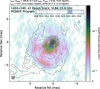 |
Fig. 2. VLBA stacked image for the blazar PKS 1424+240 at 15 GHz. Stokes I is shown by contours, the first contour corresponds to three times the image rms level. The linear polarization intensity is presented by color and the directions of EVPA by sticks. The observation dates of the 42 images used in the stacked image are indicated in the inset. A circular restoring beam is shown at the full width at half maximum (FWHM, 0.8 mas) level in the bottom left corner. FITS files of the stacked Stokes I, Q, and U images are available at the CDS. We also supply an animation of Stokes I cumulative stacking (available online). |
This debiasing procedure significantly reduced imaging artifacts, and we argue that the weak structures that are observed around the core of PKS 1424+240 in the stacked images (Figure 2) represent genuine reconstructed jet emission. The northern declination of PKS 1424+240 ensures robust VLBA uv-coverage without significant gaps. The weakly polarized emission stacks coherently over multiple epochs and is not expected to result from residual polarization leakage effects. The reduced levels of detectable 15 GHz Stokes I emission northwest next to the bright core component possibly result from residual effects of self-calibration, which only included emission to the southeast in the self-calibration model in most individual epochs.
In order to check the Figure 2 Stokes I image for consistency, we processed archival 1.6 GHz VLBA data for PKS 1424+240. See Appendix A.1 for details.
3. Looking into the jet cone
3.1. Observational signatures and magnetic field
We collected striking observational signatures of a jet that is viewed inside its cone. The stacked Stokes I and linear polarization images reveal a structure in the southeast direction, while significant emission is also present in all other directions around the core region in Stokes I and linear polarization (Figure 2). This even extends to deprojected kiloparsec scales (see Figure A.1). Furthermore, the stacked polarization image exhibits a remarkably uniform distribution of electric vector position angle (EVPA); it presents a pattern of diverging rays that start from the core. The rotation measure results obtained from 15, 24, and 43 GHz VLBA images are presented in Appendix A.2. Because the rotation measure is low and the variation very weak, we assume that the jet is propagating toward the observer. This reduces the density of the interstellar medium along its path. The low jet speeds observed by VLBI (Section 3.2) are consistent with a small jet viewing angle, θ.
We reconstructed the magnetic field structure by implementing a 90° EVPA rotation in the entire map. This assumes that neither RM nor relativistic effects significantly affect the observed projected magnetic field direction (see Appendix A.2 and Lyutikov et al. 2005). The results are shown in Figure 3. We call the image (after J. R. R. Tolkien) “the Eye of Sauron” because its nature is striking and resembles the illustrator’s (Alan Lee) views of the villain in the “Lord of the Rings”. Linear integral convolution (LIC; Cabral & Leedom 1993) was applied to the polarized intensity to visualize the morphology of the magnetic field lines by locally blurring the intensity variations in the direction of the magnetic field to effectively trace its structure. The image reveals a significant toroidal magnetic field component of a current-carrying jet that flows almost directly toward Earth. This is consistent with the widely discussed overall helical magnetic field structure (Blandford et al. 2019).
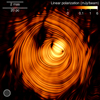 |
Fig. 3. “Eye of Sauron”. Stacked VLBA linear polarization image with the magnetic field direction incorporated by linear integral convolution. The circular restoring beam is shown at the FWHM level of 0.8 mas in the bottom left corner. |
3.2. Basic jet parameters
Lister et al. (2021) have measured apparent kinematics of two robust components in the emission of PKS 1424+240. Their apparent speed, measured in units of the speed of light, is βapp, 1 = 2.83 ± 0.89 and βapp, 2 = 1.91 ± 0.18. These moderate values are consistent with other measurements for the same source (e.g., Padovani et al. 2022; Kun & Medveczky 2023). A median intrinsic full opening angle of the jet was estimated by Pushkarev et al. (2017) to be αint = 1.2° for Fermi-detected AGN in the MOJAVE sample. We assumed this value for PKS 1424+240. Looking into the jet cone condition is defined by the requirement for the jet viewing angle θ < αint/2. This requires the Doppler factor to reach its maximum possible value of twice the Lorentz factor, δ ≈ 2Γ.
We applied the simplified assumption that the jet is observed at half of its half-opening angle, θ = αint/4. This agrees with simulations by Pashchenko et al. (in prep.). We also assumed a relation between αint and Γ, as deduced observationally by Pushkarev et al. (2017) and predicted by hydrodynamical and magnetic acceleration models of relativistic jets (Blandford & Königl 1979; Komissarov et al. 2007; Clausen-Brown et al. 2013). As a result, we found that the following set of parameters for a basic relativistic jet model is consistent with the above values and considerations: Γ = 16 (plasma flow speed β = 0.998), αint = 1.2°, θ = 0.3°, βapp = 2.8, and a Doppler factor δ = 32. The Lorentz factor is within its typical values from MOJAVE population modeling (Lister et al. 2019), as expected from the chosen conservative parameter assumptions. The Doppler factor is three times higher than the median values for the MOJAVE sample (Lister et al. 2021; Homan et al. 2021), which agrees with recent findings of Plavin et al. (2025) for neutrino-selected blazars. We note that the Γ and δ estimates are not highly sensitive to the exact value of θ as long as the line of sight remains within the jet cone. For the assumed jet viewing angle in the range 0.1 ° < θ < 1.0° and with the measured βapp values, the Doppler factors lie within the range 52 > δ > 16. Although the geometric probability of a near-zero viewing angle is low, the fraction of such jets in VLBI flux density-selected samples has been shown to be on the order of a few percent due to the Doppler bias (Lister et al. 2019).
Because of the strong projection effects and synchrotron opacity, the jet is expected to become visible many parsecs downstream from its true base. As a result, its observed radio core appears to be less active and variable than typically expected for highly boosted blazars. Moreover, the core and jet emission are superimposed, which results in a significant underestimation of the intrinsic core brightness temperature. This in turn led to an incorrect estimate of the jet parameters in Homan et al. (2021). A moderate flare occurred in the core of PKS 1424+240 during 2019–2020. The core flux density reached 0.27 Jy, while the median value over all epochs was 0.18 Jy. It did not affect these estimates significantly.
4. Emission of high-energy photons and neutrinos: Relativistic beaming
The Doppler factor crisis describes the contradiction between the short timescale of the variability in the blazar high-energy emission and the low estimates of the Doppler factor for VHE blazars (e.g., Lyutikov & Lister 2010). The apparent VLBI speed for VHE blazars is observed to be typically lower than 2 − 3c (Piner & Edwards 2018). We propose a partial solution of this problem by linking the low apparent speed with a very small jet viewing angle. Our observations suggest that the Doppler factors inferred from VHE and radio observations may be consistent and do not require different sites for these emissions.
We note that the explanation of the VHE gamma-ray flux within a leptohadronic model of Cerruti et al. (2017) required a Doppler factor of ∼30, which is consistent with our observations. The expected associated neutrino flux approximately the flux inferred from IceCube observations. The neutrino production in the blazar radio core may proceed through the pγ mechanism that was adopted by Plavin et al. (2021) and Kalashev et al. (2023) to explain TeV to PeV neutrino production. Energetic protons, which are required for the neutrino (and in the hadronic scenarios, gamma-ray production) may be accelerated either in the vicinity of the central black hole (Ptitsyna & Neronov 2016) or at the border surface between the fast spine and the slower sheath in the jet (e.g., Tavecchio & Ghisellini 2015). In any case, the specific geometry of the jet in PKS 1424+240, which is closely aligned to the line of sight, provides an additional Doppler enhancement of its multiwavelength and multimessenger fluxes. This boosting makes the object persistently bright and maintains a high average flux, which places it among the top 1% of gamma-ray sources (Ballet et al. 2023). It is also the brightest blazar in terms of high-energy neutrino emission (Abbasi et al. 2022). Future observations of this and other VHE emitting blazars are needed to pave the way for a quantitative model of neutrino production in jets, and to better understand the role of beaming in the gamma-ray emission.
5. Summary
Supermassive black holes at the heart of distant active galaxies are thought to be among the most powerful particle accelerators in the Universe. They produce VHE photons and serve as possible sources of cosmic neutrinos. The mechanism through which massive particles are accelerated to relativistic energies remains an open question in modern astrophysics. Powerful extragalactic jets are key candidates. A longstanding discrepancy, known as the Doppler factor crisis, arises from the mismatch between the low apparent plasma speeds observed with VLBI and the highly relativistic jet that is required to explain the emission. We used 16 years of 2 cm VLBI observations to uncover the properties of the parsec-scale jet of the blazar PKS 1424+240, which is exceptional in its VHE gamma-ray and probable neutrino emissions. A significant toroidal magnetic field was detected with a clear signature in linear polarization that revealed a current-carrying jet that flows almost directly toward us. We determined that the jet is observed within its cone, at a viewing angle smaller than half a degree. This geometry maximizes relativistic boosting while minimizing apparent speed, thereby resolving the Doppler factor crisis and suggesting extreme relativistic beaming for this VHE photon- and neutrino-emitting blazar. Our findings for PKS 1424+240 pave the way toward a better understanding of high-energy photon and neutrino emission from blazar jets.
The observation of jets within their plasma cone provides a unique opportunity to determine their intrinsic parameters and reconstruct the projected magnetic field structure. Moreover, these jets may represent a distinct class of AGN with enhanced VHE gamma-ray and neutrino emission. From Monte Carlo simulations of the complete VLBI-selected MOJAVE 1.5JyQC sample, we estimate that only a few percent of the jets are viewed within a degree to our line of sight (Lister et al. 2019). The results of a full MOJAVE sample analysis will be presented separately by Pushkarev et al. (in prep.).
Data availability
Stacked Stokes I, Q, U 15 GHz FITS images (Figure 2) as well as Stokes I 1.6 GHz FITS image (Figure A.1) are available at the CDS via anonymous ftp to cdsarc.cds.unistra.fr (130.79.128.5) or via https://cdsarc.cds.unistra.fr/viz-bin/cat/J/A+A/700/L12
Movie associated to Fig. 2 is available at https://www.aanda.org
Acknowledgments
We thank Andrei Lobanov, Yannis Liodakis, and Tigran Arshakian for productive discussions and comments on the manuscript. This research was funded by the European Union (ERC MuSES project No 101142396). The rotation measure analysis by JDL is supported by the M2FINDERS project, which has received funding from the ERC under the European Union’s Horizon 2020 research and innovation programme (grant agreement No 101018682). AVP is a postdoctoral fellow at the Black Hole Initiative, which is funded by grants from the John Templeton Foundation (grants 60477, 61479, 62286) and the Gordon and Betty Moore Foundation (grant GBMF-8273). The work of SVT is supported in the framework of the State project “Science” by the Ministry of Science and Higher Education of the Russian Federation under the contract 075-15-2024-541. The opinions expressed in this work are those of the authors and do not necessarily reflect the views of these Foundations. The National Radio Astronomy Observatory is a facility of the National Science Foundation operated under cooperative agreement by Associated Universities, Inc. This research has made use of the NASA/IPAC Extragalactic Database, which is funded by the National Aeronautics and Space Administration and operated by the California Institute of Technology. This research made use of the data from the MOJAVE database maintained by the MOJAVE team (Lister et al. 2018).
References
- Abbasi, R., Ackermann, M., Adams, J., et al. 2022, Science, 378, 538 [CrossRef] [PubMed] [Google Scholar]
- Aharonian, F., Akhperjanian, A. G., Bazer-Bachi, A. R., et al. 2007, ApJ, 664, L71 [NASA ADS] [CrossRef] [Google Scholar]
- Albert, J., Aliu, E., Anderhub, H., et al. 2007, ApJ, 669, 862 [Google Scholar]
- Aleksić, J., Ansoldi, S., Antonelli, L. A., et al. 2014, A&A, 567, A135 [NASA ADS] [CrossRef] [EDP Sciences] [Google Scholar]
- Ballet, J., Bruel, P., Burnett, T. H., Lott, B., & The Fermi-LAT Collaboration 2023, ArXiv e-prints [arXiv:2307.12546] [Google Scholar]
- Berezinsky, V. 1977, Proceedings of the Neutrino-77 Conference, Moscow, 177 [Google Scholar]
- Blandford, R. D., & Königl, A. 1979, ApJ, 232, 34 [Google Scholar]
- Blandford, R., Meier, D., & Readhead, A. 2019, ARA&A, 57, 467 [NASA ADS] [CrossRef] [Google Scholar]
- Cabral, B., & Leedom, L. C. 1993, Proceedings of the 20th Annual Conference on Computer Graphics and Interactive Techniques, SIGGRAPH ’93 (New York, NY, USA: ACM), 263 [Google Scholar]
- Cerruti, M., Benbow, W., Chen, X., et al. 2017, A&A, 606, A68 [NASA ADS] [CrossRef] [EDP Sciences] [Google Scholar]
- Clausen-Brown, E., Savolainen, T., Pushkarev, A. B., Kovalev, Y. Y., & Zensus, J. A. 2013, A&A, 558, A144 [NASA ADS] [CrossRef] [EDP Sciences] [Google Scholar]
- Homan, D. C., Cohen, M. H., Hovatta, T., et al. 2021, ApJ, 923, 67 [NASA ADS] [CrossRef] [Google Scholar]
- Homan, D. C., Roth, J. S., & Pushkarev, A. B. 2024, AJ, 167, 11 [Google Scholar]
- IceCube Collaboration (Aartsen, M. G., et al.) 2018, Science, 361, eaat1378 [NASA ADS] [Google Scholar]
- Kalashev, O., Kivokurtseva, P., & Troitsky, S. 2023, JCAP, 2023, 007 [Google Scholar]
- Komatsu, E., Dunkley, J., Nolta, M. R., et al. 2009, ApJS, 180, 330 [NASA ADS] [CrossRef] [Google Scholar]
- Komissarov, S. S., Barkov, M. V., Vlahakis, N., & Königl, A. 2007, MNRAS, 380, 51 [Google Scholar]
- Kovalev, Y. Y., Pushkarev, A. B., Nokhrina, E. E., et al. 2020, MNRAS, 495, 3576 [NASA ADS] [CrossRef] [Google Scholar]
- Kun, E., & Medveczky, A. 2023, Symmetry, 15, 270 [Google Scholar]
- Lister, M. L., Aller, M. F., Aller, H. D., et al. 2018, ApJS, 234, 12 [CrossRef] [Google Scholar]
- Lister, M. L., Homan, D. C., Hovatta, T., et al. 2019, ApJ, 874, 43 [NASA ADS] [CrossRef] [Google Scholar]
- Lister, M. L., Homan, D. C., Kellermann, K. I., et al. 2021, ApJ, 923, 30 [NASA ADS] [CrossRef] [Google Scholar]
- Lyutikov, M., & Lister, M. 2010, ApJ, 722, 197 [NASA ADS] [CrossRef] [Google Scholar]
- Lyutikov, M., Pariev, V. I., & Gabuzda, D. C. 2005, MNRAS, 360, 869 [Google Scholar]
- Padovani, P., Boccardi, B., Falomo, R., & Giommi, P. 2022, MNRAS, 511, 4697 [CrossRef] [Google Scholar]
- Paiano, S., Landoni, M., Falomo, R., et al. 2017, ApJ, 837, 144 [Google Scholar]
- Petrov, L. Y., & Kovalev, Y. Y. 2025, ApJS, 276, 38 [NASA ADS] [CrossRef] [Google Scholar]
- Piner, B. G., & Edwards, P. G. 2018, ApJ, 853, 68 [Google Scholar]
- Plavin, A. V., Kovalev, Y. Y., Kovalev, Y. A., & Troitsky, S. V. 2021, ApJ, 908, 157 [Google Scholar]
- Plavin, A. V., Kovalev, Y. Y., & Troitsky, S. V. 2025, ApJ, in press [arXiv:2503.08667] [Google Scholar]
- Ptitsyna, K., & Neronov, A. 2016, A&A, 593, A8 [NASA ADS] [CrossRef] [EDP Sciences] [Google Scholar]
- Pushkarev, A. B., Kovalev, Y. Y., Lister, M. L., & Savolainen, T. 2017, MNRAS, 468, 4992 [Google Scholar]
- Pushkarev, A. B., Aller, H. D., Aller, M. F., et al. 2023, MNRAS, 520, 6053 [NASA ADS] [CrossRef] [Google Scholar]
- Tavecchio, F., & Ghisellini, G. 2015, MNRAS, 451, 1502 [CrossRef] [Google Scholar]
- Wardle, J. F. C., & Kronberg, P. P. 1974, ApJ, 194, 249 [Google Scholar]
- Zobnina, D. I., Aller, H. D., Aller, M. F., et al. 2023, MNRAS, 523, 3615 [Google Scholar]
Appendix A: Supporting observational material
A.1. VLBA data at 1.6 GHz
We have processed 1.6 GHz VLBA observations of PKS 1424+240, epoch 9 May 2017, experiment code BS257A. At ten times lower frequency, the VLBA is substantially more sensitive to distant optically thin jet emission and probes angular scales ten times larger than our MOJAVE stacked image. With a total on-source time of about 3 hr, these single epoch low-frequency observations reach a high dynamic range of about 7,000:1 and confirm the emission around the VLBI core, including the North-West direction (Figure A.1). We note that our stacked image at 24 GHz also detects this emission (Figure A.2).
A.2. Rotation Measure at 15, 24, and 43 GHz
Between August 2019 and June 2021, the MOJAVE monitoring conducted monthly 15 GHz, 24 GHz, and 43 GHz band polarimetric observations of 25 AGN (including PKS 1424+240), totaling 23 epochs, in order to measure the rotation measure (RM; full results will be presented by Livingston and the MOJAVE team, in prep.). In Figure A.2 we show the mean RM of PKS 1424+240 across the two years of observations. This object is one of the lowest in total magnitude of observed RM for its core, with a median magnitude across all epochs of 302 ± 108 rad m−2, compared to a population median magnitude of 1026 ± 475 rad m−2. We also note that the median pixel-by-pixel standard deviation of RM for the core is 514 ± 57 rad m−2, making it larger than the median magnitude of RM for the core. Interestingly, across the two years, the core of PKS 1424+240 does not vary greatly in the magnitude of RM, sitting in the bottom 25th percentile of time variability of sources. However, the jet of PKS 1424+240 has a time variability of RM similar to other sources within the sample. We also detect frequency dependent depolarization, which is typical of most sources within our sample. This combined with the low magnitude RM suggests that the Faraday rotation that we do see is external to the jet.
As RM data is not available for all 42 epochs used in Figure 2 and individual epochs do not have RM data for the full jet region, we cannot apply a precise correction for the Faraday effect on EVPA. The median magnitude of RM for PKS 1424+240 corresponds to a EVPA rotation of ∼6°, which is comparable to our EVPA errors from calibration and imaging.
The low magnitude and variability of RM especially close to the core of PKS 1424+240 are indicative of either a weak magnetic field or low thermal electron density along the line of sight. We may be seeing the ‘sweeping away’ of the magneto-ionic medium, this would result in a reduction in the magnitude of RM. This effect would be more prominent within the center of the jet, while the edges would be less affected, which is supported by the magnitude and variability of RM being typical of other sources for the jet region of PKS 1424+240.
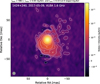 |
Fig. A.1. 1.6 GHz VLBA image of PKS 1424+240, epoch 9 May 2017. A circular restoring beam is shown in the left bottom corner at the FWHM level of 8.17 mas. The image supports the viewing angle being less than a half-opening angle even at large (kiloparsec, deprojected) spatial scales probed by the low-frequency observations. Stokes I image FITS file is is available at the CDS. |
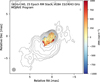 |
Fig. A.2. Stacked mean RM map of 15/24/43 GHz VLBA data for PKS 1424+240 in the frame of the observer across 23 epochs from 15 August 2019 to 25 June 2021 in color scale. The contours show the mean 24 GHz Stokes I; the first contour corresponds to 3× the image rms level, with contours increasing by a factor of 2. The grey circle indicates the FWHM level of the circular restoring beam. The map shows the magnitude of RM is low and similar across the source. |
All Figures
|
Fig. 1. IceCube skymap cutout surrounding the radio position of the PKS 1424+240 blazar. The color scale represents the local p-value from the 9-year maximum likelihood analysis performed by Abbasi et al. (2022). |
| In the text | |
|
Fig. 2. VLBA stacked image for the blazar PKS 1424+240 at 15 GHz. Stokes I is shown by contours, the first contour corresponds to three times the image rms level. The linear polarization intensity is presented by color and the directions of EVPA by sticks. The observation dates of the 42 images used in the stacked image are indicated in the inset. A circular restoring beam is shown at the full width at half maximum (FWHM, 0.8 mas) level in the bottom left corner. FITS files of the stacked Stokes I, Q, and U images are available at the CDS. We also supply an animation of Stokes I cumulative stacking (available online). |
| In the text | |
|
Fig. 3. “Eye of Sauron”. Stacked VLBA linear polarization image with the magnetic field direction incorporated by linear integral convolution. The circular restoring beam is shown at the FWHM level of 0.8 mas in the bottom left corner. |
| In the text | |
|
Fig. A.1. 1.6 GHz VLBA image of PKS 1424+240, epoch 9 May 2017. A circular restoring beam is shown in the left bottom corner at the FWHM level of 8.17 mas. The image supports the viewing angle being less than a half-opening angle even at large (kiloparsec, deprojected) spatial scales probed by the low-frequency observations. Stokes I image FITS file is is available at the CDS. |
| In the text | |
|
Fig. A.2. Stacked mean RM map of 15/24/43 GHz VLBA data for PKS 1424+240 in the frame of the observer across 23 epochs from 15 August 2019 to 25 June 2021 in color scale. The contours show the mean 24 GHz Stokes I; the first contour corresponds to 3× the image rms level, with contours increasing by a factor of 2. The grey circle indicates the FWHM level of the circular restoring beam. The map shows the magnitude of RM is low and similar across the source. |
| In the text | |
Current usage metrics show cumulative count of Article Views (full-text article views including HTML views, PDF and ePub downloads, according to the available data) and Abstracts Views on Vision4Press platform.
Data correspond to usage on the plateform after 2015. The current usage metrics is available 48-96 hours after online publication and is updated daily on week days.
Initial download of the metrics may take a while.