


Fig. 4
Download original image
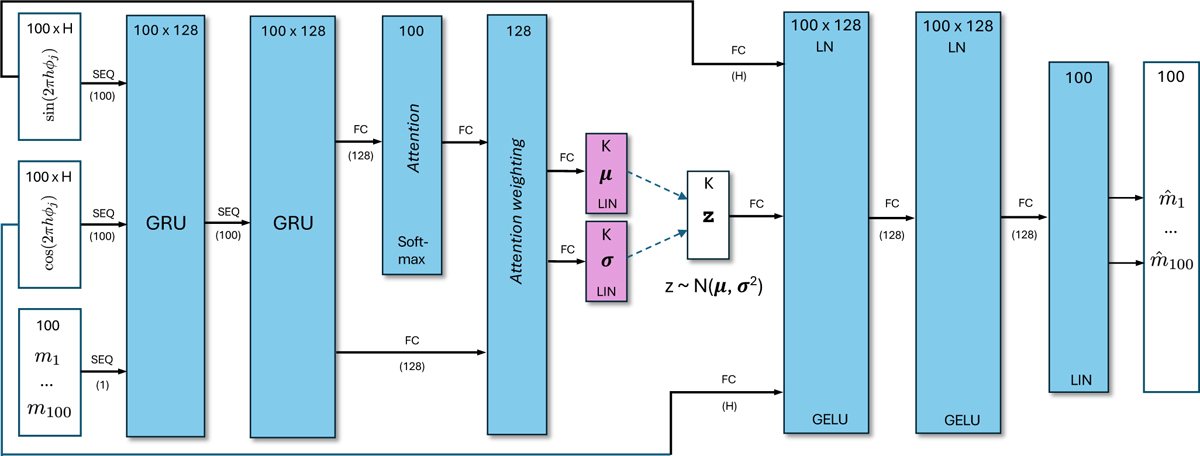
Variational autoencoder used to create a K = 5 dimensional latent space given the 100 points of the folded light curve (phase ϕj ∈ [0, 1] and the standardised G-magnitude mj). The network does not receive the 100 phase values ϕj directly but rather the 100 × H values sin(2πhϕj), with h = 1, . . ., H and an equal number of values cos(2πhϕj). The first neural layer is a GRU to which the observations are fed sequentially (SEQ), i.e. 100 consecutive sets of size 1 + 2H corresponding to each time point of the light curve. The result is a matrix of size 100 × 128. Each of the 100 rows is then fed sequentially to the next GRU layer, resulting in a matrix of the same shape. The next layer takes each row of this matrix (of size 128), and computes an attention score corresponding to each point of the light curve. These scores are then used in a subsequent layer to compute a weighted average over the matrix rows, producing a feature set of size 128 where the time points that were deemed more important given the attention score receive a higher weight. In the final layers of the encoder, this feature set is then further reduced to the K = 5-dimensional latent coordinates (purple rectangles). The decoder works similarly as explained in Fig. 2, but now also receives the phase information (sin(2πhϕj), cos(2πhϕj)). The first decoding neural layer results in a matrix of size 100 × 128. Each row (of size 128) of this matrix is then fed to a neural layer, resulting again in a 100 × 128 matrix, which is then further reduced to a vector of size 100 by the final decoding layer, resulting in the 100 reconstructed (standardised) magnitudes of the folded light curve.
Current usage metrics show cumulative count of Article Views (full-text article views including HTML views, PDF and ePub downloads, according to the available data) and Abstracts Views on Vision4Press platform.
Data correspond to usage on the plateform after 2015. The current usage metrics is available 48-96 hours after online publication and is updated daily on week days.
Initial download of the metrics may take a while.