


| Issue |
A&A
Volume 702, October 2025
|
|
|---|---|---|
| Article Number | A261 | |
| Number of page(s) | 5 | |
| Section | Atomic, molecular, and nuclear data | |
| DOI | https://doi.org/10.1051/0004-6361/202556536 | |
| Published online | 28 October 2025 | |
Absolute cross sections of single and double electron capture for C4+ colliding with He, O2, N2, and CH4
Institute of Modern Physics, Key Laboratory of Nuclear Physics and Ion-Beam Application (MOE), Fudan University,
Shanghai
200433,
China
★ Corresponding author. This email address is being protected from spambots. You need JavaScript enabled to view it.
; This email address is being protected from spambots. You need JavaScript enabled to view it.
Received:
22
July
2025
Accepted:
13
September
2025
Abstract
Context. Charge exchange between solar wind C4+ ions and neutrals drives soft X-ray and extreme ultraviolet emissions in astrophysical environments. Laboratory studies of charge exchange processes provide accurate atomic structure parameters, which are essential for the modeling of astrophysical plasmas.
Aims. We aim to measure the absolute charge exchange cross section of C4+ colliding with He, O2, N2, and CH4 for their potential applications in astrophysical plasma modeling, as such processes take place between fast solar wind and neutral gases in planetary atmospheres.
Methods. The experiments were performed on a 150 kV highly charged ion collision apparatus at Fudan University. The C4+ ions were generated from a 14.5 GHz electron cyclotron resonance ion source, collided with the target gas in the gas cell, and detected by a position-sensitive detector. We utilized the growth rate approach to investigate the electron capture cross section data.
Results. We provide new absolute electron capture cross section data of C4+ colliding with He, O2, N2, and CH4 in the energy range of 2.3–33.3 keV/u or 671–2535 km/s, with experimental uncertainties of 9% and 10% for single- and double-electron capture, respectively. The measured single-electron capture cross sections for C4++He show significant deviations from existing theoretical calculations. Conclusions. We obtained the absolute single- and double-electron capture cross sections of C4+ colliding with He, O2, N2, and CH4. These new data significantly deviate from the predictions of current modeling approaches.
Key words: atomic data / atomic processes / molecular data / solar wind
© The Authors 2025
 Open Access article, published by EDP Sciences, under the terms of the Creative Commons Attribution License (https://creativecommons.org/licenses/by/4.0), which permits unrestricted use, distribution, and reproduction in any medium, provided the original work is properly cited.
This article is published in open access under the Subscribe to Open model. This email address is being protected from spambots. You need JavaScript enabled to view it. to support open access publication.
1 Introduction
Charge exchange (CX) between highly charged solar wind ions and neutral species is a pivotal mechanism driving soft X-ray and extreme ultraviolet (EUV) emissions in diverse astrophysical environments. Since the landmark discovery of cometary X-rays via the ROSAT satellite (Lisse et al. 1996), CX has been identified as the dominant process in planetary exospheres (Jupiter's aurora; Gladstone et al. 2002), Martian proton aurorae (Deighan et al. 2018), and supernova remnants (Katsuda et al. 2011). This process involves electron transfer from neutral atoms or molecules to multiply charged ions, followed by radiative de-excitation that emits photons spanning the EUV to the soft X-ray range. Spectroscopic modeling of CX emissions enables critical diagnostics of plasma parameters, including solar wind composition, ion velocity distributions, and neutral gas densities (Dennerl et al. 2006; Bodewits et al. 2016; Gu et al. 2016, 2018; Wedlund et al. 2019), especially with the advent of high-resolution astrophysical spectroscopy (Brogi et al. 2017; Ezoe et al. 2021). However, the accurate interpretation of the space spectra remains hindered by incomplete total and state-resolved CX cross sections, particularly for multi-electron processes and molecular targets at collision energies relevant to coronal mass ejections (CMEs; Gopalswamy et al. 2009).
Carbon ions, particularly C4+, constitute 29% of solar wind carbon (Ko et al. 1997) and generate diagnostic X-ray lines when interacting with planetary neutrals (Cravens 2002), while neutral helium is abundant in planetary exospheres such as Jupiter's (Moradmand et al. 2018). The reported velocity of fast components in the solar wind is approximately 600–2000 km/s (Phillips et al. 1995; Feldman et al. 2005; Gopalswamy et al. 2009). Single- and double-electron capture (SEC and DEC) cross sections, measured in laboratory experiments by accelerating C4+ ions to specific energies and bombarding gas targets, are essential for modeling the intensity and spectral features of CX X-ray emissions. In addition, the helium-like electronic structure allows for accurate theoretical treatment using frozen-core approximations (Zatsarinny et al. 2004), thereby facilitating the calculation of atomic structure and collision dynamics. Eventually, systematic studies of CX cross sections of C4++He collisions serve as a benchmark system for the data used in astrophysical plasma modeling.
Over the past decades, the EC processes involving C4+ ions colliding with helium have been extensively investigated. For SEC, Ishii et al. 2004 measured absolute total SEC cross sections below 0.6 keV/u, but classical over-barrier (COB) calculations exhibited significant discrepancies in the low-energy region. Later, the semiclassical mechanical close-coupling (SMOCC) approach of Kimura et al. (1984) and the quantum-mechanical close-coupling method (QMOCC) of Yan et al. (2013) achieved excellent agreement with experimental measurements for E < 0.4 keV/u. Relative state-selective SEC cross sections were further studied using atomic orbital close-coupling (AOCC) calculations (Zhao et al. 2010), and their predictions have been evaluated by recent experiments (Guo et al. 2022; Yin et al. 2025). For DEC, Crandall et al. (1976) observed DEC dominance at low energies, E ≤ 1 keV/u, with cross sections up to two orders of magnitude larger than SEC. The semiclassical mechanical close-coupling calculations (Shipsey et al. 1977; Kimura et al. 1984) quantitatively reproduced the observation. Although the absolute total EC cross sections of C4++He collisions in the low-energy regime (<10 keV/u) have been well characterized through combined experimental and theoretical efforts, experimental measurements at higher collision energies remain scarce. Furthermore, studies involving molecular targets, such as O2, N2, and CH4, which are the primary species found in planetary exospheres (Waite et al. 2007; Jakosky et al. 2015), are markedly absent in astrophysical modeling. Systematic measurements for these complex targets across broader energy ranges are urgently needed.
In this article, we present a systematic experimental study of absolute cross sections of SEC and DEC in C4+ collisions with He, O2, N2, and CH4 at 2.3–33.3 keV/u or 671–2535 km/s, corresponding to the velocities of the fast ion components of the solar wind. The measured cross sections were compared with existing theoretical calculations and measurements.
2 Experimental method
The experiments were conducted on a 150 kV highly charged ion collision apparatus (Han et al. 2021; Xia et al. 2022). The details have been discussed in previous papers (Meng et al. 2023; Ma et al. 2025). As illustrated in Fig. 1, C4+ ions were obtained from the electron-cyclotron resonance (ECR) ion source operating at 14.5 GHz and accelerated to the required energy. The proper charge state of carbon ions was chosen using a 90° magnetic analyzer. The projectile ions were adjusted employing a number of slits and electric deflectors and directed toward a gas cell.
After collision with the gas target in the gas cell, the incident carbon ions with degraded charge states were separated via an electric deflector and detected by a position-sensitive detector (PSD). Note that the gas cell pressure was well maintained under 2 Pa, while the other chamber's background pressure was kept below 10−6 Pa. This ensured that a single collision occurred between the target gas and the projectile ions, and collisions with background gas were neglected. This is essential for utilizing the growth rate approach to calculate total cross sections. Moreover, based on the delay-line anode, the microchannel plate (MCP) detector produces an imaging map that provides the position information for ions with different charge states.
The growth rate approach was utilized to investigate the data of EC cross sections (Tawara & Russek 1973). The cross sections for incident ions to capture j electrons from the target is expressed by
 (1)
(1)
where kB is the Boltzmann constant, T refers to the thermal temperature of the gas cell in kelvin, and L stands for the collision length in the gas cell. In the present study, K=Fq-j/P is measured at a series of gas pressures using the growth rate approach, where Fq-j=Nq-j/Ntotal shows the detected fractions of ions with charge state q-j among all detected charged ions, and P represents the pressure of the target gas measured by a capacitance manometer.
The uncertainties in the EC cross section measurements comprise both systematic and statistical components. The systematic uncertainties primarily originate from the collision length uncertainty in the gas cell, pressure fluctuation, stability of beam, and the efficiency and homogeneity of the detector, which were estimated to be 2%, 3%, 4%, and 5.8%, respectively. A detailed discussion can be found in a previous study (Ma et al. 2025). In C4++He collision measurements, the statistical errors for SEC and DEC cross sections are 5.2% and 6.3%, respectively, resulting in total experimental uncertainties at 9.6% and 10.2%, respectively. Similarly, the experimental uncertainties were estimated to be 8.9%, 8.7%, and 8.8% for SEC measurements of C4+ colliding with O2, N2, and CH4, respectively, and 9.3%, 9.2%, and 9.5% for DEC measurements for O2, N2, and CH4, respectively.
By combining the prior results of state-selective SEC cross sections (Yin et al. 2025), the absolute state-selective SEC cross sections were obtained through normalization to the absolute total cross sections measured in this work. Note that, to acquire pure SEC cross sections, DEC autoionization and transfer ionization processes must be excluded. For C4+ colliding with He, the coincidence events of C3+ ions and recoiling He2+ ions arise from DEC autoionization and transfer ionization processes, resulting in an approximately 8.5% contribution within the experimental energy range, showing no significant dependence on the incident energy range (Yin et al. 2025).
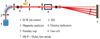 |
Fig. 1 Schematic drawing of the laboratory setup. The ions are generated using the ECR ion source. The beamline consists of carbon ions of multiple charge states. After passing through the last electric deflector behind a gas cell, ions with varying charges are detected by the delay line anode detector. |
3 Results and discussion
3.1 C4++He
The measured absolute cross sections of SEC and DEC for C4+ collisions with He at 2.3–33.3 keV/u are presented in Fig. 2, with the data summarized in Table 1. As seen in Fig. 2a, the absolute cross section for SEC noticeably shows reliance on experimental energy, which exhibits a predominantly upward trend across the energy spectrum from 2.3 to 33.3 keV/u. Below 5 keV/u, the cross section rises sharply, which is consistent with earlier measurements by Crandall et al. (1976) and Dijkkamp et al. (1985). Theoretical calculations using the molecular orbital method (Kimura et al. 1984) yield slightly lower values than the present experimental measurements, whereas the semiclassical atomic-orbital close-coupling (SCAOCC) predictions (Gao et al. 2017) show better agreement. This improved consistency is likely due to the inclusion of electron correlation effects in the SCAOCC calculations.
However, the present SEC measurements show significant deviation from theoretical predictions (Gao et al. 2017) in the energy region of 5-33 keV/u. As shown in previous results (Yin et al. 2025), different nl EC states exhibit independent tendencies with respect to collision energy. To understand the reason for this discrepancy, the absolute state-selective cross sections were derived by normalizing the measured 2s, 2p, and 3l cross sections to the total cross sections, and then compared with the calculations of Gao et al. (2017). As shown in Fig. 3 and Table 2, the absolute state-selective cross sections indicate that at energies above 13 keV/u, the dominant capture mechanism shifts from the 2p state to higher 3l states. With this change, the observed plateau in the experimental cross sections and its deviation from theory can be probably explained, as the increasing capture probability of the 3l state only partially offsets the significantly decreasing contribution of the 2p channel.
Figure 2b shows the energy dependence of the absolute DEC cross sections in the impact energy of 2.3–33.3 keV/u. Overall, absolute DEC cross sections remain nearly constant across the present energy range, with only a little decrease of about 8% at higher energies. At low energies of 2.3–6.7 keV/u, the present results align well with the reported experimental data by Crandall et al. (1976). Within experimental uncertainties, the theoretical predictions using the SCAOCC method (Gao et al. 2017) have been validated, indicating that DEC is less sensitive to variations in collision energy over the range of 10–35 keV/u.
Measured absolute cross sections of SEC and DEC processes for C4++He(IP=24.6 eV).
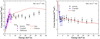 |
Fig. 2 Measured absolute SEC (a) and DEC (b) cross sections for C4++He collisions. (a) SEC experimental data: present work (black squares); Crandall et al. (1976; purple circles); and Dijkkamp et al. (1985; blue triangles). Theoretical predictions: Gao et al. (2017; solid red line); and Kimura et al. (1984; dashed blue line). (b) DEC experimental data: present work (black squares); and Crandall et al. (1976; blue circles). Theoretical predictions: Gao et al. (2017; solid red line). |
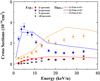 |
Fig. 3 Absolute nl-resolved SEC cross sections for C4++He collisions. Experimental data: present work (solid symbols). Theoretical predictions: Gao et al. (2017; solid lines). |
3.2 C4++O2, N2, and CH4
The experimental measurements of SEC and DEC cross sections for C4+ collisions with O2, N2, and CH4 are displayed in Fig. 4, with the data summarized in Table 3. The SEC cross sections exhibit a clear decreasing trend with increasing collision energy, dropping by 39–57% at 2.3–33.3 keV/u. This result is markedly different from that observed with the He target. Among different molecular targets, the SEC cross sections exhibit notable variations, where CH4 consistently yields larger cross sections than O2 and N2 over the energy range. The absolute cross sections of O2 and N2 targets are found to be basically equivalent, although with a 13% difference in their ionization energies.
In contrast to the downward tendency observed in the SEC cross sections, the DEC cross sections remain nearly constant across the entire energy range, resulting in an increase in the DEC/SEC ratio with increasing energy (e.g., from 0.27 to 0.44 for CH4). Furthermore, significant variation was observed between atomic and molecular targets for the DEC absolute total cross sections. Specifically, the cross sections for C4+ ions colliding with molecular targets are approximately four to five times larger than those for the He target.
Based on the classical over-barrier model (COBM; Mann et al. 1981) and the empirical scaling law by Bliman et al. (1983), the total SEC cross sections were given by the equation
 (2)
(2)
![Mathematical equation: $\sigma_{q, q-1}=(4 \pm 0.7) \times q /\left[I_{p}(\mathrm{eV})\right]^{3} \times 10^{-12} \mathrm{~cm}^{2},$](/articles/aa/full_html/2025/10/aa56536-25/aa56536-25-eq3.png) (3)
(3)
where q is the charge state of projectile ions, n represents the principal quantum number for electron capture, Ip refers to the ionization energy of targets, and A stands for charge transfer probability.
As shown in Table 4, comparison of the experimental SEC cross sections with theoretical predictions employing empirical models reveals systematic discrepancies that highlight shortcomings in current modeling approaches. The classical over-barrier model overestimates the SEC cross sections by factors of 1.7–3.3. This discrepancy arises because the COBM neglects critical factors such as the ion incident energy and the different contributions from fine-structure states (l) (Mann et al. 1981). Similarly, the results calculated using the empirical scaling law by Bliman et al. (1983) also exceed the present measurements, particularly for molecular targets. This is expected because the Bliman scaling was primarily calibrated for collisions with noble gas atoms (He, Ne, and Ar) and fails to account for critical complexities inherent to diatomic and polyatomic molecules. These comparisons underscore the need to develop quantum theoretical treatments, such as the SCAOCC method applied to molecular systems, which account for collision energy dependence, electron correlations, and state-selective EC mechanism. Moreover, the present experiments reveal target-dependent variations in EC processes, which are inconsistent with established empirical formulas. Therefore, we propose that by using experimental data for calibrations, especially for polyatomic systems, the current empirical formula can be enhanced for modeling astrophysical spectroscopy of CX emissions.
Measured absolute nl-resolved cross sections of SEC processes for C4++He collisions.
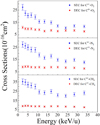 |
Fig. 4 Measured absolute cross sections of SEC and DEC processes for C4++O2, N2, and CH4. |
4 Conclusions
In this study, we presented systematic experimental measurements of absolute SEC and DEC cross sections for C4+ colliding with He, O2, N2, and CH4 targets at 2.3–33.3 keV/u. For the SEC cross sections of C4++He collisions, experimental results exhibit significant deviations from the calculations of Gao et al. (2017) using the SCAOCC method, which are attributed to the competition between different EC channels. Specifically, the dominant capture channel shifts from the 2p state to higher 3l states as the impact energy increases and the decrease in the 2p state cross section offsets the increase in the 3l state cross sections, resulting in a plateau in the total SEC cross section. For molecular targets like O2, N2, and CH4, SEC cross sections show a significant reduction by 39–57% with increasing energy, while DEC cross sections are insensitive to the impact energy and remain constant. In addition, the DEC/SEC ratio rises systematically at higher velocities, which underscores the growing importance of multi-electron processes in fast solar wind interactions. In general, classical models fail to predict accurate SEC cross sections, exposing the need for more advanced quantum theoretical treatments especially for molecular systems where theoretical calculations are lacking. The present results address critical gaps in CX databases, providing essential benchmarks for diagnosing solar wind composition and contributing to the refinement of current empirical models used in astrophysical spectroscopy of CX emissions.
Measured absolute cross sections of SEC and DEC processes for C4++O2, N2, and CH4(IP=12.1 eV, 15.6 eV, and 12.6 eV, respectively).
Comparison of measured SEC cross sections with calculations using different scaling laws for C4+ colliding with He, O2, N2, and CH4.
Acknowledgements
This work was supported by the National Key R&D Program of China (Grant No. 2022YFA1602504 and 2023YFA1606501), the National Natural Science Foundation of China (Grants No. 12374227, 12474251, and No. U1832201). The authors thank Prof. Jianguo Wang for the valuable discussions.
References
- Bliman, S., Bonnefoy, M., Bonnet, J. J., et al. Phys. Scripta, T3, 63 [Google Scholar]
- Bodewits, D., Christian, D. J., Torney, M., et al. 2007, A&A, 469, 1183 [NASA ADS] [CrossRef] [EDP Sciences] [Google Scholar]
- Brogi, M., Line, M., Bean, J., Désert, J. M., & Schwarz, H., 2017, ApJ, 839, L2 [Google Scholar]
- Crandall, D. H., Olson, R. E., Shipsey, E. J., & Browne, J. C., 1976, Phys. Rev. Lett, 36, 858 [Google Scholar]
- Cravens, T. E., 2002, Science, 296, 1042 [CrossRef] [Google Scholar]
- Dijkkamp, D., Ciric, D., Vileg, E., de Boer, A., & de Heer, F. J., 1985, J. Phys. B, 18, 4763 [Google Scholar]
- Dennerl, K., Lisse, C. M., Bhardwaj, A., et al. 2006, A&A, 451, 709 [NASA ADS] [CrossRef] [EDP Sciences] [Google Scholar]
- Deighan, J., Jain, S., Chaffin, M., et al. 2018, Nat. Astron, 2, 802 [Google Scholar]
- Ezoe, Y., Ohashi, T., & Mitsuda, K., 2021, Rev. Mod. Plasma Phys., 5, 4 [Google Scholar]
- Feldman, U., Landi, E., & Schwadron, N. A., 2005, J. Geophys. Res. Space Phys., 110, A7 [Google Scholar]
- Gao, J. W., Wu, Y., Sisourat, N., Wang, J. G., & Dubois, A., 2017, Phys. Rev. A, 96, 052703 [Google Scholar]
- Gladstone, G. R., Waite, J. H., Grodent, D., et al. 2002, Nature, 415, 1000 [Google Scholar]
- Gopalswamy, N., Yashiro, S., Michalek, G., et al. 2009, Earth Moon Planets, 104, 295 [NASA ADS] [CrossRef] [Google Scholar]
- Gu, L. Y., Kaastra, J., & Raassen, A. J. J., 2016, A&A, 588, A52 [NASA ADS] [CrossRef] [EDP Sciences] [Google Scholar]
- Gu, L. Y., Mao, J. J., Plaa, J. D., et al. 2018, A&A, 611, A26 [NASA ADS] [CrossRef] [EDP Sciences] [Google Scholar]
- Guo, D. L., Zhang, R. T., Zhu, X. L., et al. 2022, ApJ, 941, 31 [Google Scholar]
- Han, J., Wei, L., Wang, B., et al. 2021, ApJS, 253, 6 [Google Scholar]
- Ishii, K., Itoh, A., & Okuno, K., 2004, Phys. Rev. A, 70, 042716 [Google Scholar]
- Jakosky, B. M., Lin, R. P., Grebowsky, J. M., et al. 2015, Geophys. Res. Lett., 42, 21 [Google Scholar]
- Katsuda, S., Tsunemi, H., Mori, K., et al. 2011, ApJ, 730, 24 [NASA ADS] [CrossRef] [Google Scholar]
- Kimura, M., & Olson, R. E., 1984, J. Phys. B, 17, L713 [Google Scholar]
- Ko, Y. K., Fisk, L. A., Geiss, J., Gloeckler, G., & Guhathakurta, M., 1997, Sol. Phys, 171, 345 [Google Scholar]
- Lisse, C. M., Dennerl, K., Englhauser, J., et al. 1996, Science, 274, 205 [NASA ADS] [CrossRef] [Google Scholar]
- Ma, P. F., Wang, J. R., Zhang, Z. X., et al. 2023, Nucl. Sci. Technol., 34, 156 [Google Scholar]
- Ma, P. F., Yin, H., Ren, B. H., et al. 2025, ApJ, 978, 6 [Google Scholar]
- Mann, R., Folkmannt, F., & Beyer, H. F., 1981, J. Phys. B, 14, 1161 [Google Scholar]
- Meng, T., Ma, M. X., Tu, B., et al. 2023, New J. Phys, 25, 093026 [Google Scholar]
- Moradmand, A., El Ghazaly, M. O. A., Mahaptra, D. P., & Chutjian, A., 2018, ApJS, 234, 14 [Google Scholar]
- Phillips, J. L., Bame, S. J., Feldman, W. C., et al. 1995, Science, 268, 1030 [CrossRef] [Google Scholar]
- Shipsey, E. J., Browne, J. C., & Olson, R. E., 1977, Phys. Rev. A, 15, 2166 [Google Scholar]
- Tawara, H., & Russek, A., 1973, Rev. Mod. Phys, 45, 178 [Google Scholar]
- Waite, J. H., Young, D. T., Cravens, T. E., et al. 2007, Science, 316, 870 [CrossRef] [Google Scholar]
- Wedlund, C. S., Bodewits, D., Alho, M., et al. 2019, A&A, 630, A35 [NASA ADS] [CrossRef] [EDP Sciences] [Google Scholar]
- Xia, Z. H., Ren, B., Zhang, R. T., et al. 2022, ApJ, 933, 207 [Google Scholar]
- Yan, L. L., Wu, Y., Qu, Y. Z., Wang, J. G., & Buenker, R. J., 2013, Phys. Rev. A, 88, 022706 [Google Scholar]
- Yin, H., Meng, T. M., Ma, P. F., et al. 2025, Phys. Lett. A, 546, 130527 [Google Scholar]
- Zatsarinny, O., Bartschat, K., Garcia, J., & Hansen, J. E., 2004, J. Phys. B, 37, 2173 [Google Scholar]
- Zhao, Y. Q., Liu, L., Xue, P., et al. 2010, J. Phys. Soc. Jpn, 79, 064301 [Google Scholar]
All Tables
Measured absolute cross sections of SEC and DEC processes for C4++He(IP=24.6 eV).
Measured absolute nl-resolved cross sections of SEC processes for C4++He collisions.
Measured absolute cross sections of SEC and DEC processes for C4++O2, N2, and CH4(IP=12.1 eV, 15.6 eV, and 12.6 eV, respectively).
Comparison of measured SEC cross sections with calculations using different scaling laws for C4+ colliding with He, O2, N2, and CH4.
All Figures
|
Fig. 1 Schematic drawing of the laboratory setup. The ions are generated using the ECR ion source. The beamline consists of carbon ions of multiple charge states. After passing through the last electric deflector behind a gas cell, ions with varying charges are detected by the delay line anode detector. |
| In the text | |
|
Fig. 2 Measured absolute SEC (a) and DEC (b) cross sections for C4++He collisions. (a) SEC experimental data: present work (black squares); Crandall et al. (1976; purple circles); and Dijkkamp et al. (1985; blue triangles). Theoretical predictions: Gao et al. (2017; solid red line); and Kimura et al. (1984; dashed blue line). (b) DEC experimental data: present work (black squares); and Crandall et al. (1976; blue circles). Theoretical predictions: Gao et al. (2017; solid red line). |
| In the text | |
|
Fig. 3 Absolute nl-resolved SEC cross sections for C4++He collisions. Experimental data: present work (solid symbols). Theoretical predictions: Gao et al. (2017; solid lines). |
| In the text | |
|
Fig. 4 Measured absolute cross sections of SEC and DEC processes for C4++O2, N2, and CH4. |
| In the text | |
Current usage metrics show cumulative count of Article Views (full-text article views including HTML views, PDF and ePub downloads, according to the available data) and Abstracts Views on Vision4Press platform.
Data correspond to usage on the plateform after 2015. The current usage metrics is available 48-96 hours after online publication and is updated daily on week days.
Initial download of the metrics may take a while.