


Fig. 8
Download original image
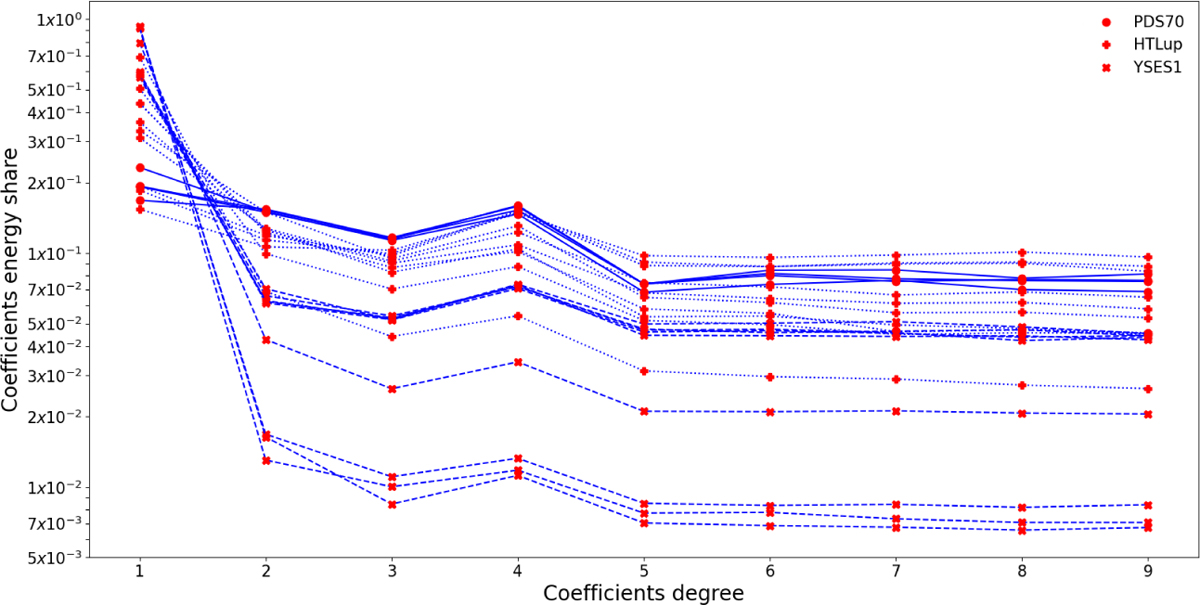
Energy share curves of the estimated polynomial coefficients for each of the degrees (except that of degree of 0 as accounting for the total flux and not for the variations) of the basis of decomposition. Before estimating each of the coefficients (except that of degree of 0), the modulations by the base polynomials are, firstly, subtracted from their average, secondly, L2 normalized. For each degree, the energy share is calculated as the median over the field of view of the squared coefficients, divided by the sum of all the median squared coefficients (except that of degree of 0). This was done for PDS70, HTLup, and YSES1 data cubes, each time for individual exposure. This shows that the degree of 4 polynomial coefficients are the last useful ones. Above, the energy of the high-degree coefficients converges towards a minimum where it is mainly fitting noise. It can be seen here that this minimum is reached for the degree of 5 for each of the 23 observations data, indicating that this choice may well generalize.
Current usage metrics show cumulative count of Article Views (full-text article views including HTML views, PDF and ePub downloads, according to the available data) and Abstracts Views on Vision4Press platform.
Data correspond to usage on the plateform after 2015. The current usage metrics is available 48-96 hours after online publication and is updated daily on week days.
Initial download of the metrics may take a while.