


Fig. 8
Download original image
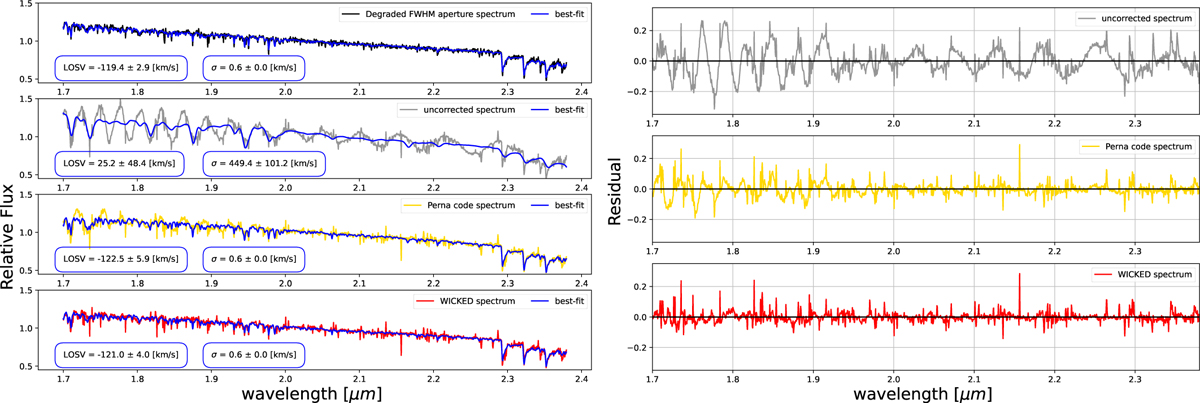
Left: PPXF fits (blue) for the integrated spectrum (black) of the M-giant star J15395077, uncorrected brightest spaxel spectrum (gray), spectrum corrected with the code by Perna et al. (2023) (yellow), and spectrum corrected using WICKED (red). The FWHM aperture spectrum was degraded to match the S/N of the brightest spaxel of the cube. The best-fit LOSV and velocity dispersion for each spectrum are shown in the blue text boxes. We see that for an uncorrected spectrum it is not possible to obtain a reliable fit due to the wiggles, having a difference ~145 km s−1 with the LOSV of the integrated spectrum, three times larger than the estimated uncertainty. While, for both the spectrum corrected using WICKED and the code by Perna et al. (2023) a good fit can be achieved, with both being consistent within uncertainties with the LOSV of the integrated spectrum (wiggles-free). We note that using WICKED we obtain a best-fit value closer to the “true” value of 119.9 ± 2.7 for the integrated spectrum, and an uncertainty ~45% smaller than for the spectrum corrected with the code by Perna et al. (2023), which is probably due to the superior performance of WICKED at removing the wiggles. Right: residuals between each spectrum and the best fit. One can see that the residuals for the spectrum corrected using WICKED (red) are flat and mostly dominated by outliers left during the data reduction with the JWST pipeline, while for the spectrum corrected using the code by Perna et al. (2023) there are plenty of residual wiggles.
Current usage metrics show cumulative count of Article Views (full-text article views including HTML views, PDF and ePub downloads, according to the available data) and Abstracts Views on Vision4Press platform.
Data correspond to usage on the plateform after 2015. The current usage metrics is available 48-96 hours after online publication and is updated daily on week days.
Initial download of the metrics may take a while.