


Fig. 4.
Download original image
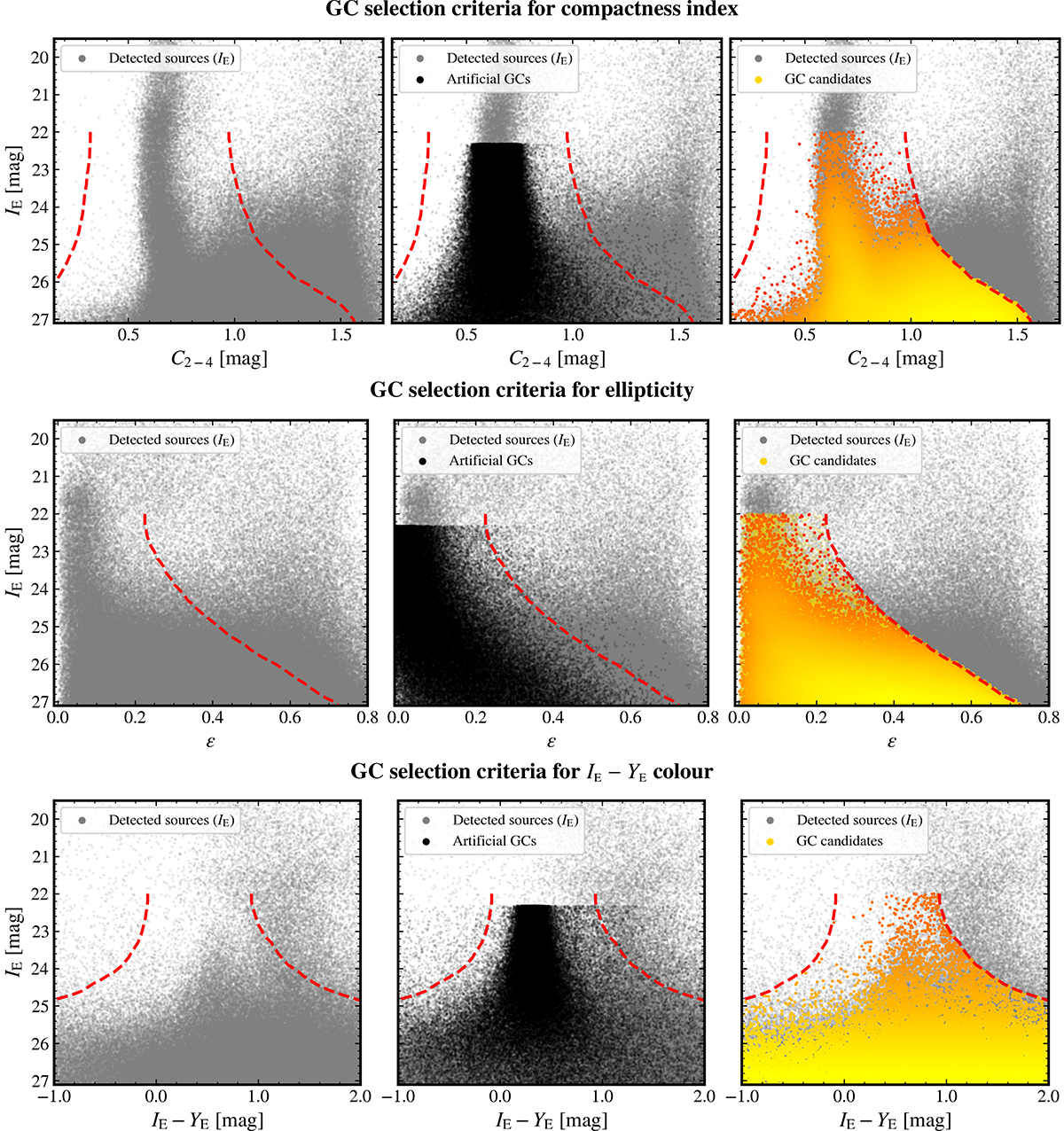
Photometric criteria applied for GC identification when aiming for high completeness. The three rows demonstrate these criteria for compactness index (C2 − 4), ellipticity (ε), and IE−YE colour (as an example). In each row, we show the real sky sources detected in Euclid IEimages (grey points), the detected artificial GCs (black points), and the real sky sources selected as GC candidates (yellow points). The dashed red curves represent the selection boundaries adopted based on the distribution of artificial GCs in each parameter space. In the top row, we see that the artificial GCs follow the vertical sequence of point sources (with an average C2 − 4 = 0.7), and the scatter becomes larger with fainter magnitude due to an increase in photometric uncertainties. In the bottom row, we see that the selection boundaries reject the majority of objects with IE < 24 and IE−YE > 1, which are foreground stars. However, a fraction of those stars end up in the final catalogue. This contamination is unavoidable considering the expected colour range of GCs. Tightening the selection criteria removes these contaminant stars, but leads to lower completeness.
Current usage metrics show cumulative count of Article Views (full-text article views including HTML views, PDF and ePub downloads, according to the available data) and Abstracts Views on Vision4Press platform.
Data correspond to usage on the plateform after 2015. The current usage metrics is available 48-96 hours after online publication and is updated daily on week days.
Initial download of the metrics may take a while.