


Fig. 5.
Download original image
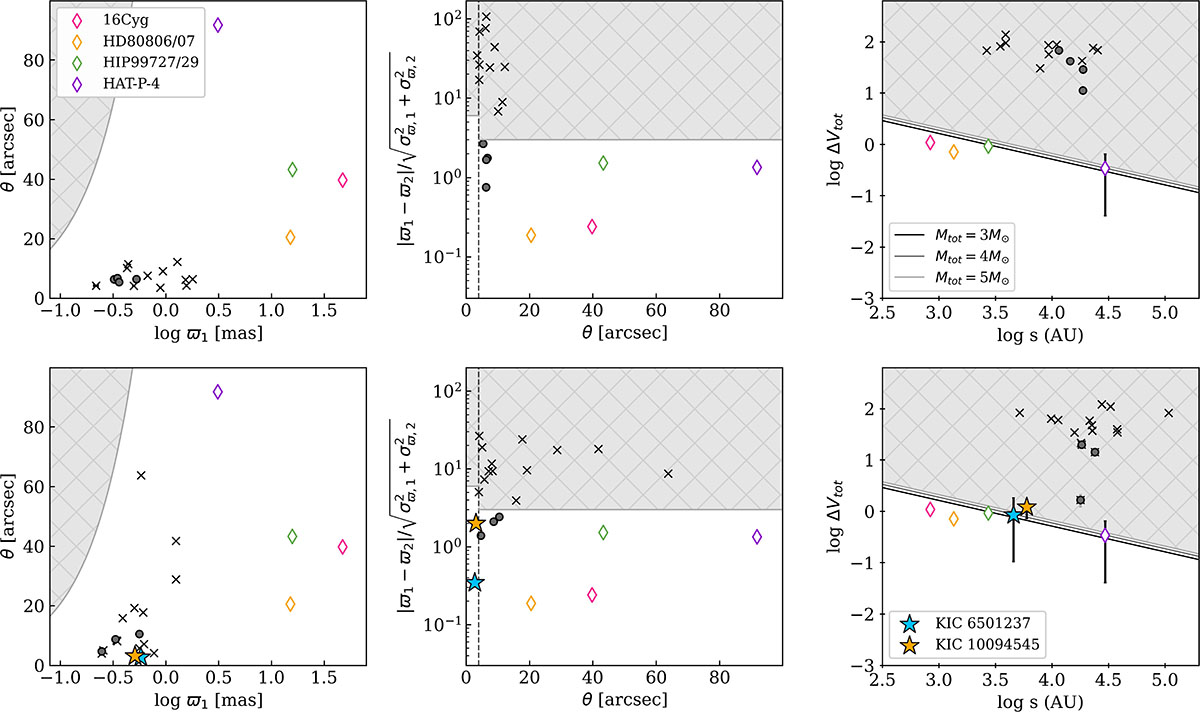
Summary of binarity criteria. Top row: AB systems with both components successfully matched to Gaia sources (Table D.1). Bottom row: All possible pairs from AB-member candidate sets, excluding those in the top row. The left panels illustrate angular separation as a function of parallax, with limits from Eq. (12) (s < 1 pc) as a hatched grey region. The centre panels show parallax consistency; dashed black lines mark the criteria from Eq. (11). The right panels show the total orbital velocity difference versus projected separation (log-log scale), with theoretical ΔVtot values from Eq. (13) for Mtot = 3, 4, and 5 M⊙. Crosses, circles, and stars represent pairs that only satisfy one, two, or three binary conditions, respectively. Well-known bona fide wide binaries 16 Cygni, HD 80806/07, HIP 99727/29, and HAT-P-4 are shown as pink, orange, green, and purple diamonds, respectively. Genuine wide binary candidates are expected to lie within the white area of each plot. KIC 6501237 and KIC 10094545, highlighted as blue and orange stars, respectively, are identified as likely genuine wide binaries.
Current usage metrics show cumulative count of Article Views (full-text article views including HTML views, PDF and ePub downloads, according to the available data) and Abstracts Views on Vision4Press platform.
Data correspond to usage on the plateform after 2015. The current usage metrics is available 48-96 hours after online publication and is updated daily on week days.
Initial download of the metrics may take a while.