


Fig. 6.
Download original image
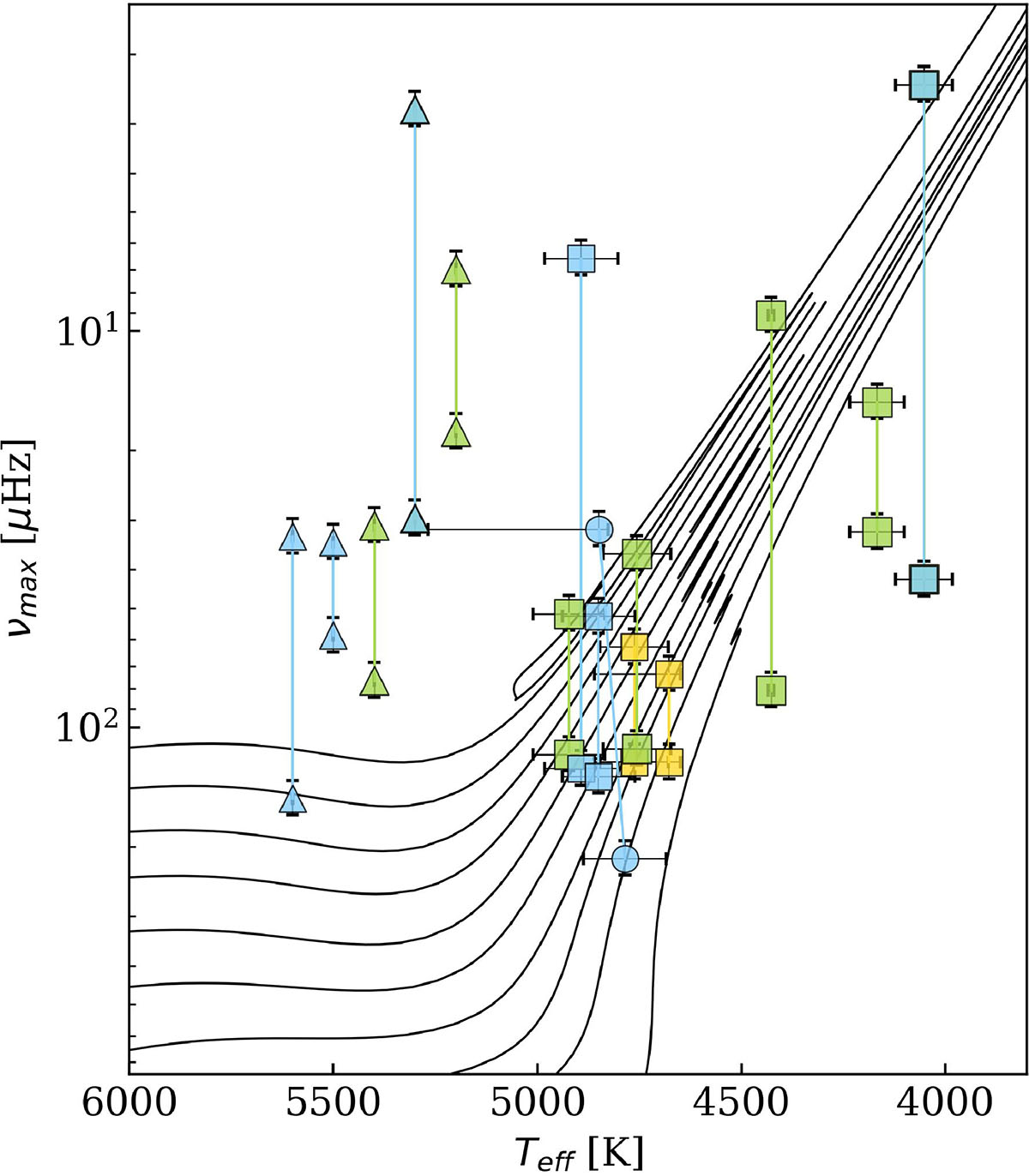
Asteroseismic binaries likely to be gravitationally bound systems. Colours represent the method used to detect the binarity, where yellow, green, and light blue represent wide binaries (Table 1), stars with high RUWE (Table 2), and stars with RV variability indicators (Table 3), respectively. Circles represent ABs for which both solar-like oscillators were matched to a Gaia source (Table D.1). Squares depict ABs for which only one of the two oscillators was matched (Table D.2), and triangles correspond to ABs for which none of the oscillators was matched to a Gaia source (Table D.3). Black lines show Dartmouth evolutionary tracks (Dotter et al. 2008) for 0.8−2.6 M⊙ at solar metallicity, with mass decreasing from left to right.
Current usage metrics show cumulative count of Article Views (full-text article views including HTML views, PDF and ePub downloads, according to the available data) and Abstracts Views on Vision4Press platform.
Data correspond to usage on the plateform after 2015. The current usage metrics is available 48-96 hours after online publication and is updated daily on week days.
Initial download of the metrics may take a while.