


Fig. 2.
Download original image
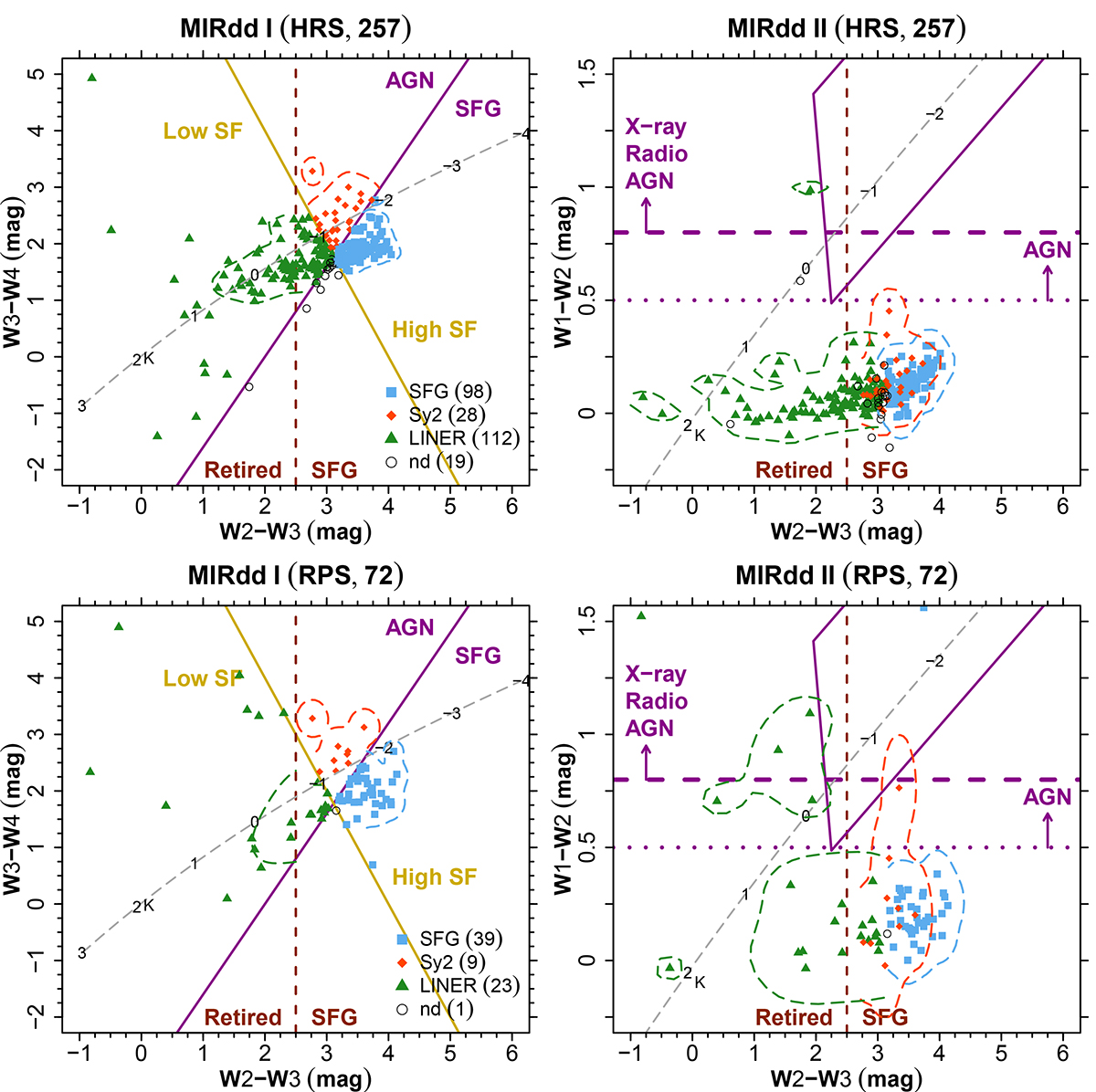
Top: mIRdds for 257 late-type HRS galaxies (Boselli et al. 2010). Bottom: mIRdds for 72 late-type RPS galaxies (Boselli et al. 2022; Tiwari et al. 2025). All photometry is based on central apertures (median size ∼3.12 kpc for the HRS; see Section 3.1.4 and Appendix D). Left: mIRdd I (Coziol et al. 2014, 2015), with diagonal divisions separating AGN from SFG excitation, and between levels of SF (diagonal magenta and gold lines and bold labels, respectively). Excitation-type counts are listed at the bottom right. Right: mIRdd II (e.g. Jarrett et al. 2011; Mateos et al. 2012; Caccianiga et al. 2015; Herpich et al. 2016), featuring horizontal thresholds (dotted and dashed magenta lines and bold labels, aided by arrows) and the AGN wedge (magenta polygon) as defined by Stern et al. (2005, 2012), and Mateos et al. (2012). Coloured geometric labels for excitation types assigned in mIRdd I are consistently maintained in mIRdd II to ensure direct comparison and the derivation of a unified classification scheme across diagrams. Common features in both mIRdds as follows. The dashed brown line and bold labels mark the SFG-Retired galaxy divisor (Herpich et al. 2016). Dashed coloured contours represent 0.1 kernel density levels. The grey curve traces the model colour sequence for power-law spectra with annotated spectral indices (Wright et al. 2010, the K-dwarf star colour, K, is also plotted), illustrating the non-thermal radiation trend. Colours redden as the spectral index decreases, distinguishing galaxies (intrinsically redder) from stars (bluer). This sequence also reinforces the characteristic negative spectral indices of AGNs.
Current usage metrics show cumulative count of Article Views (full-text article views including HTML views, PDF and ePub downloads, according to the available data) and Abstracts Views on Vision4Press platform.
Data correspond to usage on the plateform after 2015. The current usage metrics is available 48-96 hours after online publication and is updated daily on week days.
Initial download of the metrics may take a while.