


| Issue |
A&A
Volume 703, November 2025
|
|
|---|---|---|
| Article Number | A306 | |
| Number of page(s) | 20 | |
| Section | Extragalactic astronomy | |
| DOI | https://doi.org/10.1051/0004-6361/202556317 | |
| Published online | 26 November 2025 | |
The elliptical configuration of the X-ray-emitting intracluster medium
Department of Astronomy, Yale University, P. O. Box 208101 New Haven, CT 06520-8101, USA
⋆ Corresponding author: This email address is being protected from spambots. You need JavaScript enabled to view it.
Received:
8
July
2025
Accepted:
12
October
2025
Abstract
Context. The morphology of the hot gas X-ray images within galaxy clusters provides indications about the formation, populations, mergers, and evolution of clusters in connection with their dynamical state.
Aims. The aim of this investigation is to search for a link between one or more basic morphological parameters describing the elliptical configuration of intracluster medium (ICM) X-ray contours and the dynamical state of the parent cluster.
Methods. We used the 2021 X-CLASS Survey Catalogue of X-ray-detected galaxy clusters. We selected the sample of 982 spectroscopically confirmed clusters, and visually inspected the shape and orientation of their hot gas X-ray contours. We recognized a variety of morphological structures that could lead to a certain dynamical state. A more detailed analysis was carried out by fitting ellipses to the X-ray digitized contours of a subsample of 105 clusters, already classified in the literature as dynamically relaxed, dynamically non-relaxed, or dynamically intermediate.
Results. Some correlations have been found among our measurements of ellipticity (ϵ) for ICM X-ray contours and the classified dynamical state of the parent cluster. The majority of the relaxed clusters present an increase in ellipticity outward from the cluster center; exceptions include a conspicuous number of clusters with essentially ICM constant ellipticity. In contrast, most of the non-relaxed clusters have ellipticity profiles decreasing outward, with fewer exceptions. Moreover, the total variation in ellipticity (Δϵ) tends to be smaller for the X-ray contours of relaxed clusters than for those of non-relaxed clusters, including maximum ellipticity values. Intermediate clusters overlap with both groups. Similar results are found by applying the selected morphological parameters to ICM X-ray contours available in the literature from other X-ray observations.
Key words: galaxies: clusters: intracluster medium
© The Authors 2025
 Open Access article, published by EDP Sciences, under the terms of the Creative Commons Attribution License (https://creativecommons.org/licenses/by/4.0), which permits unrestricted use, distribution, and reproduction in any medium, provided the original work is properly cited.
This article is published in open access under the Subscribe to Open model. This email address is being protected from spambots. You need JavaScript enabled to view it. to support open access publication.
1. Introduction
The current modeling for clusters of galaxies describes their structures as being composed of a large dark matter halo (∼85%), filled with hundreds to thousands galaxies and permeated by hot intracluster gas. X-ray observations of clusters of galaxies have consistently revealed the diffused presence of the hot intracluster medium (ICM) (see Sarazin 1986; Biviano 2000, for historical reviews). There are two main theories about the origin of the ICM: 1. a primordial origin before the formation of galaxies (Gunn & Gott 1972) 2. an ejection origin from galaxies within the clusters, mostly by supernovae explosions, and AGN feedback (De Young 1978). Both models explain some of the properties of the intracluster hot gas, for example the high ICM mass (primordial component) and the presence of metals (galactic ejection component). The medium is a superheated plasma (T ∼ 108 K) that consists of fully ionized hydrogen and helium, with traces of heavier elements, including iron as a function of redshift (Mantz et al. 2017).
This intracluster hot gas reveals itself through the emission of strong X-ray radiation, mainly by the Bremsstrahlung process that can be observed using X-ray telescopes, from the oldest NASA Uhuru X-ray satellite (1972) to the more recent NASA Chandra X-ray spacecraft (1999) and ESA XMM-Newton satellite (1999). Despite its extremely low density (10−3 particles cm−3), the ICM is a major baryonic component of a galaxy cluster (∼12%) greater in mass than the stellar matter (∼3%) (Pratt et al. 2019).
Because of its higher mass, the measurements of the ICM from X-ray emissions with the analysis of its density distribution are fundamental steps to reveal the nature of clusters, their dynamical state, formation process and evolution. The ICM also gives insights into how ordinary matter and dark matter are distributed throughout the Universe, taking into account that clusters of galaxies are the largest bound and most massive structures in the Universe 1012 − 1014 solar masses; (Böhringer et al. 2017). However, high quality optical imaging is still used to study cluster morphology, because photometric indicators are obtained more easily from large optical surveys, than the X-ray morphological parameters obtained from high resolution pointed X-ray observations, which are extremely costly (Casas et al. 2024).
Optical and X-ray images have revealed that galaxy clusters present a range of observational properties delineating cluster dynamical states that vary from very relaxed to extremely non-relaxed and disturbed, due to their formation processes and merging histories. Other fundamental properties of clusters, such as their mass and temperature, also appear to be related directly or indirectly to their dynamical state, which provides constraints for their total mass measurements and for cosmological models (Mantz et al. 2022). Throughout the literature, various properties of clusters and some morphological features of the ICM, have been considered quantifying indicators of the cluster dynamical state. Vice versa different metrics, both observational and within simulations used to probe the cluster dynamical state, are quantifying different core properties (Cerini et al. 2023; Haggar et al. 2024, and references therein). Investigating the dynamical state of galaxy clusters becomes of paramount importance to understand their nature.
For the present study we are mostly interested in the identification of one or more possible basic morphological parameters, derived from the elliptical configuration of ICM X-ray contours, that could lead directly to a quick preliminary identification of the dynamical state of clusters and their stage of evolution. The motivation to focus on the elliptical ICM X-ray configuration came from the results that the author obtained with a similar analysis previously done on the isophotes of elliptical galaxies, in a variety of environments including galaxy clusters (di Tullio 1978, 1979). In addition, more recent studies have shown that the isophotal shapes of clusters’ central elliptical galaxies exhibit coherent alignment with the shape of their parent cluster. These studies argue that the phenomenon may be connected with the cluster formation and evolution, including the cluster ellipticity traced by the satellite distribution (Huang et al. 2016). Clusters do appear more or less elongated when projected on the sky and their shapes have been reconstructed as triaxal rather than spherical, consistent with the Lambda cold dark matter (ΛCDM) paradigm (Sereno et al. 2018, and references therein).
In this ellipsoidal model a 2D elliptical shape approximation may well illustrate the dynamical state of a cluster (Shankar & Khatri 2021) since a cluster looking not relaxed in a 2D X-ray map would look even more disturbed in a 3D representation. In this perspective, our approach to measure the 2D elliptical configuration of the ICM may become one of the quantifying indicators for the overall dynamical state of the parent cluster since ellipticity parameters can provide insights of its dynamical shape and presence of substructures in connection with its evolution history. The ellipticity of galaxy clusters has been considered an intrinsic independent cluster feature (Flin 1984).
A large number of studies, both observational and within cluster simulations, have been published to propose quantitative measurements for the relaxation or non-relaxation state of galaxy clusters (see Sect. 2 for details and references). We used their classification as the source for our initial grouping of a selected cluster sample, following their division into relaxed, non-relaxed, and intermediate, as a calibration for our proposed ellipticity morphological parameters.
From optical and near-IR photometric imaging, combined with high spatial resolution X-ray observations, clusters are generally considered candidates for dynamical relaxation if they do not show any clear sign of disruption from ongoing merger activities, for example large substructures in galaxy distribution or large asymmetries in ICM X-ray contours. In relaxed clusters, hot gas and galaxies are expected to settle into the potential well, reaching a state of hydrostatic equilibrium and stabilizing the cluster (Tchernin et al. 2020). Therefore, the relaxed dynamical state should be reflected in a more symmetric galaxy and ICM density distribution. On the contrary non-relaxed clusters have not yet settled in a stable configuration, but are still showing signs of disruption or even active mergers, with the display of ICM density perturbations and asymmetries. After an extensive merger event, it would take up to billions of years for a cluster to restore a dynamical state of relaxation in correlation with the halo mass change (Zhang et al. 2022). Clusters in the intermediate category are the bridge between the other two groups. Their partially regular X-ray morphology may still show some effects of previous merging, such as rippling in the X-ray gas density contours (Heinrich et al. 2024). Our present study concentrates on comparing some ellipticity parameters of ICM contours associated with these three categories of clusters.
The structure of the paper is as follows. In Section 2 we present our sample of clusters selected from the X-CLASS Survey Catalogue, including their dynamical state classification published by various other authors. In Section 3 we describe our procedure to extract ellipticity parameters from the X-ray ICM contours provided by the XMM Cluster Archive Super Survey. In Section 4 we present the resulting ellipticity measurements for each cluster, focusing on some specific ellipticity parameters. In Section 5 we compare our parameters with similar data available in the literature or with data extracted by applying our procedure of fitting ellipses to other published X-ray contours. In Section 6 we summarize and discuss our findings. In Section 7 we present our conclusions about an ICM ellipticity criterion for cluster relaxation.
2. Sample selection
2.1. Galaxy clusters in XMM-Newton Archive
Our sample of clusters was selected from the X-CLASS Survey Catalogue published in 2021 (Koulouridis et al. 2021). The catalog is based on the XMM-Newton archival observations publicly available until August 2015. We chose this catalog because of their homogeneous large list of X-ray detected galaxy clusters, the extended redshift range (up to z ∼ 1.5) over a wide area of the sky (∼269 deg2 across), the high galactic latitude sky (|b|> 20°), and the uniform quality of the ICM X-ray density contours, up to the projected radius of 3.5 arcminutes (exposure times of 10 and 20 ks). At first our interest concentrated on the 982 objects of the catalog list that are spectroscopically confirmed clusters. A visual inspection revealed a variety of morphological structures, from fairly uniform and symmetrical to fragmented, possibly related to the dynamical state of the cluster and not apparently connected with the cluster redshift. This interpretation would support a scenario of cluster formation and evolution of their dynamical state, as an ongoing process since the early Universe.
Figure 1 offers a sample of eight galaxy clusters with ICM X-ray density contours and spectroscopic redshifts provided by the X-CLASS catalog. They are examples of the larger cluster population contained in the catalog, with different morphological structures in the contours of constant X-ray surface brightness.
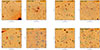 |
Fig. 1. XMM-Newton ICM X-ray contours of constant X-ray surface brightness, superimposed onto DSS2-r band images of the parent galaxy cluster. The green circles represent extended sources and the green squares refer to point sources. The eight clusters are grouped in pairs that belong to four increasing intervals of cosmological redshifts (z ∼ 0.15; 0.4 < z < 0.7; 1 < z < 1.1; 1.3 < z < 1.5). |
More regular and less regular cluster morphology with the presence of substructures appear to be somewhat independent from the cluster redshift, even taking into account the distance effect. They are probably related to the evolution history and the dynamical state of the cluster. We investigate these morphological features further in the following sections, starting with a subsample of 105 galaxy clusters (Sect. 2.2). We apply to them a procedure to extract their underlying elliptical X-ray morphology (Sects. 3 and 4).
2.2. Subsample of clusters with dynamical state classification
To carry out a more detailed analysis of the various ICM morphological structures, we have selected a subsample of 105 objects among the spectroscopically confirmed galaxy clusters in the X-CLASS catalog. They will be our calibration reference for a dynamical classification based on ICM contour ellipticity. In addition to having ICM X-ray contours available from the XMM Cluster Archive Super Survey, these clusters have their dynamical state already classified and published by different authors. The classification includes dynamically relaxed clusters (43 objects), dynamically non-relaxed (47), and dynamically intermediate (15).
Tables A.1, A.2, and A.3 give the lists of these three separate categories with their ID numbers, coordinates, and spectroscopic redshifts. The last column refers to the names and works of the various authors who provided the cluster dynamical classification. They used a variety of morphological parameters, mostly based on observations provided by the Chandra X-ray telescope.
Several of the listed authors, although with different methods, focus on symmetry, concentration, peakness, smoothness, and alignment with the global center, for cluster X-ray images and density contours (Schmidt & Allen 2007; Govoni et al. 2009; Mantz et al. 2015; Parekh et al. 2015; McDonald et al. 2019; Yuan et al. 2022; Heinrich et al. 2024; Ebeling et al. 2025; Véliz Astudillo et al. 2025).
Clusters that are dynamically relaxed present a more symmetrical and smoother morphology, with a sharper X-ray density concentration toward the center. In particular, some of the authors emphasize the alignment between the brightest central galaxy (BCG) and the peak of the cluster X-ray flux. Relaxed clusters are expected to have good alignment and concentric density contours (Casas et al. 2024; Ebeling et al. 2025; Véliz Astudillo et al. 2025).
Another sign of dynamical relaxation that has been considered is the presence of a cool core, revealed by a prominent peak in X-ray surface brightness and a systematic central temperature drop. The dynamics of relaxed clusters promotes a more uniform ICM distribution, allowing a shorter cooling time of the undisturbed gas at the cluster’s center (Hudson et al. 2010; Heinrich et al. 2024; Ebeling et al. 2025). On the other hand, mergers can disrupt cool core clusters, thus playing a vital role in cluster evolution, from dynamically relaxed to highly disturbed clusters. Mergers can also create multiple subcomponents. They can be detected through optical imaging of mass distribution inside clusters, or from X-ray observations of ICM shock waves (Tempel et al. 2017; Łokas 2023). Since galaxy clusters are dominated by dark matter, mass distribution can be measured by gravitational lensing. Relaxed clusters display a more uniform mass distribution that can produce better defined gravitational lenses, without the heavy distortion caused by substructures present in non-relaxed clusters. In contrast, relaxed clusters reveal only a single core with defined rounder contours.
In some cases, the elliptical shape of X-ray images has been measured to test the effects of the underlying dark matter gravitational potential on the dynamical state of clusters (Schmidt & Allen 2007; Mantz et al. 2015; Parekh et al. 2015; Harvey et al. 2019; Yuan et al. 2022; Cerini et al. 2023). These studies of mass concentration have found that clusters with the lowest total ellipticity appear to be dynamically relaxed, while highest ellipticity belongs to the dynamically unrelaxed. However, their data show a considerable overlap between the two groups of clusters, and total ellipticity has not been considered a useful indicator for separating relaxed from non-relaxed clusters. This result is of particular interest for our present study of ellipticity measurements for ICM X-ray contours. In Section 5 we present a comparison with our ellipticity indicators for the clusters in common.
3. Procedure for fitting ellipses to the ICM X-ray contours
We employed the following method for fitting ellipses and for extracting ellipticity morphological parameters from ICM X-ray contours in the galaxy clusters of our sample. The website of the XMM Cluster Archive Super Survey1 provides Digitized Sky Survey II R images of the clusters with ICM X-ray contours superimposed. According to the website, the X-ray contours of constant X-ray surface brightness were wavelet constructed from co-added images from the PN, M1, and M2 detectors, which cover the 0.5–2 keV range. We downloaded the images in PDF format and then digitized the contours using the Web Plot Digitizer software2. This digitation yielded approximately 50–80 points along the circumference of the smallest contours and 300 or more for the largest. The points closely followed the contours, with only minimal smoothing by hand when we had to remove the X-ray point sources in the field (identified with green squares) that were affecting the contours. Using the least-squares method, we fitted ellipses to the digitized contours, as shown in Fig. 2.
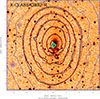 |
Fig. 2. Our digitized contours (black dots with fitted red ellipses) are superimposed onto the ICM X-ray contours (blue lines) provided by the XMM Cluster Archive for the dynamically relaxed cluster X-CLASS 1701 (see Table A.1 for dynamical classification). |
From the semimajor (a) and semiminor axes (b) of the fitted ellipses, the ellipticity ϵ (ϵ = 1 − b/a) was calculated. From the uncertainties in ellipse parameters, the one-sigma error in ϵ was calculated. Comparisons of the contours with the fitted ellipses indicated that the error in ϵ is primarily a measure of the deviation in shape from an ellipse. We also measured the rotation of the ellipses with respect to each other by measuring the angles between the semimajor axes of the ellipses. The quantity Δθ is the maximum angle between the semimajor axes of the fitted ellipses.
To evaluate the precision of the contour tracing, 20 clusters representing a variety of morphological structures were traced two or more times. The agreement between the measures of ϵ was in general ≤ ± 0.02; therefore, we confidently assumed that the systematic error associated with our procedure is ≤ ± 0.03. The few contours with larger differences also had larger error bars on ϵ, and visual inspection revealed that these contours clearly depart from true ellipses. These departures appear to be the major source of the error in ϵ and not the contour tracing procedure. In our analysis of the fitted ellipses we excluded these measurements.
4. Ellipticity measurements
4.1. Morphological parameters
We applied our tested procedure to extract ellipticity morphological parameters from the ICM X-ray density contours of the clusters listed in Tables A.1, A.2, and A.3. We investigated the use of some parameters to provide useful information about the dynamical state of clusters, based on their underlying elliptical X-ray morphology. As shown in the listing of Table A.4, four specific parameters extracted from the fitted ellipses were selected as possible indicators for cluster dynamical classification (Δϵ, ϵ max, Δθ, ϵ profile). In particular, we considered the (ϵ profile) as the most basic first parameter to be used for a preliminary classification; it is the measured run of ellipticity outward from the cluster center. The other three, which are ellipticity (ϵ max) of the most flattened contour, the overall variation in ellipticity (Δϵ) measured for contours of each cluster, and the maximum rotation angle (Δθ) of the fitted ellipses, may complement and support the cluster dynamical classification.
The ellipticity profile listed in the last column of Table A.4 describes how the ellipticity that we have extracted from the ICM contours of each galaxy cluster in our sample is varying as we move outward from the cluster center. This (ϵ profile) can be described in five different trends:
(1) ellipticity essentially constant, 13% of the total clusters (Δϵ ≤ 0.06, given the maximum systematic error ±0.03 associated with our measuring procedure);
(2) ellipticity increasing monotonically outward from the cluster center, 22% of the total clusters;
(3) ellipticity increasing from the cluster center to a maximum and then decreasing outward (peaked), 16% of the total clusters;
(4) ellipticity decreasing monotonically from the cluster center, 42% of the total clusters;
(5) ellipticity decreasing from the cluster center and then increasing outward (dip), 7% of the total clusters.
The (Δϵ) parameter describes the change in flattening that occurs in the configuration of the hot gas inside clusters. The highest change (Δϵ = 0.5) is measured in non-relaxed clusters and the smallest value (Δϵ = 0.03) belongs to the relaxed clusters, with intermediate clusters in between. The parameter (ϵ max) shows a similar trend with (ϵ max) highest in non-relaxed clusters (ϵ max = 0.68) and smallest in relaxed clusters (ϵ max = 0.09). The rotation angle (Δθ) of the fitted ellipses has less definite numbers for the two groups of clusters, with minimum (Δθ ∼ 3°) and maximum values (Δθ ∼ 120°) equally distributed between them. In the literature we found some comparison data for our ellipticity parameters of ICM density contours (see Sect. 5), but nothing equivalent to our ellipticity profiles.
4.2. Ellipticity profile data
Our plots of (ϵ profile) for ICM contours are illustrated in Figs. B.1, B.2, and B.3. Each figure refers to a group of clusters in our sample with a specific dynamical state classification: relaxed, non-relaxed, and intermediate. The projected radius in arcminutes of the contours has been converted to kiloparsec (upper scale of the figures) by using the cosmology calculator of Wright (2006) with Ho = 69.6 km s−1 Mpc−1, ΩM = 0.286, and ΩΛ = 0.714.
The ellipticity profiles for the 43 relaxed clusters in Fig. B.1 present a concentration (44%) of increasing trends outward from the cluster center. Constant (ϵ profile) follows with 33% of the relaxed clusters. Then there is a smaller number of clusters with peaked (ϵ profile) (14%), and also with (ϵ profile) decreasing (7%) or (ϵ profile) with a dip (2%). For the 47 non-relaxed clusters in our sample, Fig. B.2 indicates a different general elliptical substructure. The majority concentrate on ellipticity profiles decreasing outward from the cluster center (79%), followed by 13% with peaked (ϵ profile), 4% with increasing (ϵ profile) or with a dip, and none with constant (ϵ profile). In Fig. B.3 we note that the 15 clusters of the intermediate group do not present a specific concentration of ellipticity profiles, although it is of some relevance that their ellipticity does not show a constant trend, as for the non-relaxed clusters. Based on this analysis, it appears that only galaxy clusters that are classified as dynamically relaxed present ICM density X-ray contours that are more symmetrical with no variation in ellipticity or at least with ellipticity very close to constant. Table 1 summarizes these results.
Frequency of incidence for the classes of ellipticity profiles.
The clusters with a constant ellipticity profile have been classified by several authors, and by different parameters, as being in a dynamical relaxed state, as reported in Table A.1. Some of them, X-CLASS 21325 and X-CLASS 24004, have even been considered strongly relaxed (Parekh et al. 2015) or very relaxed, for example X-CLASS 23195 (Mantz et al. 2015). Other clusters, X-CLASS 1701 and X-CLASS 20679, have been described as having extremely regular X-ray morphologies (Govoni et al. 2009). As a result, the most extreme cases of dynamical state, both relaxed and non-relaxed, could be quickly identified by the simple morphological parameter (ϵ profile) of their intracluster hot gas: constant profile for relaxed clusters and far from constant for non-relaxed clusters.
4.3. Dynamical state separation
The plots of the ellipticity profiles for the ICM X-ray contours displayed in Figs. B.1, B.2, and B.3, show different ϵ trends for dynamically relaxed and non-relaxed clusters. The frequency of incidence for the morphology parameter (ϵ profile), as summarized in Table 1, highlights a separation between dynamical relaxation and non-relaxation, based on the increase or decrease of X-ray contour ellipticity, measured outward from the cluster center. Relaxed clusters have a tendency to develop a more elliptical substructure farther from the core (ϵ profile increasing), while the non-relaxed clusters are more elliptical closer to the center (ϵ profile decreasing).
An equivalent separation derived from two other morphology parameters is emphasized by the distributions of relative frequencies for the total variation in ellipticity (Δϵ) and for the maximum ellipticity (ϵ max) value, as shown by the histograms in Fig. 3 and in Fig. 4. The (Δϵ) parameter separates the relaxed clusters from the non-relaxed clusters around a 0.15 value (Δϵ ≤ 0.15 for the relaxed), leaving a few non-relaxed clusters in the overlap area with the relaxed (8 out of 47). The parameter (ϵ max) separates the relaxed clusters from most of the non-relaxed clusters around the value 0.3, with (ϵ max)≤0.3 for the relaxed. In this case there are more non-relaxed clusters (15 out of 47) in the overlap area with the relaxed clusters. Intermediate clusters fill both areas, as expected according to their intermediate state of evolution, in some cases closer to becoming dynamically relaxed, in other cases still in a disturbed dynamical state. Figure 5 shows that the (Δθ) parameter is less effective than the other two in separating relaxed from non-relaxed clusters. There is only a minor shifting of (Δθ) toward smaller values for clusters classified as dynamically relaxed. The significant overlap of the three groups suggests a complexity of dynamical processes related to the hydrostatic equilibrium within clusters, with the creation of different levels of turbulence in the ICM and twisting of its density contours, somehow independent from the cluster dynamical state.
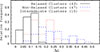 |
Fig. 3. Distribution of relative frequencies for the increment in ellipticity (Δϵ) between the least and the most flattened fitted ellipse to the ICM contours, for our three groups of clusters. |
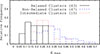 |
Fig. 4. Distribution of relative frequencies for the ellipticity (ϵ max) of the most flattened fitted ellipse to the ICM X-ray contours, for our three groups of clusters. |
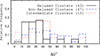 |
Fig. 5. Distribution of relative frequencies for the maximum rotation angle (Δθ) in degrees, between the semimajor axes of the fitted ellipses, for our three groups of clusters. |
5. Comparison with ellipticity data from other ICM contours
In our analysis of the highlighted elliptical configuration within galaxy clusters, we have found that the dynamical state of the clusters in our sample seems to be adequately represented by the values of specific morphology ellipticity parameters for the ICM X-ray density contours that we utilized. To validate the results of our procedure, we searched for X-ray contours computed by other studies for galaxy clusters also belonging to our sample. We compared 23 clusters in common by applying to them our procedure for fitting ellipses to these different contours. We computed their total variation in ellipticity (Δϵ), their maximum and mean ellipticity (ϵ max) and (ϵ mean), and their outward ellipticity (ϵ profile). We had to introduce a new parameter (ϵ mean) since it seems to be the most used in the literature, which also allowed a direct comparison with those data (Table A.5).
Table A.5 shows a good agreement for the selected morphological parameters, within the systematic error of our measurements, between the values obtained from the contours that we used and the values that we obtained from the contours provided by other authors from different X-ray observations. Even the ϵ profiles are in general agreement, with the exception of four relaxed clusters. This overall correspondence supports the assumption that our adopted elliptical metrics for dynamical cluster classification, could have a general application to a variety of ICM density contours.
In the case of X-CLASS 1701, 21325, and 22878, the difference in the profile classification from “constant” versus “increasing” does not remove the clusters from being identified as dynamically relaxed in our adopted classification system. The fourth cluster, X-CLASS 24615, with its constant (ϵ profile) versus our decreasing profile, more typical in our classification for non-relaxed clusters, points to the importance of carefully evaluating any exception. This can lead to a better understanding of the multidimensional complexity affecting the cluster dynamical state. A recent study (Haggar et al. 2024) has shown that there are different classes of dynamically relaxed clusters with different properties, connected with the formation state of the clusters, their local environment and merger history. However, even amid this complexity, it is still meaningful to develop a dynamical classification as a starting point for evaluating the state of relaxation of galaxy clusters.
6. Results and discussion
The data presented in the previous sections provide a good starting point for considering the ellipticity parameters (Δϵ, ϵ max, ϵ profile) that we used to describe the configuration of ICM contours, as basic preliminary morphology indicators for galaxy clusters. Because of the correspondence shown in Table A.5, these three parameters should indicate the potential dynamical state independently of the data used and the method employed to produce the contours of the X-ray cluster images.
This assumption about X-ray contour compatibility is also supported by comparing our mean ellipticity measurements with those provided by other authors for 69 clusters in common. The data listed in Table A.6 show a common trend of values for our measurements of mean ICM ellipticity (ϵ mean) and those provided by two other authors from different sets of contours. More importantly, all three provide lower values for relaxed clusters. The similar trend for the distribution of relative frequencies between the (ϵ mean) measured by our metrics and the (ϵ mean) measured by other methods, may be considered a validation of our results. The overall trend of the different measures is more valuable than the specific numbers, which are subject to systematic errors.
However the data in Table A.6, when plotted in the histograms of Fig. 6, do not support considering (ϵ mean) as a reliable indicator for cluster dynamical state. The non-relaxed group of galaxy clusters presents only a minor shifting to higher values of (ϵ mean), leaving an overlap for most of the clusters, both relaxed and non-relaxed. This result confirms a previous finding by Parekh et al. (2015), that the mean ellipticity measured for the X-ray flux in cluster images is not an effective parameter for separating relaxed from non-relaxed clusters. Mantz et al. (2015) also found that although the lowest mean ellipticity of employed isophotes are in relaxed clusters and the highest are in non-relaxed, the two distributions overlap significantly. A simple interpretation could be that the dynamical state of clusters does not seem to affect their ellipsoid shape directly.
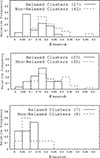 |
Fig. 6. Distribution of relative frequencies for the mean ellipticity (ϵ mean) measured by different authors as listed in Table A.6, (ϵ mean-a) from our metrics; (ϵ mean-b) from isophotes measured by Mantz et al. (2015; ϵ mean-c) from X-ray flux measured by Parekh et al. (2015). |
We had a similar outcome of cluster overlapping for the frequency distribution of the twisting of ICM contours measured by (Δθ) (Fig. 5). Again, a simple interpretation could be that the underlying elliptical structure of clusters is not much affected by the turbulence in the ICM gas.
A different perspective is offered by the measurements obtained with other two ellipticity parameters that we selected as promising indicators for cluster dynamic classification: (Δϵ) and (ϵ max). The distributions of their relative frequencies, as illustrated in Figs. 3 and 4, emphasize a clear enough separation between relaxed and non-relaxed clusters around a 0.15 value for (Δϵ) and a 0.3 value for (ϵ max). The ellipticity profile provides an even more significant separation between relaxed and non-relaxed clusters, as illustrated in Figs. B.1 and B.2 and discussed in Sect. 4.3.
7. Conclusions
By using a combination of three morphology parameters, (ϵ profile), (Δϵ), (ϵ max), extracted from ellipses fitted to the ICM X-ray density contours in our sample of 105 clusters, we investigated galaxy clusters already dynamically classified. With these metrics, we were able to separate them into two groups corresponding to the anticipated dynamical state, with some expected overlapping, given the complex dynamics of clusters. The main points that have emerged from this study are the following:
-
The underlying elliptical configuration of the intracluster medium (ICM) presents five different ellipticity trends outward from the cluster center: (ϵ profile) constant, increasing, decreasing, with a peak, and with a dip.
-
There is a significant correlation between the dynamical state of clusters and their ICM ellipticity profile:
-
A majority of relaxed clusters present an ellipticity profile constant or increasing outward (77%), with a small percentage of the other trends.
-
A majority of non-relaxed clusters present a decreasing ellipticity profile (79%), also with a small percentage of the other trends, but no ϵ constant.
-
-
There is a significant correlation between the dynamical state of clusters and their ICM total variation in ellipticity (Δϵ):
-
The majority of relaxed clusters (98%) present a (Δϵ)≤0.15.
-
Most non-relaxed clusters (83%) present a (Δϵ) > 0.15.
-
-
There is a good correlation between the dynamical state of clusters and their ICM maximum ellipticity (ϵ max).
-
100% of relaxed clusters have (ϵ max)≤0.3.
-
70% of non-relaxed clusters have (ϵ max) > 0.3.
-
On the basis of the results from this study, we propose the following strategy for a quick initial, preliminary assessment of the dynamical state of a galaxy cluster, which deserves a more in depth study. First search for ICM X-ray contours provided by the archives of X-ray Observatories. Then develop a procedure to fit ellipses to the contours and extract the ellipticity parameters used in this study, or any others more appropriate for that specific analysis. Last, create a scale of values for dynamical state separation.
In our study, the preliminary scale of values would be the following:
-
Dynamically relaxed clusters: (ϵ profile) constant (high probability of being relaxed) or increasing outward from the center, with (Δϵ)≤0.15 and (ϵ max)≤0.3 (probably relaxed or close to being relaxed). The other ellipticity trends and numerical values are ambiguous (see Table 1 and Figs. 4 and 5), confirming the multidimensional complexity of cluster dynamical states.
-
Dynamically non-relaxed clusters: (ϵ profile) decreasing outward from the center, with (Δϵ) > 0.15 and (ϵ max) > 0.3.
-
Dynamically intermediate clusters: Values overlapping the other two groups, difficult classification just on ellipticity.
As a follow up to this study, we plan to apply our tested procedure for a preliminary dynamical classification of galaxy clusters spectroscopically confirmed in the X-CLASS Survey Catalogue that were not in our selected subsample, up to 500 new objects. We also plan to study a comparable number of clusters from more recent catalogs. The aim is to provide a larger homogeneous sample of morphologically classified clusters, less subject to selection effects.
References
- Biviano, A. 2000, in Constructing the Universe with Clusters of Galaxies, eds. F. Durret, & D. Gerbal, 1 [Google Scholar]
- Böhringer, H., Chon, G., & Fukugita, M. 2017, A&A, 608, A65 [NASA ADS] [CrossRef] [EDP Sciences] [Google Scholar]
- Casas, M. C., Putnam, K., Mantz, A. B., Allen, S. W., & Somboonpanyakul, T. 2024, ApJ, 967, 14 [Google Scholar]
- Cerini, G., Cappelluti, N., & Natarajan, P. 2023, ApJ, 945, 152 [Google Scholar]
- Coe, D., Benítez, N., Broadhurst, T., & Moustakas, L. A. 2010, ApJ, 723, 1678 [NASA ADS] [CrossRef] [Google Scholar]
- De Young, D. S. 1978, ApJ, 223, 47 [Google Scholar]
- di Tullio, G. 1978, A&A, 62, L17 [Google Scholar]
- di Tullio, G. A. 1979, A&AS, 37, 591 [NASA ADS] [Google Scholar]
- Ebeling, H., Barrett, E., Donovan, D., et al. 2007, ApJ, 661, L33 [Google Scholar]
- Ebeling, H., Richard, J., Beauchesne, B., et al. 2025, MNRAS, 537, 2662 [Google Scholar]
- Flin, P. 1984, in Clusters and Groups of Galaxies, eds. F. Mardirossian, G. Giuricin, & M. Mezzetti, Astrophys. Space Sci. Lib., 111, 163 [Google Scholar]
- Govoni, F., Murgia, M., Markevitch, M., et al. 2009, A&A, 499, 371 [NASA ADS] [CrossRef] [EDP Sciences] [Google Scholar]
- Gunn, J. E., & Gott, J. R., III. 1972, ApJ, 176, 1 [NASA ADS] [CrossRef] [Google Scholar]
- Haggar, R., De Luca, F., De Petris, M., et al. 2024, MNRAS, 532, 1031 [Google Scholar]
- Harvey, D., Tam, S.-I., Jauzac, M., Massey, R., & Rhodes, J. 2019, ArXiv e-prints [arXiv:1911.06333] [Google Scholar]
- Heinrich, A., Zhuravleva, I., Zhang, C., et al. 2024, MNRAS, 528, 7274 [CrossRef] [Google Scholar]
- Huang, H.-J., Mandelbaum, R., Freeman, P. E., et al. 2016, MNRAS, 463, 222 [Google Scholar]
- Hudson, D. S., Mittal, R., Reiprich, T. H., et al. 2010, A&A, 513, A37 [NASA ADS] [CrossRef] [EDP Sciences] [Google Scholar]
- Koulouridis, E., Clerc, N., Sadibekova, T., et al. 2021, A&A, 652, A12 [NASA ADS] [CrossRef] [EDP Sciences] [Google Scholar]
- Łokas, E. L. 2023, A&A, 673, A131 [NASA ADS] [CrossRef] [EDP Sciences] [Google Scholar]
- Mantz, A. B., Allen, S. W., Morris, R. G., et al. 2015, MNRAS, 449, 199 [CrossRef] [Google Scholar]
- Mantz, A. B., Allen, S. W., Morris, R. G., et al. 2017, MNRAS, 472, 2877 [NASA ADS] [CrossRef] [Google Scholar]
- Mantz, A. B., Morris, R. G., Allen, S. W., et al. 2022, MNRAS, 510, 131 [Google Scholar]
- McDonald, M., Allen, S. W., Hlavacek-Larrondo, J., et al. 2019, ApJ, 870, 85 [NASA ADS] [CrossRef] [Google Scholar]
- Parekh, V., van der Heyden, K., Ferrari, C., Angus, G., & Holwerda, B. 2015, A&A, 575, A127 [NASA ADS] [CrossRef] [EDP Sciences] [Google Scholar]
- Pratt, G. W., Arnaud, M., Biviano, A., et al. 2019, Space Sci. Rev., 215, 25 [Google Scholar]
- Sarazin, C. L. 1986, Rev. Mod. Phys., 58, 1 [Google Scholar]
- Schmidt, R. W., & Allen, S. W. 2007, MNRAS, 379, 209 [NASA ADS] [CrossRef] [Google Scholar]
- Sereno, M., Umetsu, K., Ettori, S., et al. 2018, ApJ, 860, L4 [NASA ADS] [CrossRef] [Google Scholar]
- Shankar, S., & Khatri, R. 2021, MNRAS, 503, 2791 [Google Scholar]
- Tchernin, C., Lau, E. T., Stapelberg, S., Hug, D., & Bartelmann, M. 2020, A&A, 644, A126 [NASA ADS] [CrossRef] [EDP Sciences] [Google Scholar]
- Tempel, E., Tuvikene, T., Kipper, R., & Libeskind, N. I. 2017, A&A, 602, A100 [NASA ADS] [CrossRef] [EDP Sciences] [Google Scholar]
- Véliz Astudillo, S., Carrasco, E. R., Nilo Castellón, J. L., Zenteno, A., & Cuevas, H. 2025, A&A, 693, A106 [NASA ADS] [CrossRef] [EDP Sciences] [Google Scholar]
- Wright, E. L. 2006, PASP, 118, 1711 [NASA ADS] [CrossRef] [Google Scholar]
- Yuan, Z. S., Han, J. L., & Wen, Z. L. 2022, MNRAS, 513, 3013 [NASA ADS] [CrossRef] [Google Scholar]
- Zhang, B., Cui, W., Wang, Y., Dave, R., & De Petris, M. 2022, MNRAS, 516, 26 [NASA ADS] [CrossRef] [Google Scholar]
Appendix A: Tables
List of the dynamically relaxed clusters analyzed in this work.
List of the dynamically non-relaxed clusters analyzed in this work.
List of the dynamically intermediate clusters analyzed in this work.
Ellipticity measurements for the galaxy clusters analyzed in this work.
continued.
Comparison of our ICM ellipticity morphological parameters applied to x-ray contours published by other authors, for clusters in common with our sample.
Comparison of mean ICM ellipticity measurements for clusters in common with other authors.
continued.
Appendix B: Figures
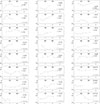 |
Fig. B.1. Ellipticity profiles of the 43 dynamically relaxed clusters as a function of semimajor axis (a) for the fitted ellipses to ICM contours. The error bars indicate the uncertainty in the fit of the ellipses to the x-ray contours. The upper scale is in kpc. |
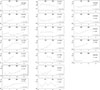 |
Fig. B.1. continued |
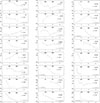 |
Fig. B.2. Ellipticity profiles of the 47 dynamically non-relaxed clusters. |
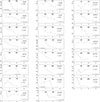 |
Fig. B.2. continued |
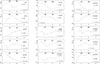 |
Fig. B.3. Ellipticity profiles of the 15 dynamically intermediate clusters. |
All Tables
Comparison of our ICM ellipticity morphological parameters applied to x-ray contours published by other authors, for clusters in common with our sample.
Comparison of mean ICM ellipticity measurements for clusters in common with other authors.
All Figures
|
Fig. 1. XMM-Newton ICM X-ray contours of constant X-ray surface brightness, superimposed onto DSS2-r band images of the parent galaxy cluster. The green circles represent extended sources and the green squares refer to point sources. The eight clusters are grouped in pairs that belong to four increasing intervals of cosmological redshifts (z ∼ 0.15; 0.4 < z < 0.7; 1 < z < 1.1; 1.3 < z < 1.5). |
| In the text | |
|
Fig. 2. Our digitized contours (black dots with fitted red ellipses) are superimposed onto the ICM X-ray contours (blue lines) provided by the XMM Cluster Archive for the dynamically relaxed cluster X-CLASS 1701 (see Table A.1 for dynamical classification). |
| In the text | |
|
Fig. 3. Distribution of relative frequencies for the increment in ellipticity (Δϵ) between the least and the most flattened fitted ellipse to the ICM contours, for our three groups of clusters. |
| In the text | |
|
Fig. 4. Distribution of relative frequencies for the ellipticity (ϵ max) of the most flattened fitted ellipse to the ICM X-ray contours, for our three groups of clusters. |
| In the text | |
|
Fig. 5. Distribution of relative frequencies for the maximum rotation angle (Δθ) in degrees, between the semimajor axes of the fitted ellipses, for our three groups of clusters. |
| In the text | |
|
Fig. 6. Distribution of relative frequencies for the mean ellipticity (ϵ mean) measured by different authors as listed in Table A.6, (ϵ mean-a) from our metrics; (ϵ mean-b) from isophotes measured by Mantz et al. (2015; ϵ mean-c) from X-ray flux measured by Parekh et al. (2015). |
| In the text | |
|
Fig. B.1. Ellipticity profiles of the 43 dynamically relaxed clusters as a function of semimajor axis (a) for the fitted ellipses to ICM contours. The error bars indicate the uncertainty in the fit of the ellipses to the x-ray contours. The upper scale is in kpc. |
| In the text | |
|
Fig. B.1. continued |
| In the text | |
|
Fig. B.2. Ellipticity profiles of the 47 dynamically non-relaxed clusters. |
| In the text | |
|
Fig. B.2. continued |
| In the text | |
|
Fig. B.3. Ellipticity profiles of the 15 dynamically intermediate clusters. |
| In the text | |
Current usage metrics show cumulative count of Article Views (full-text article views including HTML views, PDF and ePub downloads, according to the available data) and Abstracts Views on Vision4Press platform.
Data correspond to usage on the plateform after 2015. The current usage metrics is available 48-96 hours after online publication and is updated daily on week days.
Initial download of the metrics may take a while.