


| Issue |
A&A
Volume 704, December 2025
|
|
|---|---|---|
| Article Number | L8 | |
| Number of page(s) | 8 | |
| Section | Letters to the Editor | |
| DOI | https://doi.org/10.1051/0004-6361/202556581 | |
| Published online | 09 December 2025 | |
Letter to the Editor
JWST reveals a supernova following a gamma-ray burst at z ≃ 7.3
1
Department of Astrophysics/IMAPP, Radboud University Nijmegen, P.O. Box 9010 Nijmegen 6500 GL, The Netherlands
2
Department of Physics, University of Warwick, Coventry CV4 7AL, UK
3
Aix Marseille Univ., CNRS, CNES, LAM, Marseille, France
4
Université Paris-Saclay, Université Paris Cité, CEA, CNRS, AIM, 91191 Gif-sur-Yvette, France
5
Niels Bohr Institute, University of Copenhagen, Jagtvej 155, 2200 Copenhagen N, Denmark
6
The Cosmic Dawn Centre (DAWN), Denmark
7
School of Physics and Astronomy, University of Leicester, University Road, Leicester LE1 7RH, UK
8
School of Physics and Centre for Space Research, University College Dublin, Belfield Dublin 4, Ireland
9
Osservatorio di Astrofisica e Scienza dello Spazio, INAF, Via Piero Gobetti 93/3, Bologna 40129, Italy
10
LUX, Observatoire de Paris, Université PSL, CNRS, Sorbonne Université, Meudon 92190, France
11
Institut d’Astrophysique de Paris, CNRS, UMR 7095, 98 bis bd Arago, F-75014 Paris, France
12
INAF–Osservatorio Astronomico di Brera, Via E. Bianchi 46, 23807 Merate, (LC), Italy
13
National Astronomical Observatories, Chinese Academy of Sciences, Beijing 100101, China
14
IRAP, Université de Toulouse, CNRS, CNES, Toulouse, France
15
Instituto de Alta Investigacion, Universidad de Tarapaca, Casilla 7D, Arica, Chile
16
European Space Agency (ESA), European Space Research and Technology Centre (ESTEC), Keplerlaan 1, 2201 AZ Noordwijk, The Netherlands
17
CEA Paris-Saclay, Irfu/Département d’Astrophysique, 91190 Gif sur Yvette, France
18
Sorbonne Université, CNRS, UMR 7095, Institut d’Astrophysique de Paris, 98 bis bd Arago, F-75014 Paris, France
19
Space Science Data Center (SSDC) – Agenzia Spaziale Italiana (ASI), Via del Politecnico snc, I-00133 Roma, Italy
20
MIFT Department, University of Messina, Via F. S. D’Alcontres 31, Messina, Italy
21
Department of Physics and Astronomy, Baylor University, One Bear Place #97316, Waco, TX 76798, USA
22
Space Telescope Science Institute, 3700 San Martin Drive, Baltimore MD21218, USA
23
School of Physics and Astronomy and Institute for Gravitational Wave Astronomy, University of Birmingham, Birmingham B15 2TT, UK
24
Clemson University, Department of Physics & Astronony, Clemson, SC 29634, USA
25
INAF, Osservatorio Astronomico di Capodimonte, Salita Moiariello 16, I-80121 Naples, Italy
26
DARK, Niels Bohr Institute, University of Copenhagen, Jagtvej 155A, 2200 Copenhagen, Denmark
27
Centre for Astrophysics and Cosmology, Science Institute, University of Iceland, Dunhagi 5, 107 Reykjavik, Iceland
28
Department of Physics & Astronomy, University of Utah, Salt Lake City UT 84112, USA
29
INAF – Osservatorio Astronomico di Roma, Via Frascati 33, 00078 Monte Porzio Catone, (RM), Italy
30
INAF – Istituto di Astrofisica e Planetologia Spaziali, Via Fosso del Cavaliere 100, I-00133 Rome, Italy
31
Anton Pannekoek Institute of Astronomy, University of Amsterdam, P.O. Box 94249 1090 GE Amsterdam, The Netherlands
32
INAF–Istituto di Astrofisica Spaziale e Fisica Cosmica di Milano, Via A. Corti 12, 20133 Milano, Italy
33
E. Kharadze Georgian National Astrophysical Observatory, Mt. Kanobili, Abastumani, 0301 Adigeni, Georgia
34
Centre for Astrophysics Research, University of Hertfordshire, Hatfield AL10 9AB, UK
35
Key Laboratory of Particle Astrophysics, Institute of High Energy Physics, Chinese Academy of Sciences, Beijing 100049, China
⋆ Corresponding author: This email address is being protected from spambots. You need JavaScript enabled to view it.
Received:
24
July
2025
Accepted:
3
October
2025
Abstract
The majority of long-duration gamma-ray bursts (GRBs) are thought to arise from the collapse of massive stars, making them powerful tracers of star formation across cosmic time. Evidence for this origin comes from the presence of supernovae (SNe) in the aftermath of the GRB event, whose properties in turn link back to those of the collapsing star. In principle, thanks to GRBs, we can study the properties of individual stars in the distant Universe. Here, we present JWST/NIRCAM observations that have been able to detect both the host galaxy and a likely SN in the Space-based multi-band astronomical Variable Objects Monitor (SVOM) detected GRB 250314A. GRB 250314A has a spectroscopically measured redshift of z ≃ 7.3, placing it deep in the era of reionisation. The data are well described by a combination of faint blue host, similar to many z ∼ 7 galaxies, with a SN of similar luminosity to the prototype GRB SN, namely, SN 1998bw. The SN may be somewhat fainter if a larger contribution from the underlying galaxy is present, but SNe brighter than SN 1998bw can be excluded, given the evidence of low dust extinction, based on the blue afterglow colours. These observations suggest that despite disparate physical conditions, the star that created GRB 250314A was not much more massive and it might even resemble the GRB progenitors of the Local Universe.
Key words: gamma-ray burst: general / gamma-ray burst: individual: GRB 250314A / galaxies: high-redshift
© The Authors 2025
 Open Access article, published by EDP Sciences, under the terms of the Creative Commons Attribution License (https://creativecommons.org/licenses/by/4.0), which permits unrestricted use, distribution, and reproduction in any medium, provided the original work is properly cited.
This article is published in open access under the Subscribe to Open model. This email address is being protected from spambots. You need JavaScript enabled to view it. to support open access publication.
1. Introduction
Understanding the stars of the early Universe remains one of the prime goals in contemporary cosmology. It is likely that these first generations of massive stars were the engines driving cosmic reionisation beyond z ∼ 6 (e.g. Chakraborty & Choudhury 2026) and responsible for early cosmic chemical enrichment (e.g. Kobayashi et al. 2007). The very different physical conditions at early cosmic epochs could plausibly have resulted in markedly different stellar and binary evolution paths and, hence, varied stellar properties at the end of their lives (e.g. Fryer et al. 2019). Enormous efforts have been invested in studying the integrated light from populations of these stars, with progress from JWST standing out as particularly impressive in recent years (e.g. Bunker et al. 2023; Curti et al. 2023; Robertson et al. 2023; Carniani et al. 2024; Witstok et al. 2025; Naidu et al. 2025a). However, there are few probes of individual stars at this epoch because of the extreme luminosity distances involved. Observing massive stars as they collapse is one route to studying individual objects at these redshifts. Indeed, JWST surveys are now identifying supernovae (SNe) in repeatedly observed deep fields in increasing numbers (DeCoursey et al. 2025a), including both thermonuclear (e.g Pierel et al. 2024, 2025) and core collapse (e.g. Coulter et al. 2025; Moriya et al. 2025) events, probably up to z ∼ 5 (Siebert et al. 2024; DeCoursey et al. 2025b). Long gamma-ray bursts (GRBs) also offer a very promising avenue to study massive stars in the early Universe. They are bright enough to be detected at very high redshifts, z > 6 (Haislip et al. 2006; Tanvir et al. 2009, 2018; Salvaterra et al. 2009; Rossi et al. 2022a), theoretically up to z ∼ 20 (Lamb & Reichart 2000) with current technology, while offering bright backlights. These properties enable us to measure redshifts and dissect the properties of the interstellar medium in the host galaxy in exquisite detail (e.g. Tanvir et al. 2019; Heintz et al. 2023; Saccardi et al. 2023, 2025).
We can use GRB SNe to study their progenitors and, hence, individual stars at high redshift because of the connection between (most) long-duration GRBs and massive stars. Long GRBs are generally seen in association with highly energetic broad-lined type Ic SNe (e.g. Galama et al. 1998; Hjorth et al. 2003). In a minority of cases, no SN is seen, perhaps indicating direct collapse events (e.g. Fynbo et al. 2006), although more recent detections of kilonova signatures accompanying some low-z long-GRBs favour the notion that these are likely compact object mergers (e.g. Rastinejad et al. 2022; Troja et al. 2022; Levan et al. 2024; Yang et al. 2024). Nonetheless, we expect the typically luminous GRBs observed at high redshift to be dominated by core collapse events, given that collapsar GRBs reach higher luminosities and have shorter average elapsed times from initial star formation to explosion.
To date, GRB SNe have been observed to z < 1, but it is notable that the SNe appear similar even when the energetics of the prompt GRB vary by seven orders of magnitude (Levan et al. 2014; Melandri et al. 2014; Blanchard et al. 2023). For example, there is remarkably little spread in their peak luminosities, with a peak of MV = −19.2 ± 0.4 reasonably describing the bulk of the population (e.g. Cano et al. 2017; de Ugarte Postigo et al. 2018; Melandri et al. 2014); however, in at least one case (of an ultra-long duration GRB), a more luminous SN comparable to the superluminous SNe was observed (Greiner et al. 2015; Kann et al. 2019). A pressing question is then related to whether this relative lack of diversity reflects uniformity in the progenitors, as well as whether this similarity holds across cosmic time, where physical conditions may be very different. Locally, while there is an apparent preference for GRB SNe in somewhat low-metallicity environments (e.g. Fruchter et al. 2006; Perley et al. 2016), there is a significant spread in the SN metallicities from ∼Z⊙ to < 0.1 Z⊙, apparently without any substantial impact on the SN properties. Thus, this is the main changing parameter with increasing redshift. However, it is not the only one. The technological challenges (to date) of detecting GRB SNe beyond z ∼ 1 means that we have little knowledge of possible evolution. Here, we address this with observations of a SN accompanying GRB 250314A, at a spectroscopic redshift of z ≃ 7.3.
2. Observations
GRB 250314A was detected by the ECLAIRs instrument on the Space Variable Objects Monitor (SVOM) satellite at 12:56:42 UT on 14 March 2025 (Wang et al. 2025) and was also seen by its Gamma-Ray Monitor (GRM; SVOM/GRM Team 2025). Observations with the Visible Telescope (VT) did not reveal any counterpart (Li et al. 2025), but an infrared (IR) afterglow was discovered with the Nordic Optical Telescope (Malesani et al. 2025a). An X-ray counterpart was also identified by both the Swift X-Ray Telescope (XRT; Kennea et al. 2025) and the Einstein Probe Follow-up X-ray Telescope (FXT; Turpin et al. 2025). Optical spectroscopy obtained at the VLT revealed a redshift of z ≃ 7.3 based on a strong spectral break between the optical and IR regimes (Malesani et al. 2025b), a result that was later confirmed via deep z-band imaging (Rakotondrainibe et al. 2025). A full summary of the multi-wavelength follow-up of this event is presented in a companion paper (Cordier et al. 2025).
We obtained observations with JWST/NIRCAM on 1 July 2025, an epoch ∼110 days post-burst (or 13 days in the rest frame). The eight-band imaging of the field is shown in Fig. A.1 and photometry is shown in Table A.1. At the location of the counterpart (see the appendix), we can identify a faint source visible in all filters redwards of F150W2. The source shows a nearly flat spectrum from F150W2 to F277W, followed by a strong rise to the redder filters. In F150W2, there is some weak evidence for extension of the source, suggesting that at least some of the light at this wavelength is contributed by the host galaxy.
3. A benchmark expectation for a GRB SN
The light observed from a stellar collapse driven GRB at any given time can be split into components from the GRB afterglow, the associated SN and the underlying host galaxy. On both theoretical grounds, and based on the extensive observations of GRBs to date we can make a prediction about a benchmark model for GRB 250314A, adopting the assumption that it looks like GRBs locally – this is our simplest model, and the rationale of our JWST observations was to confront this model with observations. We describe these expectations for each of the components briefly below.
There are relatively limited observations of the afterglow light in GRB 250314A. However, the observations reported in Cordier et al. (2025) show that the afterglow is described as a power-law in time and frequency, Fν ∝ t−αν−β, with α = 2.1 ± 0.6 and β = 0.2 ± 0.4. This gives a large range of plausible magnitudes at the time of the JWST observations, but all are faint, at 31 < F150W2 < 37 mag. Therefore, we do not believe that there is a significant afterglow contribution in our data.
Overall, GRB SNe are a relatively homogeneous population, showing peak magnitudes that typically only span a factor of 2 (Cano et al. 2017). Indeed, the GRB SN prototype SN 1998bw generally offers a good description of the SNe seen in more distant events and we adopt it as a primary example here. Critically, SN Ic-BL exhibit heavy metal line blanketing bluewards of ∼3000 Å in the rest frame, even in bursts in the lowest metallicity environments (Z < 0.3 Z⊙); for instance, GRB/XRF 060218 (Pian et al. 2006), which is not unreasonable for some galaxies at z ∼ 7 (e.g. Venturi et al. 2024). Hence, SN light should be undetected in the blue NIRCAM filters, but should dominate in the red, with SN 1998bw (Galama et al. 1998) reaching a peak magnitude of MB ∼ −19.3 (F444W = 27.7(AB)) at z = 7.3. These expectations are shown, along with our observations, in Figs. 1 and 2.
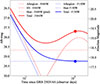 |
Fig. 1. Light curve of GRB 250314A as expected in the F150W2 and F444W bands. Components from both afterglow, SN, and host galaxy are included. Expectations for the afterglow are based on the ground-based J and H measurements, extrapolated to F444W based on the measured spectral slope. The host galaxy magnitudes are similarly based on the F150W2 detection (see text) and extrapolated to F444W based on the typical galaxy spectrum at z ∼ 7. The observed points are also indicated, demonstrating luminosity consistency between observations and a SN 1998bw-like SN (in this case scaled to 70% of the luminosity of SN 1998bw). |
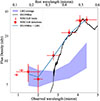 |
Fig. 2. Observed SED of the location of GRB 250314A as observed with NIRCAM at 110 days post-burst, roughly 13 days rest frame (red points). The weak detection in the blue of a marginally extended source is consistent with a faint host galaxy, while the rise to the red is entirely consistent with the expectations of SN 1998bw at this epoch (black line). For comparison, we also show (shaded region) the typical range of SEDs of the Lyman-break galaxies (LBGs) at z ∼ 7 from Merlin et al. (2024), along with an SED obtained from summing an average LBG and a SN with 70% of the luminosity of SN 1998bw (blue line). |
The host galaxy is the most difficult element to constrain. Observations of local GRB hosts show them to be low luminosity, relatively compact and highly star-forming galaxies (Fruchter et al. 2006; Savaglio et al. 2009; Perley et al. 2016; Schneider et al. 2022). At high redshift, the majority of hosts are undetected, even to the limits of the Hubble Space Telescope (HST; Tanvir et al. 2012; Sears et al. 2024). Our expectation is, thus, to identify a faint, blue galaxy, probably with colour similar to typical Lyman-break galaxies at z ∼ 7 (Roberts-Borsani et al. 2024), but whose luminosity could span a range from undetectable to dominating the observed light (see also Salvaterra et al. 2013). The range of GRB host galaxy magnitudes, from several large-scale space-based surveys, are shown in Fig. C.1.
4. The SN in GRB 250314A
Overall, the comparison between NIRCAM photometry and the canonical model is extremely good. We detected a marginally extended object in F150W2, suggesting a faint host galaxy with MUV ≈ −17.8. This is somewhat fainter than the handful of high-z GRB hosts that have been detected to date (McGuire et al. 2016; Rossi et al. 2022b), but it is still consistent with the upper limits that have been placed on others (Tanvir et al. 2012). The source then exhibits a strong rise through the F277W to F444W bands, reaching a peak at F444W = 27.64, corresponding to an absolute magnitude of MB = −19.41 mag. The observing epoch of 110 days is ∼13 days in the rest frame, approximately the time of the B-band peak of SN 1998bw (14 days, Galama et al. 1998; Clocchiatti et al. 2011). If we adopt a typical Lyman break galaxy spectral shape from Merlin et al. (2024) and use the F150W2 observations to fix the normalisation, the resulting absolute magnitude of probable transient emission (host subtracted) is MB = −18.9, which is ∼70% of SN 1998bw at the same redshift.
Hence, the photometry is entirely consistent with the predictions made prior to the observations and is supportive of the detection of SN light at z ≃ 7.3. This SN has a similar luminosity and spectral shape to SN 1998bw and it is also consistent with the range of SN properties seen in GRB SNs locally (e.g. Cano et al. 2017; Melandri et al. 2014). In particular, it robustly rules out events either brighter or bluer than SN 1998bw, including superluminous-like SNe or transitional events (e.g. Greiner et al. 2015).
There are expectations that SNe at high redshift might appear different to those in the Local Universe. There are several plausible reasons behind this, such as general changes to stellar (and binary) evolution with metallicity (e.g. Yoon et al. 2006; Eldridge et al. 2019), very different evolutionary channels that metal free (so-called pop III) stars may take (e.g. Whalen et al. 2013), or differences in the stellar population properties (e.g. the initial mass function or feedback) or the availability of different binary evolution channels. At low metallicity, stars retain both more mass and angular momentum, which could potentially be identified as GRB SNs with higher SN ejecta masses and, hence, brighter associated SNe. While the most massive pop III stars likely explode as pair instability events, some are also of sufficiently low mass to leave behind compact objects, which could result in very long-lived SNe; due to the lack of metal line blanketing, such SNe might be much bluer than those observed locally (e.g. Whalen et al. 2013).
In the case of GRB 250314A, this would not appear to be the case. The similarity of this SN to SN 1998bw implies that the progenitor of GRB 250314A is similar to that of the GRB SNs that we observe in the Local Universe. In particular, these observations robustly constrain any more luminous events (i.e. formally, the SN could be less luminous in the case of a larger host contribution; see more details below). The answer to whether high-z GRBs exhibit the same homogeneity in SN behaviour as observed locally will ultimately be answered if observations of larger samples can be obtained.
5. Alternative interpretations
Although the observations match the expectations of the canonical model, they do not currently demonstrate the variability of the source and, thus, it is relevant to consider if they could also be described by alternative solutions. One possibility is an afterglow contribution, which seems generally unlikely because the extrapolation of the afterglow from the previous limit is well below the F150W2 flux. However, the decay rate between the H-band observations at ≈0.7 days and the JWST observations is α = 1.25. Hence, it is also worth considering if an afterglow might play a role. In Fig. C.2 we show a model in which the F150W2 light is dominated by an afterglow. The blue afterglow light provides an overall spectral shape that is similar to that of a LBG (in broad-terms). Thus, it could also provide a reasonable description of the observations and would yield similar conclusions regarding the brightness of the associated SNe.
Perhaps a more pressing issue in this context is whether the light could be entirely dominated by the host galaxy with a smaller (or even zero) contribution from the underlying SNe. A further analysis of this scenario is given in the appendix, but we can note in summary that the observed spectral energy distribution (SED) is not a good match to the SEDs of the large number of galaxies found at z ∼ 7 by JWST (e.g. Merlin et al. 2024) due to the very red colours in the NIRCAM bands. Moreover, it is too blue (in particular in the F200-F277W region of the spectrum) to be a match to the population of ‘little red dots’ (LRDs) at similar redshifts. Given the limited number of data points and significant degrees of freedom, it is possible to obtain a reasonable fit via SED fitting with CIGALE (Boquien et al. 2019) with the fit shown in Fig. C.3. This fit provides an adequate description of the observations, although the match to the data is marginally worse than in our simple models with fewer free parameters (the fundamentally different approaches inherent in complex galaxy SED fitting and our simple models make a robust model comparison complex). Importantly, the properties of the galaxy derived in this scenario are not comfortable for several reasons. Firstly, they predict a dominant old population, which is not consistent with the properties of GRB hosts seen locally, despite the fact that much later cosmic epochs are dominated by young stellar populations that can readily create GRBs (Savaglio et al. 2009). Secondly, they require a very early redshift of formation for the bulk of the stellar population (z ∼ 21); while this is not impossible, this scenario is not straightforward. Finally, the subtraction of a point source from the burst location suggests the light is dominated by an unresolved source in the redder bands (i.e. beyond F150W2) and implies a size at the low end of those seen in galaxies at comparable redshifts (Ormerod et al. 2024). Critically, in the galaxy scenario, the similarity in terms of luminosity of the red component to SN 1998bw must be coincidental.
Given the lack of observed galaxies with similar properties, the awkward (albeit not impossible) characteristics of the emission could feasibly be attributed to the galaxy and the fine-tuning requirements. Thus, we conclude that it is most likely that the NIRCAM observations are capturing the combination of a blue host and associated SN.
6. Conclusions
We present the discovery of a likely SN accompanying GRB 250314A at z ≃ 7.3. These observations demonstrate the promise of JWST to identify stellar explosions in the very early Universe, especially relatively bright SNe, such as those associated with GRBs. In the case of GRB 250314A, the agreement of the data to model expectations prior to the observations is remarkable, suggesting a SN very similar to SN 1998bw. If correct, this would imply a rather limited scope for the evolution in the GRB and SN properties across much of cosmic history. It also rules out the possibility that GRB SNe at higher redshifts are either much more luminous than local events or that they would have a spectral evolution resembling the shape of superluminous events. Ultimately, the host contribution can be accurately determined via a second epoch of observations. Data taken 1–1.5 years from the first epoch would probe subsequent epochs 60–90 days post-explosion, where would we expect a SN 1998bw-like SN to have faded by > 2 magnitudes, enabling a complete characterisation of both the SN and the host galaxy.
Acknowledgments
Acknowledgements can be found in the appendix.
References
- Blanchard, P. K., Villar, V. A., Chornock, R., et al. 2023, GCN, 33676, 1 [Google Scholar]
- Boquien, M., Burgarella, D., Roehlly, Y., et al. 2019, A&A, 622, A103 [NASA ADS] [CrossRef] [EDP Sciences] [Google Scholar]
- Bruzual, G., & Charlot, S. 2003, MNRAS, 344, 1000 [NASA ADS] [CrossRef] [Google Scholar]
- Bunker, A. J., Saxena, A., Cameron, A. J., et al. 2023, A&A, 677, A88 [NASA ADS] [CrossRef] [EDP Sciences] [Google Scholar]
- Calzetti, D., Armus, L., Bohlin, R. C., et al. 2000, ApJ, 533, 682 [NASA ADS] [CrossRef] [Google Scholar]
- Cano, Z., Wang, S.-Q., Dai, Z.-G., & Wu, X.-F. 2017, Adv. Astron., 2017, 8929054 [CrossRef] [Google Scholar]
- Carniani, S., Hainline, K., D’Eugenio, F., et al. 2024, Nature, 633, 318 [CrossRef] [Google Scholar]
- Chabrier, G. 2003, PASP, 115, 763 [Google Scholar]
- Chakraborty, A., & Choudhury, T. R. 2026, Encyclopedia of Astrophysics, Volume 4, 4, 433 [Google Scholar]
- Ciesla, L., Elbaz, D., Ilbert, O., et al. 2024, A&A, 686, A128 [NASA ADS] [CrossRef] [EDP Sciences] [Google Scholar]
- Clocchiatti, A., Suntzeff, N. B., Covarrubias, R., & Candia, P. 2011, AJ, 141, 163 [NASA ADS] [CrossRef] [Google Scholar]
- Cordier, B., Wei, J. Y., Tanvir, N. R., et al. 2025, A&A, 704, L7 [NASA ADS] [CrossRef] [EDP Sciences] [Google Scholar]
- Coulter, D. A., Pierel, J. D. R., DeCoursey, C., et al. 2025, ApJ, submitted [arXiv:2501.05513] [Google Scholar]
- Curti, M., D’Eugenio, F., Carniani, S., et al. 2023, MNRAS, 518, 425 [Google Scholar]
- de Ugarte Postigo, A., Thöne, C. C., Bensch, K., et al. 2018, A&A, 620, A190 [NASA ADS] [CrossRef] [EDP Sciences] [Google Scholar]
- DeCoursey, C., Egami, E., Pierel, J. D. R., et al. 2025a, ApJ, 979, 250 [Google Scholar]
- DeCoursey, C., Egami, E., Sun, F., et al. 2025b, ApJ, 990, 31 [Google Scholar]
- Eldridge, J. J., Stanway, E. R., & Tang, P. N. 2019, MNRAS, 482, 870 [NASA ADS] [CrossRef] [Google Scholar]
- Fruchter, A. S., Levan, A. J., Strolger, L., et al. 2006, Nature, 441, 463 [NASA ADS] [CrossRef] [Google Scholar]
- Fryer, C. L., Lloyd-Ronning, N., Wollaeger, R., et al. 2019, Eur. Phys. J. A, 55, 132 [Google Scholar]
- Fynbo, J. P. U., Watson, D., Thöne, C. C., et al. 2006, Nature, 444, 1047 [NASA ADS] [CrossRef] [Google Scholar]
- Galama, T. J., Vreeswijk, P. M., van Paradijs, J., et al. 1998, Nature, 395, 670 [Google Scholar]
- Greiner, J., Mazzali, P. A., Kann, D. A., et al. 2015, Nature, 523, 189 [Google Scholar]
- Haislip, J. B., Nysewander, M. C., Reichart, D. E., et al. 2006, Nature, 440, 181 [NASA ADS] [CrossRef] [Google Scholar]
- Heintz, K. E., De Cia, A., Thöne, C. C., et al. 2023, A&A, 679, A91 [NASA ADS] [CrossRef] [EDP Sciences] [Google Scholar]
- Hjorth, J., Sollerman, J., Møller, P., et al. 2003, Nature, 423, 847 [Google Scholar]
- Kann, D. A., Schady, P., Olivares, E. F., et al. 2019, A&A, 624, A143 [NASA ADS] [CrossRef] [EDP Sciences] [Google Scholar]
- Kennea, J. A., D’Elia, V., Evans, P. A.& Swift/XRT Team 2025, GCN, 39734, 1 [Google Scholar]
- Killi, M., Watson, D., Brammer, G., et al. 2024, A&A, 691, A52 [NASA ADS] [CrossRef] [EDP Sciences] [Google Scholar]
- Kobayashi, C., Springel, V., & White, S. D. M. 2007, MNRAS, 376, 1465 [Google Scholar]
- Kocevski, D. D., Finkelstein, S. L., Barro, G., et al. 2025, ApJ, 986, 126 [Google Scholar]
- Kokorev, V., Caputi, K. I., Greene, J. E., et al. 2024, ApJ, 968, 38 [NASA ADS] [CrossRef] [Google Scholar]
- Lamb, D. Q., & Reichart, D. E. 2000, ApJ, 536, 1 [Google Scholar]
- Levan, A. J., Tanvir, N. R., Starling, R. L. C., et al. 2014, ApJ, 781, 13 [Google Scholar]
- Levan, A. J., Gompertz, B. P., Salafia, O. S., et al. 2024, Nature, 626, 737 [NASA ADS] [CrossRef] [Google Scholar]
- Li, H. L., Li, R. Z., Wang, Y., et al. 2025, GCN, 39728, 1 [Google Scholar]
- Lyman, J. D., Levan, A. J., Tanvir, N. R., et al. 2017, MNRAS, 467, 1795 [NASA ADS] [Google Scholar]
- Malesani, D. B., Corcoran, G., Izzo, L., et al. 2025a, GCN, 39727, 1 [Google Scholar]
- Malesani, D. B., Pugliese, G., Fynbo, J. P. U., et al. 2025b, GCN, 39732, 1 [Google Scholar]
- Matthee, J., Naidu, R. P., Brammer, G., et al. 2024, ApJ, 963, 129 [NASA ADS] [CrossRef] [Google Scholar]
- McGuire, J. T. W., Tanvir, N. R., Levan, A. J., et al. 2016, ApJ, 825, 135 [NASA ADS] [CrossRef] [Google Scholar]
- Melandri, A., Pian, E., D’Elia, V., et al. 2014, A&A, 567, A29 [NASA ADS] [CrossRef] [EDP Sciences] [Google Scholar]
- Merlin, E., Santini, P., Paris, D., et al. 2024, A&A, 691, A240 [NASA ADS] [CrossRef] [EDP Sciences] [Google Scholar]
- Moriya, T. J., Coulter, D. A., DeCoursey, C., et al. 2025, PASJ, 77, 851 [Google Scholar]
- Naidu, R. P., Oesch, P. A., Brammer, G., et al. 2025a, Open J. Astrophys., submitted [arXiv:2505.11263] [Google Scholar]
- Naidu, R. P., Matthee, J., Katz, H., et al. 2025b, ArXiv e-prints [arXiv:2503.16596] [Google Scholar]
- Ormerod, K., Conselice, C. J., Adams, N. J., et al. 2024, MNRAS, 527, 6110 [Google Scholar]
- Perley, D. A., Tanvir, N. R., Hjorth, J., et al. 2016, ApJ, 817, 8 [Google Scholar]
- Pian, E., Mazzali, P. A., Masetti, N., et al. 2006, Nature, 442, 1011 [Google Scholar]
- Pierel, J. D. R., Engesser, M., Coulter, D. A., et al. 2024, ApJ, 971, L32 [Google Scholar]
- Pierel, J. D. R., Coulter, D. A., Siebert, M. R., et al. 2025, ApJ, 981, L9 [Google Scholar]
- Popesso, P., Concas, A., Cresci, G., et al. 2023, MNRAS, 519, 1526 [Google Scholar]
- Rakotondrainibe, N. A., de Ugarte Postigo, A., Izzo, L., et al. 2025, GCN, 39743, 1 [Google Scholar]
- Rastinejad, J. C., Gompertz, B. P., Levan, A. J., et al. 2022, Nature, 612, 223 [NASA ADS] [CrossRef] [Google Scholar]
- Roberts-Borsani, G., Treu, T., Shapley, A., et al. 2024, ApJ, 976, 193 [NASA ADS] [CrossRef] [Google Scholar]
- Robertson, B. E., Tacchella, S., Johnson, B. D., et al. 2023, Nat. Astron., 7, 611 [NASA ADS] [CrossRef] [Google Scholar]
- Rossi, A., Frederiks, D. D., Kann, D. A., et al. 2022a, A&A, 665, A125 [NASA ADS] [CrossRef] [EDP Sciences] [Google Scholar]
- Rossi, A., Rothberg, B., Palazzi, E., et al. 2022b, ApJ, 932, 1 [NASA ADS] [CrossRef] [Google Scholar]
- Rusakov, V., Watson, D., Nikopoulos, G. P., et al. 2025, Nature, submitted [arXiv:2503.16595] [Google Scholar]
- Saccardi, A., Vergani, S. D., De Cia, A., et al. 2023, A&A, 671, A84 [NASA ADS] [CrossRef] [EDP Sciences] [Google Scholar]
- Saccardi, A., Vergani, S. D., Izzo, L., et al. 2025, A&A, submitted [arXiv:2506.04340] [Google Scholar]
- Salvaterra, R., Della Valle, M., Campana, S., et al. 2009, Nature, 461, 1258 [NASA ADS] [CrossRef] [PubMed] [Google Scholar]
- Salvaterra, R., Maio, U., Ciardi, B., & Campisi, M. A. 2013, MNRAS, 429, 2718 [NASA ADS] [CrossRef] [Google Scholar]
- Savaglio, S., Glazebrook, K., & Le Borgne, D. 2009, ApJ, 691, 182 [Google Scholar]
- Saxena, A., Cameron, A. J., Katz, H., et al. 2024, MNRAS, submitted [arXiv:2411.14532] [Google Scholar]
- Schneider, B., Le Floc’h, E., Arabsalmani, M., Vergani, S. D., & Palmerio, J. T. 2022, A&A, 666, A14 [NASA ADS] [CrossRef] [EDP Sciences] [Google Scholar]
- Sears, H., Chornock, R., Strader, J., et al. 2024, ApJ, 966, 133 [Google Scholar]
- Setton, D. J., Greene, J. E., de Graaff, A., et al. 2024, ApJ, submitted [arXiv:2411.03424] [Google Scholar]
- Siebert, M. R., DeCoursey, C., Coulter, D. A., et al. 2024, ApJ, 972, L13 [NASA ADS] [CrossRef] [Google Scholar]
- SVOM/GRM Team, Wang, C.-W., Zheng, S.-J., et al. 2025, GCN, 39746, 1 [Google Scholar]
- Tanvir, N. R., Fox, D. B., Levan, A. J., et al. 2009, Nature, 461, 1254 [Google Scholar]
- Tanvir, N. R., Levan, A. J., Fruchter, A. S., et al. 2012, ApJ, 754, 46 [Google Scholar]
- Tanvir, N. R., Laskar, T., Levan, A. J., et al. 2018, ApJ, 865, 107 [NASA ADS] [CrossRef] [Google Scholar]
- Tanvir, N. R., Fynbo, J. P. U., de Ugarte Postigo, A., et al. 2019, MNRAS, 483, 5380 [Google Scholar]
- Troja, E., Fryer, C. L., O’Connor, B., et al. 2022, Nature, 612, 228 [NASA ADS] [CrossRef] [Google Scholar]
- Turpin, D., Cordier, B., Cheng, H. Q., et al. 2025, GCN, 39739, 1 [Google Scholar]
- Venturi, G., Carniani, S., Parlanti, E., et al. 2024, A&A, 691, A19 [NASA ADS] [CrossRef] [EDP Sciences] [Google Scholar]
- Wang, Y., Li, R.-Z., Brunet, M., et al. 2025, GCN, 39719 [Google Scholar]
- Whalen, D. J., Joggerst, C. C., Fryer, C. L., et al. 2013, ApJ, 768, 95 [NASA ADS] [CrossRef] [Google Scholar]
- Witstok, J., Jakobsen, P., Maiolino, R., et al. 2025, Nature, 639, 897 [Google Scholar]
- Yang, Y.-H., Troja, E., O’Connor, B., et al. 2024, Nature, 626, 742 [NASA ADS] [CrossRef] [Google Scholar]
- Yoon, S. C., Langer, N., & Norman, C. 2006, A&A, 460, 199 [NASA ADS] [CrossRef] [EDP Sciences] [Google Scholar]
Appendix A: Photometry
NIRCAM frames were retrieved from the JWST archive, and subsequently re-drizzled to a pixel scale of 0.02 and 0.04 arcsec/pixel for the blue and red cameras, respectively. At ∼110 days after the GRB trigger (13 days in rest frame), we obtained 1868 s of observations in the F090W, F115W, F200W, 356W, F410M and F444W filters and 3800 s of exposure with the F150W2 and F277W filters providing complete coverage from the 1 to 5 micron regime (roughly from Ly-α to 0.6 micron at a redshift of 7.3).
Photometry was undertaken in 0.08 and 0.12 arcsecond apertures for the blue and red channel respectively, and subsequently corrected for encircled energy losses assuming a point-like source. The resulting photometric measurements are shown in Table A.1.
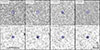 |
Fig. A.1. Our eight-band NIRCAM images of the location of GRB 250314A. The source is undetected in the bluest F090W band, consistent with the z > 7 origin. A clear signature from an extended object is present in the F150W2 observations (with a very broad filter), with a blue colour between F150W2 and F200W. The source is much brighter in the NIRCAM red channel, and brightens consistently between F277W and F444W. |
JWST observations.
Appendix B: Astrometry
We located the afterglow on the images by performing relative astrometry between the HAWK-I J-band image presented in Cordier et al. (2025), and the NIRCAM observations. Using ten objects in common between the NIRCAM F150W2 and HAWK-I observations we obtain an astrometric match with an RMS of 1.8 NIRCAM pixels (0.037 arcseconds). We hence determine that the offset between the NIRCAM and ground-determined positions is 1.5 ± 1.8 pixels, confirming that the JWST source is consistent with the afterglow. There is no significant or systematic centroid shift in the location of the transient between the source location measured in the different NIRCAM bands, although the modest signal to noise of the detections makes robust statements in this regard challenging.
Appendix C: Host galaxy contribution and properties
As noted in the main text, a key question regarding the emission is if the observed SED can be explained entirely by the presence of a host galaxy. It is apparent that the F150W2 observations can be explained as a host galaxy, as also evidenced by the apparent small extension of the source. The magnitude of this host galaxy, compared to observations of other high-z hosts by HST is consistent with expectations (see Fig. C.1, although we note that F150W2 = 29.25 is beyond the limits of HST for all but the longest exposures). However, in our preferred interpretation, the redder observations, and the shape of the SED are explained by the presence of a SN component.
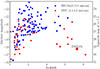 |
Fig. C.1. Comparison of GRB host galaxy absolute magnitudes (or upper limits) from the SHOALS sample at 3.6 microns (Perley et al. 2016), and from various HST observations at 1.1-1.6 microns (Tanvir et al. 2012; McGuire et al. 2016; Lyman et al. 2017); note that these are in a fixed observed band, and so substantially different rest-frame band at different redshifts. Under the assumption that the host of GRB 250314A dominates the emission in the F150W2 band, the observations are consistent with other GRB hosts at high-z. |
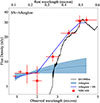 |
Fig. C.2. Alternative explanation for the observed emission in which the blue detections are instead dominated by afterglow light. The spectral shape of the afterglow is similar to that of an LBG, and results in similar conclusions regarding the properties of the associated SNe. |
To assess if a host galaxy provides a viable alternative to a SN we use two different approaches, the first is an direct empirical comparison to galaxies at z ∼ 7 that have been detected in increasing numbers by JWST in recent years. The second is to fit the SED with a population synthesis modelling code (in this case CIGALE) to ascertain which kinds of stellar populations could explain the emission.
In Fig. C.3 we plot the SEDs of 93 Lyman break galaxies observed with NIRCAM at z ∼ 7 (Merlin et al. 2024), scaled down by 2.2 magnitudes to match the blue end of the NIRCAM observations of GRB 250314A. As is apparent, these galaxies do not provide a reasonable match to the observations. Although a handful do show sufficiently red colours, the overall match to the spectral shape is poor.
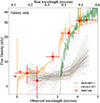 |
Fig. C.3. Colours of 93 LBGs identified in the JADES, CEERS, and PRIMER deep fields by JWST (Merlin et al. 2024) compared to the colours of GRB 250314A. Although a handful of LBGs do show apparent red colours these do not exhibit the same bluer shape in F150W-F200W, and indeed are dominated by Balmer break-like emission that increases predominantly beyond F277W. We also plot the NIRSPEC spectrum of the LRD MoM-BH1 (Naidu et al. 2025a), which shows a very strong (likely non-stellar) Balmer break, and demonstrates that while very red objects can be found at z ∼ 7, they do not explain the spectral shape seen in GRB 250314A. Finally, we also include a fit to the SED with CIGALE. This provides a reasonable match to the observations, although requires galaxy properties unusual both amongst the z ∼ 7 galaxy population and GRB host galaxies, in particular in requiring the galaxy to be dominated by an ancient stellar population, with a formation redshift of z ∼ 21. |
An alternative explanation would be to invoke a host similar to the population of LRDs (Matthee et al. 2024), which are not thought to be explained by emission from a purely stellar population (Matthee et al. 2024; Rusakov et al. 2025). An LRD as a GRB host would be of substantial interest in its own right. LRDs comprise a minority of high-z galaxies (1–10%,Kokorev et al. 2024) and display blue continuum combined with a red excess beyond the Balmer break (Kocevski et al. 2025; Killi et al. 2024). This includes larger Balmer breaks at higher redshift than potentially seen here (e.g. Naidu et al. 2025b). However, all LRDs exhibit inflections at the Balmer limit (Setton et al. 2024), at z ≃ 7.3, the spectrum would be expected to begin rising in flux into the red wavelength region at ∼3 μm, only at the edge of the F277W filter. In contrast the SN component flux rises very rapidly redwards of 300 nm, which is ∼2.5 μm, providing substantial flux in the F277W band, comparable to the inferred host galaxy flux for a standard LBG SED. In other words, the rise of the red component observed in the F277W filter, is consistent with the SN interpretation, but not with a strong Balmer break as in LRDs. We conclude that known z ∼ 7 galaxies, even with very strong Balmer breaks, are not consistent with the light seen in the aftermath of GRB 250314A.
However, it should also be considered, that GRB host selection differs from the selection function for galaxies found in wide-field surveys, and could sample different regions of the galaxy parameter space. Assuming that the observed SED is entirely dominated by host emission, we fit the available photometry with the SED fitting code CIGALE (Boquien et al. 2019). For the input parameters, we set the redshift at 7.3 (Malesani et al. 2025b). We adopt a delayed star formation history (SFH) with or without a recent burst. The main stellar population age is constrained to a maximum of 700 Myr, representing the limit of what is physically possible at z = 7.3, with a maximum e-folding time of 200 Myr. The maximum age of the burst is defined at 100 Myr with a stellar mass fraction due to the burst < 0.1. A Chabrier (2003) initial mass function with the stellar synthesis models of Bruzual & Charlot (2003) is used, and models include nebular emission with standard parameters. The possible attenuation by dust is modeled using a modified version of the attenuation law of Calzetti et al. (2000) assuming a maximum color excess of E(B − V) = 0.2. This choice is motivated by the relatively blue spectral slope of the GRB afterglow reported in Cordier et al. (2025), which indicates a low dust extinction along the line of sight and suggests a likely minimal dust attenuation within the host galaxy as also observed for star-forming galaxies at those redshifts (Saxena et al. 2024).
The results demonstrate that it is possible to model the observed magnitudes of GRB 250314A as purely arising from the host galaxy. However, the unsatisfactory aspects of this interpretation remain. In particular, in order to explain the observed brightening between the F150W2 and F444W bands one must invoke a significant Balmer decrement, perhaps indicative of (i) old stars; or (as noted above) (ii) the class of recently discovered JWST LRDs.
The output parameters are derived from the probability distribution functions (PDFs), using their mean values and associated standard deviations. The posterior PDFs favor a model without a recent burst and a population age of 562 ± 71 Myr, corresponding to an extremely early redshift of formation (z ∼ 21). While not impossible, this is likely extremely rare and not entirely comfortable. The resulting properties of the fit provide log(M*/M⊙) = 8.9 ± 0.1, and SFR = 0.4 ± 0.2 M⊙ yr−1. This puts this galaxy well below the main sequence at these redshifts (Popesso et al. 2023; Ciesla et al. 2024) and yields a relatively low specific star formation rate (log(sSFR) = − 9.4 ± 0.3 yr−1), indicating relatively low ongoing star formation relative to past star formation. While such specific star formation rates are not unique in the z ∼ 7 host galaxy population (Ciesla et al. 2024; Roberts-Borsani et al. 2024), it seems to be quite uncommon, and is not in keeping with what is expected and observed for GRB host galaxies (Perley et al. 2016).
Finally, as noted in the main text, in the host-only scenario, the similarity in the absolute magnitude of the source to SN 1998bw is entirely co-incidental. We therefore consider that, while possible in the absence of further observations to constrain variability, the most likely explanation of the available photometry is that we are detecting light from the associated SN.
Appendix D: Acknowledgements
This work is based on observations made with the NASA/ESA/CSA James Webb Space Telescope. The data were obtained from the Mikulski Archive for Space Telescopes at the Space Telescope Science Institute, which is operated by the Association of Universities for Research in Astronomy, Inc., under NASA contract NAS 5-03127 for JWST. These observations are associated with program 9296, the data can be retreived via the DOI:https://doi.org/10.17909/5wtc-wc46. Based on observations collected at the European Southern Observatory under ESO programme(s) 114.27PZ. BS, ELF, SDV and VB acknowledge the support of the French Agence Nationale de la Recherche (ANR), under grant ANR-23-CE31-0011 (project PEGaSUS). DBM, DW, and ASn are funded by the European Union (ERC, HEAVYMETAL, 101071865). The Cosmic Dawn Center (DAWN) is funded by the Danish National Research Foundation under grant DNRF140. ASa acknowledges support by a postdoctoral fellowship from the CNES. BPG is supported by STFC grant No. ST/Y002253/1 and Leverhulme Trust grant No. RPG-2024-117. FEB acknowledges support from ANID-Chile BASAL CATA FB210003, FONDECYT Regular 1241005, and Millennium Science Initiative, AIM23-0001. NRT, NH acknowledge support from STFC grant ST/W000857/1. AMC and LC acknowledge support from the Irish Research Council Postgraduate Scholarship No. GOIPG/2022/1008.
All Tables
All Figures
|
Fig. 1. Light curve of GRB 250314A as expected in the F150W2 and F444W bands. Components from both afterglow, SN, and host galaxy are included. Expectations for the afterglow are based on the ground-based J and H measurements, extrapolated to F444W based on the measured spectral slope. The host galaxy magnitudes are similarly based on the F150W2 detection (see text) and extrapolated to F444W based on the typical galaxy spectrum at z ∼ 7. The observed points are also indicated, demonstrating luminosity consistency between observations and a SN 1998bw-like SN (in this case scaled to 70% of the luminosity of SN 1998bw). |
| In the text | |
|
Fig. 2. Observed SED of the location of GRB 250314A as observed with NIRCAM at 110 days post-burst, roughly 13 days rest frame (red points). The weak detection in the blue of a marginally extended source is consistent with a faint host galaxy, while the rise to the red is entirely consistent with the expectations of SN 1998bw at this epoch (black line). For comparison, we also show (shaded region) the typical range of SEDs of the Lyman-break galaxies (LBGs) at z ∼ 7 from Merlin et al. (2024), along with an SED obtained from summing an average LBG and a SN with 70% of the luminosity of SN 1998bw (blue line). |
| In the text | |
|
Fig. A.1. Our eight-band NIRCAM images of the location of GRB 250314A. The source is undetected in the bluest F090W band, consistent with the z > 7 origin. A clear signature from an extended object is present in the F150W2 observations (with a very broad filter), with a blue colour between F150W2 and F200W. The source is much brighter in the NIRCAM red channel, and brightens consistently between F277W and F444W. |
| In the text | |
|
Fig. C.1. Comparison of GRB host galaxy absolute magnitudes (or upper limits) from the SHOALS sample at 3.6 microns (Perley et al. 2016), and from various HST observations at 1.1-1.6 microns (Tanvir et al. 2012; McGuire et al. 2016; Lyman et al. 2017); note that these are in a fixed observed band, and so substantially different rest-frame band at different redshifts. Under the assumption that the host of GRB 250314A dominates the emission in the F150W2 band, the observations are consistent with other GRB hosts at high-z. |
| In the text | |
|
Fig. C.2. Alternative explanation for the observed emission in which the blue detections are instead dominated by afterglow light. The spectral shape of the afterglow is similar to that of an LBG, and results in similar conclusions regarding the properties of the associated SNe. |
| In the text | |
|
Fig. C.3. Colours of 93 LBGs identified in the JADES, CEERS, and PRIMER deep fields by JWST (Merlin et al. 2024) compared to the colours of GRB 250314A. Although a handful of LBGs do show apparent red colours these do not exhibit the same bluer shape in F150W-F200W, and indeed are dominated by Balmer break-like emission that increases predominantly beyond F277W. We also plot the NIRSPEC spectrum of the LRD MoM-BH1 (Naidu et al. 2025a), which shows a very strong (likely non-stellar) Balmer break, and demonstrates that while very red objects can be found at z ∼ 7, they do not explain the spectral shape seen in GRB 250314A. Finally, we also include a fit to the SED with CIGALE. This provides a reasonable match to the observations, although requires galaxy properties unusual both amongst the z ∼ 7 galaxy population and GRB host galaxies, in particular in requiring the galaxy to be dominated by an ancient stellar population, with a formation redshift of z ∼ 21. |
| In the text | |
Current usage metrics show cumulative count of Article Views (full-text article views including HTML views, PDF and ePub downloads, according to the available data) and Abstracts Views on Vision4Press platform.
Data correspond to usage on the plateform after 2015. The current usage metrics is available 48-96 hours after online publication and is updated daily on week days.
Initial download of the metrics may take a while.