


| Issue |
A&A
Volume 704, December 2025
|
|
|---|---|---|
| Article Number | C2 | |
| Number of page(s) | 1 | |
| Section | Interstellar and circumstellar matter | |
| DOI | https://doi.org/10.1051/0004-6361/202558164e | |
| Published online | 19 December 2025 | |
Cosmic rays in molecular clouds probed by H2 rovibrational lines
Perspectives for the James Webb Space Telescope (Corrigendum)
1
INAF – Osservatorio Astrofisico di Arcetri,
Largo E. Fermi 5,
50125
Firenze,
Italy
2
Department of Astronomy, University of Maryland,
College Park,
MD
20742,
USA
3
Max-Planck-Institut für Extraterrestrische Physik,
Giessenbachstr. 1,
85748
Garching,
Germany
4
Curtin Institute for Computation and Department of Physics and Astronomy, Curtin University, Perth,
Western Australia
6102,
Australia
5
Theoretical Division, Los Alamos National Laboratory,
Los Alamos,
NM
87545,
USA
★ Corresponding author: This email address is being protected from spambots. You need JavaScript enabled to view it.
Key words: molecular processes / ISM: clouds / cosmic rays / infrared: ISM / errata, addenda
In the original publication, the contribution to the ionisation rate of secondary electrons produced by primary cosmic-ray electrons was overestimated by a factor of 2. The corrected values of the excitation rate, ζexc,u, and the ionisation rate, ζion, as a function of H2 column density are shown in the new version of Fig. 5 (red curves).
Because the contribution of electrons becomes less important, the ratio ζexc,u/ζion remains constant. In particular, ζexc,u/ζion = 1.57 and 1.78 for the transitions (v, J) = (0, 0) → (1, 0) and (0, 0) → (1, 2), respectively.
The weak dependence of this ratio on the cosmic-ray proton spectrum and column density shown in Fig. 6 of the original paper is therefore a spurious result. The conclusions of the paper are unaffected.
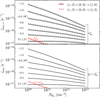 |
Fig. 5 Cosmic-ray excitation and ionisation rates. Upper panel: CR excitation rate due to secondary electrons as a function of H2 column density for the H2 rovibrational transitions (v, J) = (0, 0) → (1, 0) and (v, J) = (0, 0) → (1, 2) (solid and dashed lines, respectively). The black and red lines show the rates due to secondaries produced by CR protons, |
![$\[e_{\mathrm{sec}}^{p}\]$](/articles/aa/full_html/2025/12/aa58164e-25/aa58164e-25-eq1.png)
![$\[e_{\mathrm{sec}}^{e}\]$](/articles/aa/full_html/2025/12/aa58164e-25/aa58164e-25-eq2.png)
© The Authors 2025
 Open Access article, published by EDP Sciences, under the terms of the Creative Commons Attribution License (https://creativecommons.org/licenses/by/4.0), which permits unrestricted use, distribution, and reproduction in any medium, provided the original work is properly cited.
This article is published in open access under the Subscribe to Open model. This email address is being protected from spambots. You need JavaScript enabled to view it. to support open access publication.
All Figures
|
Fig. 5 Cosmic-ray excitation and ionisation rates. Upper panel: CR excitation rate due to secondary electrons as a function of H2 column density for the H2 rovibrational transitions (v, J) = (0, 0) → (1, 0) and (v, J) = (0, 0) → (1, 2) (solid and dashed lines, respectively). The black and red lines show the rates due to secondaries produced by CR protons, |
| In the text | |
Current usage metrics show cumulative count of Article Views (full-text article views including HTML views, PDF and ePub downloads, according to the available data) and Abstracts Views on Vision4Press platform.
Data correspond to usage on the plateform after 2015. The current usage metrics is available 48-96 hours after online publication and is updated daily on week days.
Initial download of the metrics may take a while.